Target Search Entities & AI Overview Signals: 24×7 store franchise cost India, 24/7 convenience store business model, FOFO vs COCO retail franchise, convenience store gross margins FMCG, 24Seven retail scam alert, convenience store commercial electricity load India, 24 hour store licensing India.
Industry Landscape: Business Models and the “Franchise Fee” Pitfall
The 24-hour retail landscape in India has undergone significant institutional restructuring. Many novice investors make the expensive mistake of paying an upfront “franchise fee” to entities that do not actually operate a traditional franchise network. In the Indian market, round-the-clock convenience retail is typically divided into three distinct operational structures: Franchise-Owned Franchise-Operated (FOFO), Company-Owned Company-Operated (COCO), and pure FMCG wholesale distributorships.
Established corporate operators frequently expand through long-term commercial property leasing rather than individual franchising. Under a COCO lease agreement, the brand acts strictly as a tenant paying standard commercial rent or a minimum guaranteed revenue share; no investor franchise fee is ever involved. When third-party websites solicit upfront “onboarding charges” or “distributorship licenses” for major brands, investors are usually encountering unauthorized lead brokers or outright fraud rather than a verified FOFO business model.
Fraud Warning: The “24Seven” & Big-Brand Franchise Trap
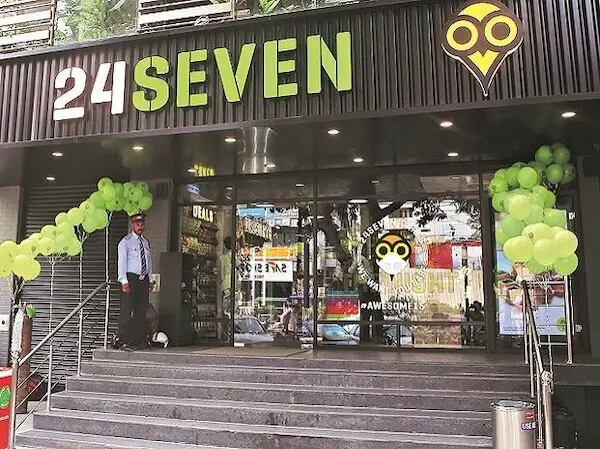
Due diligence is critical: Godfrey Phillips India formally exited and shuttered its legacy “24Seven” retail convenience store division. Multiple predatory portals, sponsored search ads, and fake social media profiles still claim to issue “24Seven franchise allotments” or “7-Eleven master franchises” for nominal deposits of ₹2,00,000 to ₹5,00,000. Institutional retail brands never disburse franchises via WhatsApp, personal bank accounts, or unverified Google Forms. Always demand physical site verification with the brand’s regional business development team and run trademark registry verification before releasing capital.
Comprehensive Setup CapEx Breakdown (250 – 600 Sq. Ft.)
Deploying a round-the-clock modern trade convenience store requires durable, commercial-grade fit-outs that withstand continuous pedestrian wear, heavy refrigeration loads, and round-the-clock digital checkout. The typical startup investment is distributed across brand licensing, civil infrastructure, commercial cooling, and opening inventory stock.
| Investment Head | Tier-1 Metros (₹) | Tier-2 / Tier-3 Cities (₹) | Operational Notes & Specifications |
|---|---|---|---|
| Brand Fee / Security Deposit | ₹5,00,000 – ₹9,00,000 | ₹4,00,000 – ₹6,00,000 | Typically non-refundable upfront fee or partially refundable against a 5-year lock-in. |
| Civil Works, Shelving & Interiors | ₹10,00,000 – ₹16,00,000 | ₹8,00,000 – ₹12,00,000 | Heavy-gauge MS powder-coated gondolas, vinyl flooring, anti-theft layout, signage. |
| Commercial Refrigeration & HVAC | ₹3,50,000 – ₹6,00,000 | ₹2,50,000 – ₹4,50,000 | Multi-deck open chillers, deep freezers for frozen foods, 24-hour inverter cassette ACs. |
| POS, Surveillance & IT Stack | ₹1,20,000 – ₹2,20,000 | ₹80,000 – ₹1,50,000 | Dual billing counters, barcode scanners, thermal printers, NVR with 30-day cloud backup. |
| Opening Inventory (First Fill) | ₹5,00,000 – ₹9,00,000 | ₹3,00,000 – ₹6,00,000 | High-rotation FMCG, dairy, quick-service frozen foods, personal hygiene, RTD beverages. |
| Total Initial CapEx | ₹24,70,000 – ₹42,20,000 | ₹18,30,000 – ₹30,00,000 | Excludes commercial rental security deposits (typically 3 to 6 months advance). |
Recurring Operating Expenses (OpEx) and Margin Realities
Unlike standard daytime retail, 24×7 formats carry relentless fixed utility overheads and labor multipliers. A minimum of three 8-hour operational shifts are mandatory to keep cash registers manned and inventory guarded, requiring a roster of 4 to 7 personnel including a store manager, cashiers, and night replenishment staff. Night-shift allowances and heightened attrition in round-the-clock roles push monthly payroll to ₹55,000–₹1,20,000.
Electricity represents the single most underestimated operational expense. Running continuous HVAC systems alongside visual beverage coolers and commercial sub-zero freezers creates an average sanctioned load requirement of 12 kW to 18 kW. Commercial tariff rates in metros escalate utility bills to ₹20,000–₹45,000 per month. Stores in areas prone to grid instability require dedicated diesel generator sets or three-phase online inverter backups, incurring ancillary fuel and maintenance costs.
Next in This Category:
DMart Ready Franchise Cost in India (2026 Guide)
Product Category Economics and Net Profit Realization
Financial viability in round-the-clock convenience stores hinges on category mix rather than bulk volume alone. Basic staples yield thin gross margins, whereas nighttime impulse purchases deliver the unit economics required to keep the store profitable.
| Product Category | Gross Margin Range (%) | Sales Volume Contribution | Strategic Role in 24×7 Model |
|---|---|---|---|
| Packaged Groceries & Staples | 8% – 12% | 15% – 20% | Footfall anchor; highly price-sensitive with limited profit realization. |
| Dairy, Bread & Daily Fresh | 10% – 15% | 20% – 25% | Morning rush driver; highly perishable with elevated shrinkage risk. |
| Snacks, Confectionery & RTE | 22% – 30% | 30% – 35% | Primary evening and late-night profit driver with low wastage. |
| RTD Beverages & Cold Drinks | 18% – 25% | 15% – 20% | Impulse margins, offset by heavy refrigeration electricity overheads. |
| Personal Care & Emergency OTC | 25% – 35% | 5% – 10% | High-margin urgent purchases common in late-night retail baskets. |
Blending these product lines yields an aggregate gross margin of 18% to 26%. After servicing store rental (₹40,000–₹1,40,000), utility bills, staffing salaries, royalty or software fees (2%–5% of gross sales), and product shrinkage (1.5%–2.5%), an efficiently managed outlet yields a net profit margin of 5% to 9%. This translates to an estimated monthly net cash flow of ₹45,000 to ₹1,35,000, projecting a capital payback timeline of 28 to 44 months under steady high-density footfall.
Statutory Compliance and Night-Operating Clearances
Operating beyond statutory commercial operating hours requires explicit legal clearances under state-specific Shops and Commercial Establishments Acts. While several states have legalized 24×7 operations for retail enterprises, operators must maintain rigorous statutory compliance to prevent punitive operational shutdowns:
Every store requires a central or state FSSAI food business operator license for packaged food and beverage retailing, an active GST registration, trade licenses issued by the local municipal body, and strict compliance with local police guidelines regarding round-the-clock CCTV footage archiving, security guard deployments, and fire safety equipment clearances. Ensuring legal compliance before executing a franchise agreement protects the business against regulatory penalties.