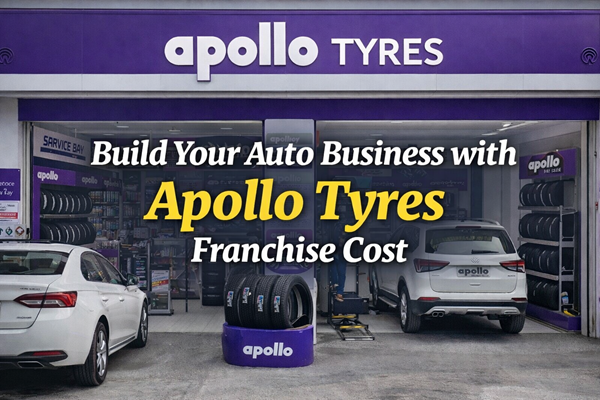
Starting an Apollo Tyres franchise in India in 2026 generally requires a cost of around ₹20 lakh to ₹60 lakh investment depending on showroom size, city, and stock level. The business mainly involves tyre sales, wheel alignment, balancing services, and basic vehicle care. A space requirement of about 800 to 2,500 sq ft in a roadside or highway-connected location is preferred.
Apollo provides branding, dealer training, and supply support, making it suitable even for first-time automobile entrepreneurs. Most dealers target break-even within 18 to 30 months with steady vehicle traffic. Apollo Tyres franchise cost in India 2026 is ₹20–60 lakh with 800–2,500 sq ft space requirement, auto services setup, and dealer support. Expected break-even about 18–30 months.
Why Choose Apollo Tyres Franchise
Entering the automobile sector feels safer when associated with a known brand. Vehicle owners rarely experiment with unknown tyre shops because tyres directly affect safety. Apollo Tyres already has strong trust in the Indian market, so customers often walk in without heavy advertising.
For many entrepreneurs, this business becomes a long-term stable venture since vehicles require tyre replacement regularly every few years. Compared to seasonal businesses, tyre demand stays consistent in both cities and highway towns.
Total Investment and Setup Details
The overall investment is divided into multiple parts that together create a professional outlet. A portion goes toward dealership security deposit and brand authorization. Another major share covers showroom interiors including display racks, counters, signboards, and lighting.
Workshop equipment such as wheel alignment machine, wheel balancer, tyre changer, air compressor, and tools also form a significant expense. Initial tyre stock takes the biggest share because multiple vehicle models require different tyre sizes and patterns. Working capital is also needed to manage early operational months smoothly.
Space Requirement and Location Selection
The success of a tyre dealership depends heavily on visibility and vehicle movement. The recommended space requirement ranges from 800 sq ft for a compact urban outlet to around 2,500 sq ft for a full service shop with alignment bay.
Roadside properties, highways, petrol pump areas, or automobile markets usually perform best. Easy entry for cars and small trucks is important so customers can quickly access services without traffic difficulty. The brand often guides partners in selecting a suitable location before approval.
Training and Company Support
Apollo provides onboarding training covering tyre categories, fitting methods, and customer handling. Staff learn how to suggest correct tyres based on driving conditions and vehicle type. The company also offers branding materials, promotional campaigns, and technical guidance for equipment usage.
Central supply distribution ensures consistent stock availability so the dealer does not struggle with multiple wholesalers. This structured support helps beginners operate confidently from the first month.
Profit Margin and Earnings Potential
Tyre businesses usually operate on moderate but steady profit margin. Average margins often range between 8% and 18% depending on tyre category and services provided. Alignment, balancing, nitrogen filling, and puncture repair services significantly improve earnings because they require minimal material cost. Commercial vehicle tyres generate higher revenue value, while two-wheeler tyres increase daily sales volume. Over time, repeat customers and nearby fleet vehicles build stable monthly income.
Monthly Expenses
Regular expenses include shop rent, staff salary, electricity for heavy machines, and inventory refilling. Compressor and alignment equipment maintenance is another important recurring cost. Proper stock planning prevents money from being blocked in slow-moving tyre sizes. When operational expenses remain controlled, the business produces consistent monthly returns.
Eligibility and Documents Required
To become a dealer, the owner must meet basic eligibility conditions like financial capability and suitable property. Required documents typically include identity proof, address proof, GST registration, shop establishment certificate, and bank details. Business registration in proprietor or company form may also be required. Having basic automobile interest or experience is helpful but not mandatory because technical training is provided.
Challenges to Consider
The tyre market includes local competitors who may offer discounts. Managing stock variety and predicting demand needs careful planning. Seasonal fluctuations may occur during monsoon and travel seasons. However, brand recognition and reliable product quality usually help the dealership maintain customer loyalty over time.
Long-Term Business Value
Many dealers appreciate that this business connects with daily transportation needs. Every vehicle owner eventually returns for replacement or service, creating long-term relationships. Instead of depending on trends, the dealership grows with increasing vehicle population in the area, making it a dependable family business.
FAQ about Apollo Tyres Franchise Cost
Q. Do I need automobile experience to start?
A. No prior experience is compulsory because technical training is provided, though interest in vehicles helps in customer interaction.
Q. How much monthly income can I expect?
A. Depending on location, many dealers aim for ₹50,000 to ₹2,00,000 monthly net profit after expenses once sales stabilize.
Q. Can I open in a small town?
A. Yes, growing towns often perform well because vehicle ownership is increasing rapidly and branded tyre options are limited.
Q. Does the company supply tyres regularly?
A. The brand maintains a distribution network that helps dealers receive tyres consistently based on demand.
Q. Is wheel alignment necessary for better profit?
A. Yes, service equipment increases revenue because service margins are usually higher than tyre sales margins.
Q. How long is the dealership agreement?
A. Agreement duration varies by region but generally continues long-term with renewal based on performance.