Dealership vs. Franchise: How the Goodyear Retail Model Actually Operates
Prospective tyre retailers frequently search for “Goodyear tyre franchise costs,” assuming the global brand licenses its name via a conventional retail franchise agreement with upfront license royalties. In the Indian automotive aftermarket, Goodyear India Ltd. operates through an authorized dealership and institutional distribution network.
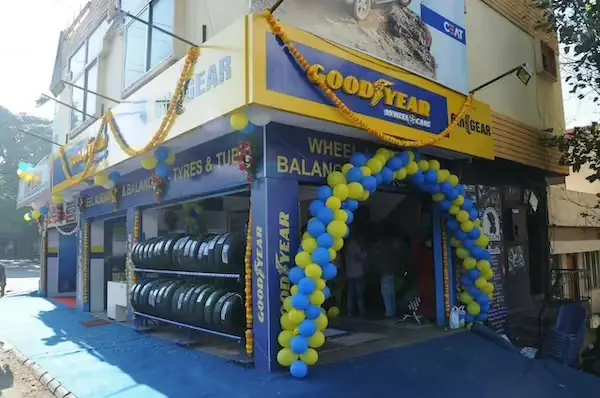
Retail touchpoints typically fall into two categories: a traditional Multi-Brand Tyre Dealership (carrying Goodyear among other brands) or an exclusive Goodyear Autocare / Club 4 branded outlet.
Unlike fast-food or education franchises, Goodyear does not charge a non-refundable franchise fee. Commercial entry requires an authorized dealership security deposit (often structured as a refundable bank deposit or revolving letter of credit), investment in physical alignment machinery, and upfront procurement of tyre inventory.
The manufacturer provides exterior fascia branding, showroom display fixtures, and technical technician training rather than selling a proprietary business format.
Critical Fraud Advisory: Counterfeit Dealership Portals & Allotment Scams
Red Flag Advisory: Bogus Online “Allotment Letters”
Automotive dealership applicants are frequent targets of sophisticated cyber fraud syndicates operating clone websites disguised as official manufacturer registration portals. These malicious portals solicit ₹25,000 to ₹1,50,000 under the pretext of “Application Processing Fees,” “Territory Inspection Charges,” or “Provisional Dealership Allotment Deposits” payable via personal UPI IDs or shell bank accounts.
Verification Standard: Goodyear India Ltd. never issues dealership certificates or demands security deposits through unsecured digital application links or personal bank accounts. Genuine dealership onboarding requires in-person vetting by a Goodyear Territory Sales Manager (TSM), physical verification of your commercial bay frontage, evaluation of your local automotive market, and formal commercial execution with verified corporate bank accounts.
Realistic CapEx & Workshop Machinery Outlay (2026 Projections)
Launching a viable tyre dealership requires adequate commercial space to accommodate both customer parking and drive-in service bays.
An entry-level retail counter requires roughly 400 to 600 square feet, while an authorized Goodyear Autocare service hub requires 800 to 1,500 square feet with a minimum 25-foot road frontage to allow simultaneous alignment and wheel balancing operations.
| Investment Category | Standard Tyre Counter (400–600 sq. ft.) | Goodyear Autocare Hub (800–1,500 sq. ft.) |
|---|---|---|
| Refundable Company Deposit | ₹1,50,000 – ₹2,50,000 | ₹3,00,000 – ₹5,00,000 (Or Bank Guarantee) |
| Commercial Rental Advance | ₹1,00,000 – ₹2,00,000 | ₹2,50,000 – ₹5,00,000 (Frontage-dependent) |
| Workshop Equipment & Service Bay | ₹1,50,000 – ₹3,00,000 (Manual changers/balancer) | ₹7,00,000 – ₹13,00,000 (3D aligner, lifts, tyre changers) |
| Initial Tyre Inventory (Car, SUV, Farm) | ₹5,00,000 – ₹8,00,000 | ₹12,00,000 – ₹20,00,000 |
| Interior Showroom, Flooring & Reception | ₹1,00,000 – ₹2,00,000 | ₹2,50,000 – ₹4,50,000 (Brand specification) |
| Operational Working Capital Buffer | ₹2,00,000 – ₹3,50,000 | ₹5,00,000 – ₹8,00,000 (Credit float & utilities) |
| Franchise Fee / Ongoing Royalty | ₹0 (Zero) | ₹0 (Zero) |
| Estimated Total Setup Outlay | ₹12,00,000 – ₹21,00,000 | ₹32,00,000 – ₹55,50,000 |
A heavy portion of the capital expenditure in an Autocare hub is dedicated to precision equipment. A 3D computerized wheel alignment system, high-speed dynamic wheel balancer, automated pneumatic tyre changer with run-flat assist arm, and industrial screw air compressor represent long-term capital assets that drive high-margin service revenue.
Profit Margins: Product Sales vs. High-Margin Technical Services
A common mistake in tyre business planning is assuming that selling new tyres produces high gross margins. In reality, tyre retail is a high-ticket, low-margin business driven by price competition from nearby shops and online platforms. Dealer profitability is built on a two-pillar model: rapid inventory turnover to earn manufacturer volume rebates, and offering mechanical wheel care services.
| Revenue Stream | Gross Margin Range | Operational Dynamics & Cash Flow Impact |
|---|---|---|
| Passenger Car Radials (PCR / SUV) | 6% – 10% | Fast stock rotation; margins heavily compressed by local retail discounting. |
| Commercial & Farm Tyres (Tractor) | 3% – 6% | High unit values and steady rural replacement demand, but requires trade credit to farmers/fleets. |
| Wheel Alignment & Balancing Services | 65% – 80% | High net margin; labor and electricity are the only primary direct costs per vehicle. |
| Nitrogen Inflation & Valve Replacements | 75% – 90% | Low-ticket add-ons that carry near-pure gross profit and encourage repeat visits. |
| Ancillary Sales (Batteries, Lubricants) | 12% – 20% | Cross-sold during tyre fitting and alignment waiting times. |
| Company Volume Rebates & Targets | 2% – 5% (Quarterly bonus) | Crucial for net profitability; unlocked only upon meeting strict monthly purchasing targets. |
An authorized Goodyear dealer who actively drives wheel alignment and balancing services alongside new tyre replacements can achieve an overall blended net operating margin of 8% to 14%. A standard tyre showroom generally reaches operating break-even within 12 to 18 months, depending on drive-in bay traffic and local commercial fleet tie-ups.
Goodyear vs. Competing Indian Tyre Dealerships
Evaluating a Goodyear dealership requires benchmarking capital requirements, product range strength, and regional consumer pull against competing tyre manufacturers in India.
| Parameter | Goodyear India | MRF Tyres | Apollo Tyres |
|---|---|---|---|
| Brand Segment Strength | Passenger Car Radials (PCR) & Farm/Tractor | Dominant in Two-Wheeler, Commercial & PCR | Strong in Truck/Bus Radials (TBR) & Passenger Car |
| Total Capital Outlay | ₹20L – ₹50L | ₹35L – ₹75L+ (Strict stock commitments) | ₹25L – ₹55L |
| Retail Format | Goodyear Autocare / Dealership | MRF TireTok / T&S Hubs | Apollo Tyre Zone |
| Dealer Margin Profile | Moderate margin + Strong Farm presence | Low product margin; high volume pull | Balanced product margins & marketing support |
Don’t forget to visit other business opportunity: Apollo Tyres Dealership Cost Analysis
Legitimate Onboarding: Step-by-Step Dealership Application Protocol
To establish an authorized dealership with Goodyear India Ltd. without risking capital through unauthorized third-party broker websites, follow these industry-standard procurement steps:
1. Verify Corporate Entity & Official Contact: Initiate contact exclusively through the corporate portal of Goodyear India Ltd. or by visiting the nearest regional company sales office. Avoid third-party franchise portals that ask for upfront registration fees.
2. Site Selection & Frontage Compliance: Secure a commercial plot or showroom with a minimum of 600 to 1,000 square feet, ensuring ample road frontage and parking space to house a vehicle service bay and drive-over inspection lift.
3. Statutory Business Documentation: Provide active business registration credentials, including a valid Goods and Services Tax Identification Number (GSTIN) under tyre distribution codes, commercial shop establishment registration, enterprise PAN, and audited financial statements or bank solvency certificates.
4. Territory Inspection & Direct Escrow: A Goodyear Area Sales Manager will conduct an on-site market potential assessment and inspect the property. Upon approval, all formal deposits and stock billing transactions are executed directly with Goodyear India Ltd.’s official corporate banking accounts.