Securing an authorized dealership with Hero MotoCorp represents one of the largest footprint business ventures in the Indian two-wheeler sector. Because Hero holds the largest market share in commuter motorcycles across urban, semi-urban, and rural territories, commercial interest in their retail network remains exceptionally high.
However, prospective channel partners frequently encounter conflicting financial projections and misleading terminology regarding franchise models. To make an informed capital allocation, investors need a transparent breakdown of actual operational setup costs, dealership classifications, genuine margin structures, and the verified direct application workflow.
Automobile Dealership vs. Traditional Franchise: Clarifying the Model
A standard misconception in commercial reporting is labeling an automobile outlet as a generic franchise. Hero MotoCorp operates strictly on an Authorized Principal-to-Principal Commercial Dealership model rather than a royalty-charging retail franchise. In this framework, dealers do not pay recurring brand royalties on monthly revenue.
Instead, the dealership procures vehicles, genuine spare parts, and accessories directly from the Original Equipment Manufacturer (OEM) at wholesale dealer price and retails them under standardized maximum retail prices and brand guidelines. The primary corporate contract revolves around territorial allocation, facility standardization, and working capital inventory rotation rather than speculative franchise licensing fees.
Scam Alert: Fraudulent Hero Dealership Allotment Portals
Due to intense market demand, fraudulent syndicates regularly create spoofed domain names posing as corporate booking channels. These impostors demand advance processing fees ranging from ₹25,000 to ₹3,00,000 for “No Objection Certificates” or “Site Inspection Clearance.” Hero MotoCorp never solicits security deposits or processing fees via personal UPI accounts, non-official payment gateways, or third-party agencies. All official expressions of interest are registered solely through Hero MotoCorp’s verified corporate channel portal. Never transfer funds without an in-person verification from the designated Regional Territory Sales Manager.
Hero Dealership Formats & Estimated Capital Expenditure (2026)
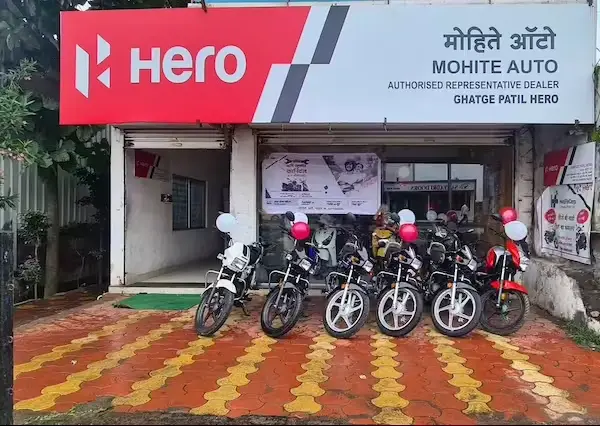
Capital requirements vary significantly based on the operating format allocated by the company’s network development team. Outlets are categorized based on regional vehicle density and footfall into full-scale 3S setups (Sales, Service, Spare Parts), dedicated urban retail boutiques, and rural Authorised Representative of Dealer (ARD) sub-dealerships.
| Format Type | Space Required (Sq. Ft.) | CapEx (Interior, Civil, Tools) | Working Capital (Rolling Stock) | Total Capital Outlay |
|---|---|---|---|---|
| Main Dealership (3S Facility) | 3,500 – 6,000 (Min. 50 ft frontage) | ₹60 Lakh – ₹1 Crore | ₹50 Lakh – ₹1.2 Crore | ₹1.2 Crore – ₹2.2 Crore |
| Urban Showroom (Sales & Display) | 1,500 – 2,500 | ₹35 Lakh – ₹55 Lakh | ₹30 Lakh – ₹50 Lakh | ₹65 Lakh – ₹1.05 Crore |
| Rural Sub-Dealer / ARD Point | 800 – 1,500 | ₹15 Lakh – ₹25 Lakh | ₹15 Lakh – ₹25 Lakh | ₹30 Lakh – ₹50 Lakh |
Cost Composition and Operational Budgeting
The upfront expenditure divides between physical asset creation and operational liquidity. Showroom setup mandates strict adherence to the manufacturer’s corporate identity manual, involving glass frontages, illuminated corporate signage, customer waiting lounges, customer management software, and standardized service bays equipped with automated hydraulic lifts, pneumatic tools, and diagnostic scanners.
Working capital serves as the operational engine, financing display inventory of fast-moving commuter bikes, high-displacement models, spare parts inventory, oil lubricants, and initial transit insurance.
Revenue Generation and Realized Dealer Margins
A dealership’s bottom line is not driven entirely by vehicle wholesale-to-retail price differentials. In reality, vehicle unit margins are relatively slim, while post-sales and allied verticals provide cash-flow stability.
| Revenue Segment | Average Gross Margin (%) | Contribution to Net Profit |
|---|---|---|
| New Two-Wheeler Sales | 3% to 6% per unit | High volume, low margin anchor |
| Genuine Spare Parts & Consumables | 12% to 18% | High recurring profitability |
| Workshop Labor & Periodic Service | 45% to 60% on billing | Core driver of monthly overhead absorption |
| Finance & Insurance Payouts | ₹800 – ₹2,500 per logged file | Pure operational commission |
| Accessories & Extended Warranties | 20% to 35% | Immediate point-of-sale margin buffer |
Due to real estate lease commitments, electricity overheads, and multi-tier staff salaries (technicians, advisors, customer relationship managers), typical net profit margins hover between 1.5% and 3.5% on total gross turnover. Payback periods typically range from 2.5 to 4 years rather than the unrealistic 12-month projections frequently cited in generic business directories.
Eligibility Criteria & Real Estate Mandates
Hero MotoCorp evaluates applicants rigorously on financial net worth, local business standing, and commercial location viability. Key requirements include:
The primary applicant or entity (Proprietorship, Partnership, or Pvt Ltd) should demonstrate liquid working capital capabilities and clear unencumbered title or long-term registered lease rights (minimum 9 to 15 years) on the proposed land parcel.
The property must be situated on a prominent commercial thoroughfare or highway artery, offering unhindered commercial vehicle movement, customer parking, and minimum frontage clearances (typically 50 to 70 feet). Prior background in logistics, automotive components, retail management, or distribution businesses provides a distinct evaluation advantage during network team reviews.
You Might Also Like:
Ather Electric Scooter Franchise Cost in India 2026
Step-by-Step Authorized Application Process
Applicants must circumvent middleman consultancies and apply directly through the authorized company procedure:
First, navigate to Hero MotoCorp’s verified corporate distribution channel portal. Complete the expression of interest form by detailing business antecedents, current net worth, proposed property GPS coordinates, road width, and photographic documentation of the site.
Following initial automated screening, the regional territory sales team schedules an on-site feasibility evaluation to study local market absorption, geographic proximity to existing dealers, and vehicular traffic counts. Qualified proposals are summoned to the regional/zonal office for an interview with the network development committee, concluding with a Letter of Intent (LOI) and layout sign-off prior to civil work commencement.