Prospective entrepreneurs searching for a Dixon Technologies franchise will not find a standard retail or dealership model. As India’s largest home-grown Electronics Manufacturing Services (EMS) and Original Design Manufacturer (ODM), Dixon Technologies operates strictly in business-to-business (B2B) contract manufacturing. Exploring opportunities with Dixon means entering the tier-1/tier-2 industrial supply chain, establishing specialized ancillary manufacturing, or qualifying as an audited vendor.
Urgent Advisory: Beware of Dixon Technologies Franchise Scams
Neither Dixon Technologies (India) Ltd nor its subsidiaries issue retail franchise licenses, regional distributorships, or dealership certificates to individual applicants. Fraudulent operators run fake websites, send deceptive emails, and post classified ads demanding ₹50,000 to ₹5,00,000 as “document verification fees” or “security deposits.”
Dixon never charges money to register a vendor or review a manufacturing partnership proposal. Any communication demanding upfront deposits for licensing, machinery subsidies, or exclusive geographical territories should be reported directly to cybercrime authorities and corporate communication channels via Dixon’s official portal.
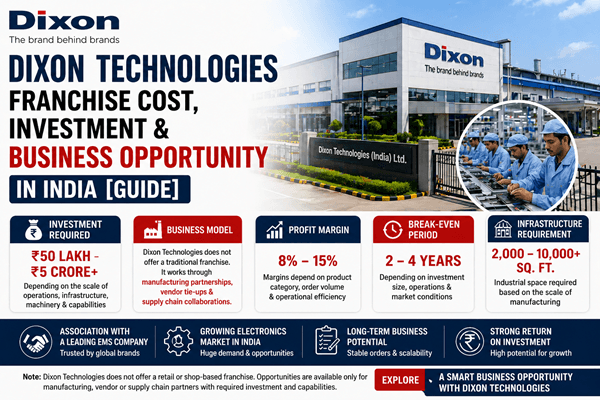
Understanding the EMS Business Model vs. A Franchise
A franchise typically involves paying an upfront licensing fee to replicate a consumer-facing retail storefront or brand outlet. Dixon Technologies operates on the complete opposite end of the value chain. As a contract manufacturer for original equipment manufacturers (OEMs) such as Samsung, Xiaomi, Motorola, and Panasonic, Dixon builds consumer electronics, home appliances, lighting products, and mobile phones inside its own automated factories.
Because Dixon does not operate company-branded consumer retail outlets, external commercial participation is limited to industrial vendor networks. These opportunities require setting up precision component fabrication, sheet metal pressing, plastic injection moulding, printed circuit board assembly (PCBA), or raw packaging supply.
Realistic Capital Expenditure (CapEx) & Working Capital
Entering the electronics manufacturing supply chain demands substantial upfront capital. Unlike turnkey retail units, setting up an ancillary component manufacturing plant requires heavy machinery, ISO/IEC cleanroom facilities, uninterrupted high-tension power, and sophisticated testing apparatus.
A small-scale ancillary unit—such as packaging, precision plastic enclosures, or wire harness production—typically requires a baseline CapEx starting at ₹1.5 Crore to ₹3 Crore. Mid-tier component manufacturing or semi-automated sub-assembly operations easily require ₹5 Crore to ₹15 Crore. In addition to plant and machinery, vendors must maintain significant working capital reserves to support 60-to-90-day B2B credit cycles.
Comparative Overview: Retail Franchise Myths vs. Industrial Reality
| Parameter | The Common Online Myth | Industrial Reality (Dixon Ecosystem) |
|---|---|---|
| Business Model | Retail Dealership / Brand Store Franchise | B2B Contract Manufacturing & Ancillary Supply |
| Franchise / Brand Fee | ₹5 Lakh to ₹10 Lakh | ₹0 (No franchise system exists) |
| Initial Setup CapEx | ₹20 Lakh to ₹50 Lakh | ₹1.5 Crore to ₹10+ Crore (Plant, Tooling & Machinery) |
| Facility Space | 500 – 1,500 sq. ft. commercial shop | 5,000 – 25,000+ sq. ft. zoned industrial shed |
| Operating Margins | 15% to 25% (Retail claim) | 3% to 6% (Standard EMS) / 8% to 12% (Component Ancillaries) |
| Break-Even Horizon | 12 to 18 Months | 3 to 5 Years (Asset-intensive amortisation) |
Operating Margins and Financial Viability in EMS
Speculative franchise portals frequently mislead readers with promises of 15% to 20% net profit margins. In actual electronics manufacturing services, operating margins are notoriously slim and volume-dependent. A listed EMS giant like Dixon typically delivers operating EBITDA margins in the 3.5% to 5.5% band.
Ancillary suppliers providing specialized components (such as die-cast tooling or custom injection moulding) can extract higher gross margins between 8% and 12%. However, these margins are counterbalanced by high plant depreciation, rigorous maintenance expenses, and stringent defect penalties. Sustaining profitability requires continuous production cycles, minimal scrap rates, and adherence to strict Six Sigma quality controls.
Also Worth Reading:
Bajaj Electronics Franchise Cost in India [2026]
How to Qualify as a Vendor or Supply Partner
Instead of filling out an internet franchise inquiry form, established manufacturing businesses must approach Dixon’s corporate procurement and supply chain management division. The qualification procedure evaluates financial soundness, production scalability, and compliance credentials.
Prospective vendors must demonstrate established facilities certified under ISO 9001 (Quality Management), ISO 14001 (Environmental Management), and IATF 16949 where applicable. Initial supplier approval involves factory audits, sample validation under strict tolerance limits, and an inspection of your operational history before any purchase orders or long-term contracts are issued.
Frequently Asked Questions
Can I open an exclusive Dixon Technologies showroom in my city?
No. Dixon Technologies is an electronics contract manufacturer, not an end-consumer brand. They manufacture goods on behalf of client labels such as Samsung, Philips, or Xiaomi. There are no retail brand showrooms or consumer outlets available for franchising.
What is the minimum land requirement for an electronics ancillary unit?
An industrial unit supplying secondary assemblies or precision parts generally requires a minimum of 5,000 to 10,000 square feet of industrial-zoned space. The facility must feature reinforced flooring for heavy machinery, three-phase power connections, cleanroom infrastructure, and designated loading bays.
How can investors gain financial exposure to Dixon Technologies?
For individual investors seeking exposure to the growth of Dixon Technologies and India’s broader electronics sector, the most direct and liquid route is purchasing shares of Dixon Technologies (India) Limited on the National Stock Exchange (NSE) or Bombay Stock Exchange (BSE), rather than seeking non-existent franchise contracts.