Executive Takeaway: Can You Buy an American Eagle Franchise?
Scam Alert: Fake Brand Allotment Schemes
Due to the high prestige of global denim and lifestyle labels, fraudulent broker websites frequently solicit non-refundable “franchise registration fees,” “application processing deposits,” or “territory lock-in charges” using counterfeit brand letterheads. American Eagle and ABFRL never conduct franchise licensing via third-party WhatsApp brokers or unauthorized lead forms. Never transfer upfront verification fees to individual or non-corporate bank accounts without direct, verified engagement via ABFRL’s official corporate business channels.
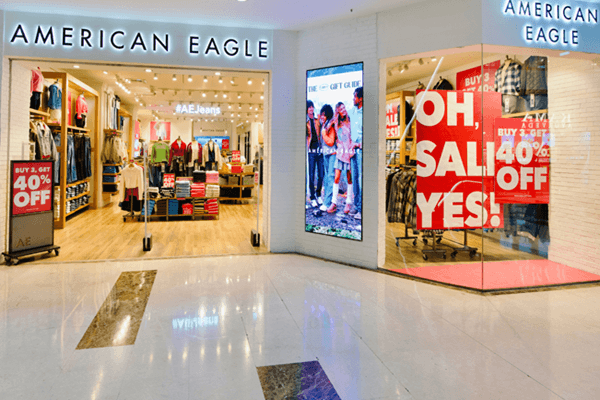
Understanding the Master Licensee Model vs. Direct Franchising
International apparel powerhouses enter the Indian market almost exclusively through master licensing or joint venture agreements. Under this structure, the master licensee manages store rollouts, supply chain logistics, visual merchandising, and inventory risk. When ABFRL expands the American Eagle footprint into Tier-1 metropolitan hubs or emerging Tier-2 luxury corridors, they evaluate locations using strict spatial and demographic criteria.
For retail investors and commercial landlords, the most common entry mechanism is leasing prime high-street commercial storefronts or Grade-A mall units spanning 1,500 to 2,500 square feet. These agreements generally run on long-term commercial lease arrangements featuring a fixed base rent per square foot combined with a revenue-share model (minimum guarantee vs. percentage turnover), rather than a conventional FOFO (Franchise-Owned, Franchise-Operated) small-business setup.
Realistic Fit-Out Costs and Capital Expenditure (CapEx)
Constructing an international denim destination requires strict adherence to corporate visual merchandising guidelines. A standard 1,500 to 2,000 square foot outlet demands substantial technical and design infrastructure. Global fit-out specifications encompass specialized denim architectural walls, directional high-CRI track lighting, reinforced facade glazing, commercial HVAC integration, and certified point-of-sale systems.
Across prime Indian retail developments, complete fit-out and architectural setup costs typically range between ₹4,000 and ₹6,500 per square foot. When accounting for fire suppression systems, custom acoustic paneling, and imported visual merchandising fixtures, total physical buildout expenses reliably reach ₹60 lakh to ₹1.3 crore, entirely separate from inventory provisioning.
Financial Architecture & Investment Overview
Whether evaluating a property fit-out for corporate retail placement or participating in a corporate FOCO arrangement, retail capital must reflect prevailing Indian commercial standards.
| Investment Component | Realistic Estimated Range | Strategic Consideration |
|---|---|---|
| Direct Franchise License Fee | Nil / Not Applicable | No direct third-party unit fee; managed internally by master licensee (ABFRL). |
| Interior Fit-Out & Architectural CapEx | ₹60,00,000 – ₹1,30,00,000 | Calculated at ₹4,000–₹6,500/sq.ft for a 1,500–2,000 sq.ft store; covers denim walls, lighting, and HVAC. |
| Commercial Lease Security Deposit | ₹15,00,000 – ₹60,00,000 | Equivalent to 3 to 6 months of commercial rent in Grade-A retail centers. |
| Initial Working Capital & Launch Contingency | ₹15,00,000 – ₹30,00,000 | Covers pre-opening staffing, local compliance licenses, and utility deposits. |
| Total Capital Outlay (Turnkey Establishment) | ₹90,00,000 – ₹2,20,00,000 | Excludes core inventory risk when operating under standard corporate property leasing models. |
Operating Economics: Operating Expenses and Margin Profile
Premium lifestyle and denim retail operates on healthy gross merchandise margins, generally hovering between 45% and 58% depending on end-of-season clearance depth and promotional discounting cycles. However, brick-and-mortar profitability in shopping centers like Mumbai’s High Street Phoenix, Delhi NCR’s Select Citywalk, or Bengaluru’s Indiranagar is heavily dictated by occupancy cost ratios.
Total monthly operational overhead—consisting of high-street or mall lease charges, Common Area Maintenance (CAM), electrical loads for high-output display lighting, store manager packages, and sales associate payroll—routinely ranges from ₹4,50,000 to ₹14,00,000 per month. For a location to maintain healthy financial viability, total occupancy costs (Rent + CAM) should ideally remain below 15% to 18% of monthly net revenues.
Related Franchise Audits:
Thinking of a Fashion Retail Business? Arvind Store Cost Explained [2026]
| Commercial Route | Primary Investor Role | Capital Risk Level | Target Return Structure |
|---|---|---|---|
| Corporate Real Estate Leasing (COCO) | Commercial Property Owner / Landlord | Low (Tenant investment funded by master brand) | Fixed monthly base rent or 8%–12% revenue-share turnover rental. |
| Investor FOCO Retail Partnership | Capital Partner / Fit-Out Investor | Moderate (Store fit-out and location performance risk) | Predictable monthly operating commission or shared store net profit. |
| Unsanctioned Third-Party “Franchise” | Independent Applicant | Severe (High fraud risk) | Capital loss to fraudulent broker entities. |
How Genuine Investors Can Partner with American Eagle in India
Individuals possessing verified commercial assets in high-density fashion districts or retail corridors can submit property portfolios directly to ABFRL’s corporate real estate and leasing divisions. Store selection teams evaluate catchment footfalls, frontage breadth (preferably minimum 25–30 feet), power infrastructure, and surrounding anchor brands before committing capital.
Entrepreneurs seeking active fashion retail operations without property ownership should pivot toward brands that explicitly utilize open Franchise-Owned, Franchise-Operated (FOFO) frameworks, or explore regional multi-brand apparel distribution agreements where independent dealership licenses are legitimately offered.
Frequently Asked Questions
Can an individual open a standalone American Eagle franchise in India?
No. American Eagle operates in India through an exclusive master licensing agreement with Aditya Birla Fashion and Retail Limited (ABFRL). Unit-level franchises are not distributed to the general public through open franchise applications.
What is the authentic investment cost to set up an American Eagle-grade retail store?
Establishing an international-standard fashion retail space of 1,500 to 2,000 square feet requires a realistic capital outlay of ₹90 lakh to ₹2.2 crore. This accounts for Grade-A mall fit-outs (₹4,000–₹6,500/sq.ft), statutory HVAC compliance, signage, security deposits, and opening operational reserves.
How can commercial property owners partner with American Eagle?
Commercial landlords with prime retail property in Tier-1 and top Tier-2 shopping centers can pitch their commercial space directly to ABFRL’s retail business development team for corporate lease agreements.