Executive Summary: Launching “The Arvind Store” or an Exclusive Brand Outlet (EBO) under the Arvind Fashions Limited umbrella in 2026 typically demands a capital outlay between ₹45 lakh and ₹1.45 crore. The capital expenditure heavily skews toward bespoke interior fit-outs (₹2,200 to ₹3,500 per sq ft) and upfront seasonal inventory.
Most stores operate under a Franchise-Owned, Franchise-Operated (FOFO) structure with gross product margins ranging between 30% and 42%, targeting unit-level operating break-even within 24 to 36 months.
Understanding the Retail Model: Corporate Portfolio vs. Franchise Concept
Prospective retail entrepreneurs often confuse Arvind Limited (the historic textile manufacturing titan) with Arvind Fashions Limited (AFL), the retail-operating entity. Entering this business does not mean securing a generic clothing stall; the operational umbrella splits into two distinct avenues: single-brand Exclusive Brand Outlets (such as Arrow, U.S. Polo Assn., or Flying Machine) and The Arvind Store.
The latter is a hybrid lifestyle showroom that integrates premium textile suiting fabrics, on-premise customized tailoring services (Studio Arvind), and ready-to-wear collections.
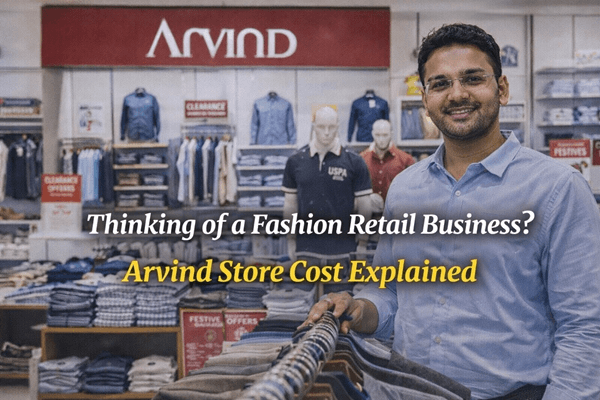
Unlike standard franchise chains that rely on heavy initial franchise fees, Arvind’s commercial model centers on trade partnerships. Capital isn’t absorbed by license fees; instead, it goes toward mandatory security deposits, infrastructure standardization, and rolling trade receivables for stock replenishment.
Understanding this distinction safeguards partners against third-party brokers attempting to sell non-existent “territorial license slots.”
Investor Advisory: Fraudulent Allotment Scams
Due to Arvind’s broad brand recognition, fraudulent networks frequently establish deceptive web domains claiming to issue instant dealership certificates and allotment letters in exchange for non-refundable “application” or “site verification fees” (typically ₹25,000 to ₹2 lakh).
Arvind Fashions Limited never asks for personal account transfers or upfront registration charges prior to exhaustive background checks and in-person corporate verifications. Always verify retail leads directly via Arvind’s registered corporate office or their official portal.
Capital Expenditure (CapEx) Breakdown for 2026
Space and aesthetic compliance represent the heaviest financial commitments. Apparel retail demands rigorous floor-plan architecture, high-CRI lighting systems to correctly render textile colors, climate control, centralized ERP/PoS systems, and high-tensile display racks. The following breakdown reflects realistic outlays for a standard Tier-1 or Tier-2 city commercial format spanning 1,000 to 1,800 square feet.
| Capital Expense Head | Estimated Outlay (INR) | Nature & Allocation Details |
|---|---|---|
| Refundable Security Deposit | ₹5,00,000 – ₹10,00,000 | Held by brand against inventory allocations; interest-free. |
| Interior Fit-Outs & Civil Work | ₹22,00,000 – ₹45,00,000 | Flooring, branded fixtures, trail rooms, electricals (₹2,200–₹3,200/sq ft). |
| IT, PoS, Security & Sound Systems | ₹3,50,000 – ₹6,00,000 | Company-integrated PoS hardware, barcoding, CCTV, EAS anti-theft gates. |
| Initial Opening Stock (Inventory) | ₹20,00,000 – ₹55,00,000 | Opening seasonal launch batch across ready-to-wear, denims, and fabric rolls. |
| Studio Tailoring Equipment (Optional) | ₹2,50,000 – ₹5,00,000 | Industrial stitching, pressing, and finishing machines for custom tailoring. |
| Pre-operative Launch & Marketing | ₹2,00,000 – ₹4,00,000 | Signage installations, local opening promotions, catchment flyers, launch activations. |
| Total Initial Project Cost | ₹55,00,000 – ₹1,25,00,000 | Excluding local commercial lease advances/deposits. |
Operational Economics, Working Capital, and Realized Margins
Gross margin structures in organized lifestyle apparel vary based on inventory risk mechanics. When partnering through outright purchase models, gross realizations settle between 38% and 42%.
In contrast, consignment or systemic markdown-supported models trade closer to 30% to 34% gross profit, offsetting end-of-season liquidation liabilities back to the brand.
Operating cash flow relies on maintaining an inventory turnover ratio (ITR) between 3.5 and 4.5. Apparel demand experiences steep spikes around marriage seasons and festivals (Q3/Q4), meaning reserve liquidity is mandatory to stock inventory weeks before peak footfall.
Store overhead—dominated by high-street rental costs (often ₹120 to ₹250 per sq ft in prime hubs), staff incentives, and commercial electricity—must be factored in to calculate true net earnings.
| Retail Operating Metric | Tier-1 High Street / Mall | Tier-2 Commercial High Street |
|---|---|---|
| Showroom Carpet Area | 1,400 – 2,200 sq ft | 1,000 – 1,500 sq ft |
| Average Monthly Sales Realization | ₹14,00,000 – ₹25,00,000 | ₹8,00,000 – ₹15,00,000 |
| Gross Margin Yield (32%–38%) | ₹4,50,000 – ₹9,50,000 | ₹2,60,000 – ₹5,70,000 |
| Store OpEx (Rent, Payroll, Utilities) | ₹3,00,000 – ₹6,00,000 | ₹1,50,000 – ₹3,20,000 |
| Estimated Monthly Net Cash Flow | ₹1,50,000 – ₹3,50,000 | ₹1,10,000 – ₹2,50,000 |
| Projected Payback Horizon | 28 to 36 Months | 24 to 32 Months |
Site Selection Criteria and Regulatory Diligence
Apparel retail performance is tied directly to clear line-of-sight and frontage dimensions. A location requires a minimum clear frontage of 20 to 25 feet to accommodate brand-compliant display windows that convert walking traffic into walk-ins.
Commercial properties must carry clean commercial usage titles, fire safety approvals, and three-phase industrial electrical connections capable of carrying 12–18 kW connected loads for uninterrupted HVAC operations.
Operational documentation requires an active GST registration, municipal shop and establishment licensing, clear leaseholder agreements with lock-in protections (ideally 3 to 5 years minimum with a defined renewal structure), and comprehensive all-risk transit and warehouse insurance policies to safeguard stocks against theft, water damage, or electrical hazards.
Before You Decide:
Build a Fashion Accessories Store – Artificial Jewellery Franchise India [2026]
Frequently Asked Questions
Does Arvind charge an ongoing monthly franchise royalty?
In most product-distribution partnerships and FOFO agreements, Arvind Fashions does not charge a flat monthly royalty. Instead, corporate compensation is built directly into wholesale wholesale billing and product distribution margins, aligning the brand’s profitability directly with product movement.
What happens to unsold seasonal stock at the end of the year?
Depending on the specific contractual arrangement (Sale or Return vs. Outright Purchase), older inventory is either cycled back through regional clearance consolidations, marked down during corporate End of Season Sales (EOSS), or offset through seasonal stock-rotation credit notes.
Can a franchisee independently adjust pricing or discounts?
No. Standardized multi-channel pricing is strictly enforced through the central point-of-sale ERP software. Franchisees cannot modify maximum retail prices or independently run unapproved promotions, ensuring uniform consumer trust across India.