Before budgeting capital for a standalone Big Bowl outlet, prospective food entrepreneurs must look past generic franchise directories. Big Bowl operates as an internet-first virtual restaurant brand within the Rebel Foods cloud kitchen ecosystem rather than an independent mom-and-pop shopfront.
Understanding whether you are looking at a master multi-brand FOFO hub, an aggregator virtual brand, or a corporate-owned cloud kitchen is essential to avoiding costly commercial missteps.
Quick Facts
Brand Ownership: Rebel Foods Private Limited (parent company of Faasos, Behrouz Biryani, Oven Story, and Lunchbox).
Primary Operating Model: Multi-brand cloud kitchen (Dark Kitchen / Internet Restaurant) and Rebel Multi-Brand Hubs; not sold as a standalone single-brand storefront.
Actual CapEx Requirement: Single-brand standalone franchise fees do not exist. Commercial kitchen setups range from ₹18 lakh to ₹28 lakh for a shared multi-brand dark kitchen shell, while official Rebel Foods multi-brand FOFO hubs (incorporating offline footprints like Oven Story/EatSure with multi-brand cloud kitchens) require approximately ₹90 lakh to ₹1 crore.
Typical EBITDA Margin: 12% to 18% net operating margin after platform aggregator commissions (22%–30%), customer discounts, and packaging overheads.
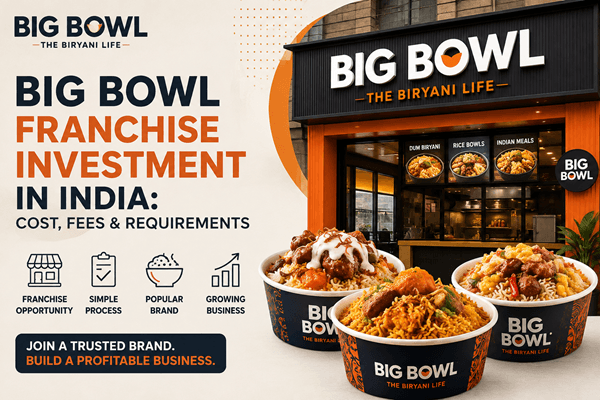
The Franchise Fee Myth: How Big Bowl and Rebel Foods Actually Operate
Prospective investors frequently search for single-brand franchise packages for brands like Big Bowl, expecting an arrangement similar to a traditional quick-service restaurant (QSR). However, Big Bowl functions primarily as an internal digital brand created to capture high-frequency lunch and dinner demand across food aggregator channels such as Zomato, Swiggy, and Rebel Foods’ proprietary D2C platform, EatSure.
In most Indian metropolitan clusters, orders are cooked and dispatched from shared multi-brand cloud kitchen facilities rather than dedicated standalone dine-in properties.
Consequently, paying a standalone “Big Bowl Franchise Fee” of ₹3 lakh to ₹5 lakh to third-party consultants is fundamentally misaligned with how the parent entity expands. Rebel Foods has historically scaled via Company-Owned, Company-Operated (COCO) facilities and corporate joint ventures.
While the parent company has rolled out Franchise-Owned, Franchise-Operated (FOFO) avenues, these opportunities encompass multi-brand infrastructure (such as combined Oven Story offline stores paired with Faasos, Behrouz, and Big Bowl delivery modules) rather than solo Big Bowl retail stalls.
Investor Advisory: Fraud and Unofficial Intermediary Alert
Due to the high consumer search volume around Rebel Foods brands, fraudulent franchise brokers frequently operate clone websites and fake Google Forms soliciting advance deposits, “site verification charges,” and token fees under the guise of Big Bowl franchise allotment. Rebel Foods never issues franchise approvals through personal messaging apps or unsecured bank accounts. All genuine FOFO discussions and multi-brand licensing opportunities must be verified directly through corporate channels at rebelfoods.com.
Realistic CapEx: Single Kitchen Shell vs. Official Multi-Brand Hub
If you are setting up a commercial kitchen designed to service high-volume delivery brands like Big Bowl, your budget must be divided into physical plant setup, food licensing, commercial ventilation, and working capital buffers.
A commercial delivery facility spanning 350 to 500 square feet in a high-density urban corridor typically demands between ₹18 lakh and ₹28 lakh in setup expenditure, primarily driven by three-phase commercial power installations, heavy-duty stainless steel workbenches, exhaust ducting, and commercial refrigeration.
Conversely, an official institutional rollout under Rebel Foods’ recognized multi-brand FOFO program requires 1,100 to 1,500 square feet of compliant space. Such installations incorporate commercial combi ovens, specialized impinger equipment, Rebel+ restaurant ERP terminals, and integrated dine-in customer interfaces, pushing total project expenditure into the ₹90 lakh to ₹1 crore bracket.
| Investment Head | Independent Delivery Shell (350–500 sq. ft.) | Official Multi-Brand FOFO Hub (1,100–1,500 sq. ft.) |
|---|---|---|
| Initial Brand / Franchise Fee | Nil (Independent Brand Creation) | ₹10 Lakh (Covers Multi-Brand Rights & SOPs) |
| Kitchen Fit-out, Exhaust & Electricals | ₹6,00,000 – ₹9,00,000 | ₹25,00,000 – ₹32,00,000 |
| Commercial Kitchen Equipment & Storage | ₹5,50,000 – ₹8,50,000 | ₹28,00,000 – ₹35,00,000 (Impinger Ovens, Freezers) |
| Licenses, POS Hardware & Tech Integration | ₹1,00,000 – ₹2,00,000 (FSSAI, Fire, Trade) | ₹3,50,000 – ₹5,00,000 (Rebel+ ERP, IoT Devices) |
| Security Deposits & Pre-Operating Rent | ₹3,00,000 – ₹5,00,000 (Tier-1 Cluster) | ₹8,00,000 – ₹15,00,000 (Prime Commercial Belt) |
| Reserve Working Capital (3–4 Months) | ₹2,50,000 – ₹4,00,000 | ₹6,00,000 – ₹9,00,000 |
| Total Estimated Project Capital | ₹18,00,000 – ₹28,50,000 | ₹90,00,000 – ₹1,00,00,000+ |
City-Wise Commercial Variations Across Indian Metros
Commercial rent and security deposit conventions differ widely across Indian commercial real estate hubs. In Mumbai, security deposits for even non-retail back-alleys and industrial estates in regions like Andheri East, Lower Parel, or Malad frequently command 6 to 10 months of upfront rent, pushing early cash outlays significantly higher than in northern or southern corridors.
An operator in Mumbai must anticipate total setup allocations starting at ₹24 lakh to ₹30 lakh for an independent kitchen unit.
In Bengaluru and Hyderabad, high delivery density across IT corridors (such as HSR Layout, Whitefield, Madhapur, and Gachibowli) provides robust lunchtime order frequency.
However, competition from existing cloud kitchen clusters and specialized bowl brands keeps delivery marketing expenses elevated. In Delhi-NCR, while square-footage rental rates in peripheral light-commercial areas are often more affordable, utility expenses—specifically high summer power tariffs required for continuous deep-freezer and air-curtain operation—increase ongoing OpEx.
Unit Economics, Operating Costs, and True Margins
Evaluating the commercial viability of a delivery brand requires unbundling the platform economics of Swiggy and Zomato. While gross margins on rice, curries, and biryani bowls look appealing on paper at 60% to 65%, net operational realization is heavily compressed by aggregator commissions, which consistently range between 22% and 30% on gross billing.
Beyond commissions, delivery packaging engineered to maintain heat and prevent spillage costs between ₹12 and ₹20 per meal. Combined with sponsored aggregator ad placements, merchant discounts, kitchen utility power, and local prep labor, realistic EBITDA margins stabilize between 12% and 18%. Breakeven cycles for properly capitalized cloud kitchens typically sit between 18 and 30 months, dependent entirely on sustained daily order volume crossing 90 to 140 tickets per day.
Before You Decide:
Arzoo Restaurant Franchise Cost in India [2026]
Due Diligence: Questions Every Prospective Operator Must Ask
Before entering any contractual agreement or making commercial real estate commitments, request a full written disclosure regarding territorial exclusivity. A major risk in virtual brand licensing is geographic cannibalization: because internet restaurant brands can be launched in multiple nearby cloud kitchens on the same delivery aggregator radius, ensure your legal agreement guarantees protected dispatch coordinates.
Furthermore, confirm ingredient procurement mandates. If raw materials, gravies, and marinades must be bought exclusively from a central commissary, inspect the wholesale landed pricing. High supply-chain markups on pre-portioned bases can rapidly erase unit-level gross profit, making it impossible to survive after paying delivery platform service fees.