Unlike commercial quick-service restaurants or mainstream apparel chains, ultra-luxury fashion brands virtually never operate open, third-party unit-franchise programs. Amiri maintains uncompromising control over its supply chain, visual merchandising, and pricing corridors. Bringing the brand into prime Indian retail corridors—such as Jio World Plaza in Mumbai or DLF Emporio in New Delhi—requires institutional-scale retail infrastructure, multi-crore capital reserves, and direct corporate or master distributor authorizations rather than an off-the-shelf retail license.
Investor Advisory: Luxury Brand Dealership & Franchise Scams
Due to the explosive growth of luxury retail interest in India, multiple fraudulent websites, unauthorized brokers, and phishing operations claim to offer official “Amiri Dealerships,” “Amiri Franchise Allotment Forms,” or “Exclusive Outlet Licenses” in exchange for non-refundable application fees ranging from ₹2 lakh to ₹15 lakh. Amiri LLC does not solicit franchise applications through online forms or third-party agencies. Legitimate expansions occur exclusively through direct corporate-to-corporate dialogue or recognized luxury retail groups. Never wire advance funds or store security deposits to domestic intermediaries claiming brand representation rights.
Retail Framework: Franchise vs. Master Distribution vs. COCO
The phrase “Amiri franchise cost” is fundamentally a misnomer in modern fashion economics. High-fashion conglomerates, including OTB Group (which holds a key stake in Amiri), expand into emerging economies using one of two well-defined strategies: Company-Owned, Company-Operated (COCO) flagships, or long-term Master Franchise/Exclusive Distribution Agreements with corporate luxury operators like Reliance Brands Limited (RBL) or Aditya Birla Fashion and Retail (ABFRL). Under these enterprise frameworks, individual retail investors participate primarily as commercial real estate partners leasing prime mall footprints, rather than independent shopkeepers buying a retail license.
For high-net-worth business consortiums attempting to negotiate a mono-brand partnership or multibrand concept boutique carrying Amiri, the required commitments span millions of dollars in bank guarantees, direct wholesale purchase orders, and multi-year inventory off-take assurances. Below is a structured comparison of how consumer brands scale compared to Amiri’s ultra-luxury operational model.
| Operational Parameter | Standard Commercial Apparel Franchise | Amiri / Luxury Designer Model |
|---|---|---|
| Franchise Availability | Publicly available to qualified individual retail operators | Strictly closed; enterprise partnerships or corporate flagships only |
| Upfront Brand Fee | ₹5,00,000 to ₹25,00,000 (typical unit franchise fee) | No individual franchise fee; high corporate collateral / bank guarantee |
| Store Fit-out CapEx | ₹3,000 – ₹7,000 per sq. ft. | ₹25,000 – ₹45,000+ per sq. ft. (custom imports, Italian fixtures) |
| Inventory Model | Consignment or standard 30–60 day credit cycle | Seasonal firm-commitment OTB orders; cash-in-advance or documentary LC |
| Typical Location Mandate | High streets, Tier-1 & Tier-2 retail malls | Exclusively Grade-A luxury corridors (Jio World Plaza, DLF Emporio) |
Realistic CapEx Breakdown for a 1,500–2,500 Sq. Ft. Boutique
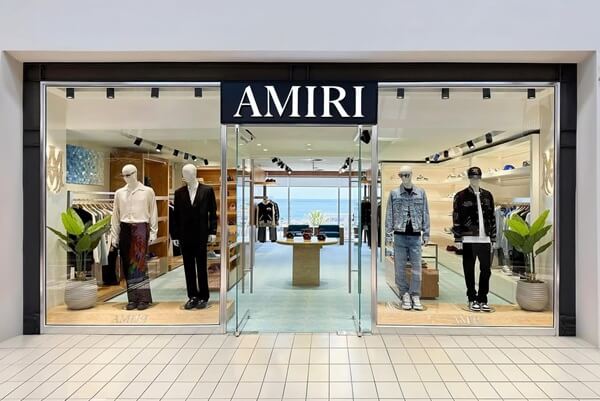
If an enterprise retail partner develops an authorized standalone boutique in India, the capital expenditure is significantly higher than domestic apparel benchmarks. Ultra-luxury boutiques must adhere to exacting brand architectural guidelines, which mandate bespoke woodwork, imported terrazzo or natural stone flooring, specialized directional acoustic lighting, and certified bulletproof security showcases for high-ticket leatherwear and accessories.
Fit-out expenses for a standardized 2,000 sq. ft. footprint frequently exceed ₹5.00 crore to ₹7.50 crore purely for civil works, international MEP (mechanical, electrical, plumbing) installations, and specialized facade glazing. Additionally, because high-end garments, exotic leathers, and designer footwear attract significant basic customs duty, social welfare surcharge, and 12% to 18% IGST upon arrival into India, seasonal stock capitalization requires substantial liquid reserves. Maintaining adequate breadth across seasonal runways, core denim capsules, and footwear requires an upfront inventory commitment between ₹4.00 crore and ₹8.00 crore per purchasing cycle.
| CapEx & Working Capital Element | Estimated Allocation (INR) | Strategic Considerations |
|---|---|---|
| Store Architecture & Interiors | ₹4.50 Cr – ₹7.50 Cr | Adherence to global blueprint; imported Italian fixtures and displays |
| Initial Seasonal Inventory | ₹4.00 Cr – ₹8.00 Cr | Covers denim, shearling, RTW, sneakers, import customs, and IGST |
| Security Deposit (Real Estate) | ₹1.20 Cr – ₹2.50 Cr | Equivalent to 6 months’ base rent in Grade-A luxury malls |
| IT, Security, Surveillance & ERP | ₹35 Lakh – ₹65 Lakh | RFID tracking, specialized POS, biometric vaults, high-res security |
| Operating Reserve (6 Months) | ₹1.50 Cr – ₹3.00 Cr | Working capital buffer for payroll, CAM charges, and VIP hospitality |
| Total Initial Outlay | ₹11.55 Cr – ₹21.65 Cr | Reflects realistic institutional-grade investment parameters |
Operating Overheads, Real Estate Dynamics, and Unit Economics
Operating a boutique in India’s prime luxury complexes involves significant overhead. Commercial lease agreements in Tier-1 luxury malls typically involve a hybrid structure: a base Minimum Guaranteed (MG) rental rate ranging from ₹600 to ₹1,400 per sq. ft. monthly, coupled with Common Area Maintenance (CAM) and a revenue-share clause of 8% to 14%. For a 2,000 sq. ft. boutique, monthly real estate occupancy alone can demand ₹18 lakh to ₹32 lakh.
Recommended Coverage:
Babyhug Franchise Cost in India [2026]
Staffing also diverges sharply from regular apparel retail. Amiri boutiques require bilingual, highly trained luxury client advisors, personal shoppers, and dedicated VIP liaison managers skilled in private clienteling and relationship sales. Monthly personnel expenses often touch ₹8 lakh to ₹15 lakh. While gross product margins in luxury fashion wholesale hover between 55% and 65%, heavy customs duties, international shipping, localized luxury client events, and high retail occupancy mean boutique net margins generally stabilize between 12% and 18%, subject to effective inventory sell-through rates and minimal end-of-season markdown dilution.
Frequently Asked Questions
Can an individual investor apply for an Amiri retail franchise in India?
No. Amiri does not offer retail franchises to individuals. The brand enters international markets either directly through corporate subsidiaries or via exclusive partnerships with established luxury retail conglomerates possessing established mall relationships and nationwide distribution logistics.
What is the realistic capital requirement to establish an authorized luxury boutique?
An institutional partner establishing a standalone luxury boutique of Amiri’s caliber should budget between ₹12 crore and ₹22 crore. This includes global-spec interior engineering, multi-season inventory import commitments, high commercial rental deposits, and multi-month operational reserves.
Which Indian locations meet Amiri’s global site-selection criteria?
Amiri’s site-selection parameters strictly demand co-tenancy alongside Tier-1 luxury houses (such as Balenciaga, Gucci, Louis Vuitton, and Saint Laurent). Consequently, viable spaces are limited to dedicated luxury properties like Jio World Plaza in Mumbai and DLF Emporio / The Chanakya in New Delhi.