The Franchise Reality: Can Individuals Buy a Devyani International Outlet?
Devyani International functions as a corporate Master Franchisee in India for global hospitality giants under Yum! Brands (KFC, Pizza Hut) and Coca-Cola (Costa Coffee), alongside its proprietary food concepts such as Vaango. The company expands strictly through a Company-Owned, Company-Operated (COCO) structure. It funds its own capital expenditures (CapEx), deploys internal management, and handles operations directly. Consequently, retail investors cannot purchase or operate an individual KFC, Pizza Hut, or Costa Coffee storefront through Devyani.
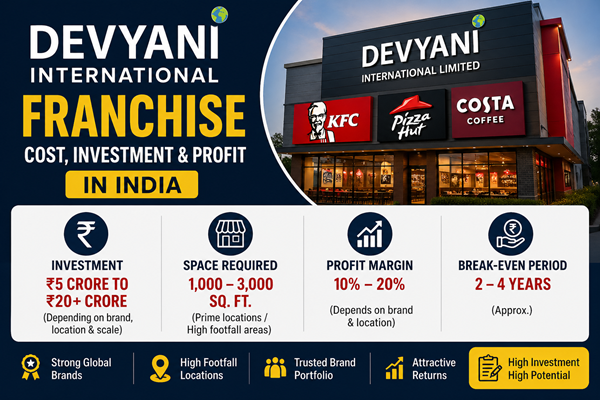
Critical Warning: Fake Franchise Application & Fee Scams
Because Yum! Brands assets like KFC and Pizza Hut hold immense consumer pull, organized cyber syndicates run widespread advance-fee fraud across India. These fraudulent operations involve cloning official brand assets, running deceptive search ads, and distributing forged “Letter of Intent” (LOI) documents demanding advance security deposits or verification fees ranging from ₹2,00,000 to ₹10,00,000.
Devyani International has repeatedly issued public advisories clarifying that it never solicits sub-franchise applications, nor does it collect approval deposits from the general public. Any website, broker, or WhatsApp representative demanding upfront registration charges or claiming to issue a “Devyani KFC Franchise Agreement” is fraudulent
The Real Partnership Channel: Property Leasing (COCO Model)
While equity-based or sub-franchise store partnerships do not exist for retail operators, individuals holding prime commercial property can partner with Devyani International via commercial long-term leases. The company actively procures real estate on highway corridors, transit hubs, tier-1 high streets, and regional shopping malls.
Under this arrangement, the property owner acts strictly as a commercial landlord, while Devyani bears the fit-out CapEx, kitchen equipment outlays, staffing, and regulatory licensing. Compensation typically follows a long-term lease contract (typically 9 to 15 years with periodic escalation clauses) structured either as a fixed per-square-foot monthly rent or a hybrid revenue-sharing agreement (commonly 7% to 12% of net monthly store turnover).
Model Breakdown: Sub-Franchise vs. Corporate Master Franchisee
Understanding the operational and financial boundary lines between what unverified blogs claim and how Devyani actually conducts business is essential for proper capital allocation.
| Metric / Parameter | What Unofficial Portals Claim | Actual Devyani Corporate Model |
|---|---|---|
| Franchise Model | FOFO / FOCO Sub-Franchising | Corporate Master Franchise / Pure COCO |
| Direct Investor CapEx | ₹1 Crore to ₹5 Crore per outlet | Zero (DIL funds 100% internal CapEx) |
| Franchise License Fee | ₹5 Lakh to ₹20 Lakh upfront | Not Applicable (No retail licensing offered) |
| Direct Store Profit Margins | Claimed 15% to 20% net margin | Retained by DIL; Store EBITDA varies by brand |
| Eligible Participation | Retail investors, small entrepreneurs | Commercial property owners (via lease) or public equity shareholders |
| Commercial Space Required | Vague generic estimates | 1,200 to 2,000 sq. ft. carpet area with prime frontage |
Realistic QSR Unit Economics & CapEx Realities
For investors attempting to benchmark institutional QSR formats in India, capital deployment requirements are significantly more complex than standard commercial storefronts. Building a standard 1,500 to 2,000 square foot western-style fast-food restaurant requires extensive civil works, specialized high-amperage electrical loads, exhaust scrubber ducting, walk-in cold rooms, and commercial-grade pressure fryers or conveyor ovens.
Institutional operators allocate an average of ₹1.5 crore to ₹3 crore in pure capital expenditure per store, depending on whether the format is a cloud-adjacent express counter or a flagship highway dine-in unit. From a unit economics perspective, raw food and beverage gross margins typically hover between 65% and 70%, but heavy corporate overheads, platform commissions, prime urban rents, and utility loads typically yield store-level EBITDA margins in the range of 12% to 18%.
Next Steps in Your Research:
Avadh Food Franchise Cost in India [2026]
Legitimate Ways to Gain Exposure to Devyani’s Growth
For entrepreneurs and investors determined to participate in the enterprise value generated by brands like KFC, Pizza Hut, and Costa Coffee, realistic alternatives exist that do not violate corporate brand protocols or expose capital to advance-fee scams.
First, commercial real estate investors can submit property dossiers directly through the official property intake portal at Devyani International’s corporate website. Locations that meet footfall, frontage, and utility criteria will receive direct engagement from the real estate acquisition team without intermediaries.
Second, capital investors looking for financial returns rather than physical business operations can take direct equity exposure. Devyani International Limited is a publicly listed entity on both the National Stock Exchange (NSE: DEVYANI) and Bombay Stock Exchange (BSE: 543330). Investing through standard equity markets provides authentic, liquid exposure to the company’s QSR growth, same-store sales growth (SSSG), and geographic expansion across India.
Third, entrepreneurs who want hands-on restaurant operations should redirect their focus toward franchise-friendly QSR networks. Indian and regional brands operating under authentic FOFO (Franchisee-Owned, Franchisee-Operated) or FOCO (Franchisee-Owned, Company-Operated) models provide structured onboarding, formal disclosure documents, and legal territorial licenses suited for individual ownership.