Executive Summary: The “Franchise Fee” Trap
Prospective investors and clinicians searching for an ASG Eye Hospital franchise cost in India often encounter misleading franchise portals advertising turnkey dealership licenses and off-the-shelf franchise fee slabs. In reality, ASG Hospital Ltd does not operate an open retail or quick-service franchise network. Backed by private equity majors including General Atlantic and Kedaara Capital, ASG expands primarily through Company-Owned Company-Operated (COCO) facilities, clinical joint ventures, doctor acqui-hires, and institutional mergers and acquisitions (M&A)—such as its acquisitions of regional hospital chains like Sharp Sight Eye Hospital and Dr. Gadgil Eye Hospital.
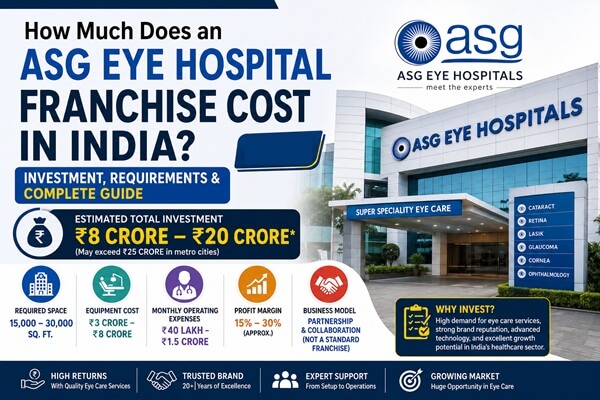
Healthcare delivery mandates clinical credentialing, strict biomedical accountability, and compliance with the Clinical Establishments Act and NABH protocols. Consequently, independent entrepreneurs without medical backgrounds cannot simply purchase a retail territorial license. However, for real estate owners offering long-term institutional leases or qualified ophthalmic surgeons exploring strategic equity partnerships, capital allocation for an ASG-scale tertiary eye facility ranges from ₹8 crore to ₹20+ crore depending on municipal tier, operational floor area, and diagnostic technology tiers.
Investor Advisory & Scam Alert: Fake Franchise Verification
Multiple unauthorized franchise aggregators and imposter domains solicit upfront “registration fees,” “token deposits,” or “franchise allotment fees” ranging from ₹2 lakh to ₹15 lakh, claiming to provide ASG Eye Hospital franchise rights. ASG Hospital Ltd never solicits franchise fees via individual bank transfers, UPI accounts, or classified portals. Any legitimate institutional collaboration undergoes multi-tiered clinical due diligence, physical site validation, and direct legal contracts executed by ASG’s corporate headquarters in Jodhpur or executive leadership teams. Never transfer funds to third-party consultants or unverified digital portals.
How ASG Eye Hospital Actually Expands in India
Rather than offloading risk onto amateur franchisees, tertiary eye hospital chains protect their surgical reputation, NABH accreditation standards, and clinical outcome metrics through institutional capital arrangements. If you are seeking to collaborate with the network, market entry generally falls into one of three legitimate pathways:
1. Strategic Clinical Partnerships & Equity Mergers: Established ophthalmologists running standalone clinics or single-doctor hospitals with steady surgical footfalls often enter equity-swap or revenue-share models. ASG provides capital for state-of-the-art surgical technology (such as femtosecond laser platforms and modular cleanroom operation theatres), centralized supply-chain procurement for intraocular lenses (IOLs), and corporate insurance/TPA empanelments, while the local senior surgeon manages regional clinical operations.
2. Commercial Real Estate Leasing (Long-Term Built-to-Suit): Commercial property owners possessing 15,000 to 30,000 square feet of frontage space in accessible urban centers can pitch properties for long-term institutional leases (typically 9 to 15 years). ASG undertakes interior fit-outs, heavy medical HVAC installations, and radiation/laser safety zoning, while landlords secure stable corporate yields rather than transactional franchise royalties.
3. Institutional Mergers & Acqui-hires: In Tier-1 and Tier-2 growth corridors, the group actively acquires majority stakes in mid-tier eye clinics looking for succession planning or financial exits, completely absorbing the target brand into the wider ASG regional hub-and-spoke infrastructure.
Further Reading:
Planning a Healthcare Venture? Apollo Hospital Franchise Cost India [2026]
Realistic CapEx Architecture for a Full-Scale Tertiary Eye Hospital
To evaluate the financial gravity of setting up a comparable 15,000 to 25,000 sq. ft. super-specialty eye care center in India, investors must understand the high upfront capital expenditure (CapEx) dominated by advanced diagnostic and surgical machinery rather than cosmetic branding.
| Expense Head | Estimated CapEx (INR) | Key Deliverables & Specifications |
|---|---|---|
| Ophthalmic Surgical Equipment | ₹3.5 Crore – ₹8.5 Crore | Phacoemulsification units, surgical operating microscopes, Femtosecond/excimer laser platforms (LASIK/SMILE), vitrectomy units. |
| OPD & Diagnostic Suites | ₹1.5 Crore – ₹3.0 Crore | Optical Coherence Tomography (OCT), fundus cameras, visual field analyzers, autorefractors, slit lamps, corneal topographers. |
| Civil Fit-Outs & Modular OTs | ₹2.5 Crore – ₹5.5 Crore | Class 100/10,000 modular operation theatres, laminar airflow, medical gas manifolds, antimicrobial vinyl flooring, patient lounges. |
| Utility Infrastructure & IT | ₹60 Lakh – ₹1.8 Crore | Hospital Information Management Systems (HIMS), dedicated servers, high-capacity backup generators (DG sets), fire suppressors. |
| Licensing, Legal & Pre-Launch | ₹40 Lakh – ₹1.2 Crore | Clinical Establishments Act compliance, AERB clearances, pharmacy licenses, biomedical waste agreements, NABH consultancy. |
| First-Year Working Capital | ₹1.0 Crore – ₹2.5 Crore | Operating liquidity cushion for surgeon stipends, nursing payroll, surgical consumables, and initial catchment marketing. |
| Total Project Outlay | ₹9.5 Crore – ₹22.5 Crore+ | Excludes freehold land purchase; assumes long-term institutional leasehold premises. |
Operating Economics: Revenue Levers, OpEx, and EBITDA Realities
Specialty eye hospitals command fundamentally different financial profiles than general healthcare facilities. The procedure mix heavily influences margin realization. High-volume cataract procedures provide steady cash flow and baseline bed turnover, while refractive corrections (Contoura Vision, LASIK, SMILE) and complex vitreoretinal interventions generate superior contribution margins.
A functional regional center with steady community trust typically generates between ₹75 lakh and ₹2.2 crore in monthly gross billing across diagnostics, surgical interventions, optical dispensaries, and in-house pharmacy counters. However, recurring operational expenditure (OpEx) remains substantial:
| Financial Metric | Industry Standard Range | Operational Analysis |
|---|---|---|
| Monthly Operating Expense | ₹45 Lakh – ₹1.2 Crore | Driven by competitive compensation for senior anterior segment/retina surgeons, anesthetists, Comprehensive Annual Maintenance Contracts (CAMC) for lasers, and high-purity medical gases. |
| Mature Operating EBITDA Margin | 18% – 26% | Highly sensitive to insurance vs. cash patient mix; public scheme dependencies (e.g., Ayushman Bharat/CGHS) depress realization compared to cash or premium TPA claims. |
| Payback Period | 4 to 6 Years | Reflects the long clinical ramp-up period required to establish community credibility, institutional doctor retention, and sustained surgical volumes. |
Institutional Due Diligence: What Strategic Partners Must Prepare
Healthcare investors and physician groups seeking formal corporate tie-ups with ASG Hospital Ltd should avoid speculative brokerage middle-men and initiate institutional contact through corporate channels. Preparation requires institutional-grade documentation rather than a retail franchise application:
Institutional evaluators prioritize candidates who present comprehensive geographic catchment feasibility studies detailing population density, demographic aging profiles, and local ophthalmologist density. Furthermore, proposals must feature clear title or commercial zoning documentation for 15,000+ square feet of space featuring high floor-to-ceiling clearances for ceiling-mounted microscope arms, high sanctioned electrical power loads (150+ kVA), and structural floor loading capacities capable of supporting heavy diagnostic and generator machinery.
Finally, partnership viability hinges on local clinical integration. A network hospital requires an established clinical anchor—either practicing sub-specialists in cornea, retina, and glaucoma committed to long-term clinical retention or an active referral pipeline from local optometry and physician associations.