Executive Summary: Dealership vs. Traditional Franchise
Prospective investors frequently search for the “Asian Paints franchise cost,” but Asian Paints Limited does not license conventional commercial franchises. There are no recurring royalties, territories carved out via brand-licensing fees, or turn-key franchise management agreements. Instead, the company operates India’s most expansive paint retail distribution network through authorized commercial dealerships.
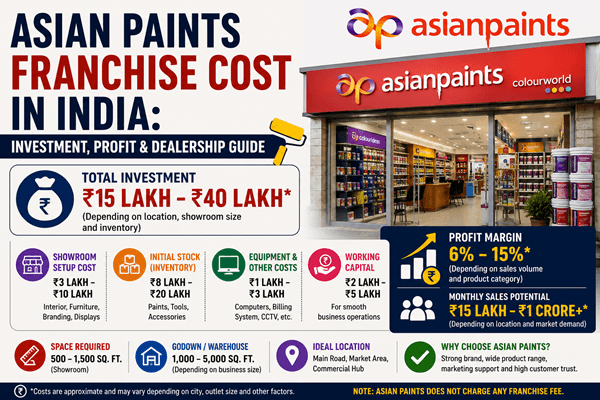
Opening an authorized Asian Paints retail counter requires a capital expenditure typically between ₹10 lakh and ₹25 lakh for standard Tier-2 and Tier-3 town setups, scaling upward to ₹35 lakh to ₹50 lakh in metropolitan centers where real estate deposits and upfront inventory depth are significantly higher. Rather than paying for a brand name upfront, your capital is deployed directly into tangible business assets: tinting hardware, commercial showroom interiors, revolving inventory, and working capital buffers.
Urgent Warning: Dealership Application Scams
Due to the immense retail pull of Asian Paints, multiple fraudulent syndicates run lookalike websites, spoofed online forms, and fake newspaper ads offering guaranteed “distributorship allotments.” These fraudsters often demand an upfront “application processing fee” or “refundable registration charge” ranging from ₹25,000 to ₹50,000, followed by demands for ₹1 lakh to ₹3 lakh in fictitious “security deposits” transferred to individual bank accounts.
Asian Paints does not collect registration fees via UPI, personal accounts, or unverified online forms. Dealership appointments are finalized only after physical site inspections by the local Territory Sales Officer (TSO) or Area Sales Manager (ASM). Any payment toward opening stock or tinting machinery is invoiced directly through official corporate accounts after formal background verification and physical document validation.
Realistic Capital Expenditure (CapEx) Breakdown
The core capital requirement revolves around two primary assets: initial product inventory and the mandatory automatic colour tinting machine. Because modern paint retail relies on base paints mixed on-demand to produce thousands of computer-generated shades, a shop cannot function without an authorized tinting setup and gyroscopic paint mixer, which typically involves an outlay of ₹1.5 lakh to ₹2.5 lakh.
Working capital is equally critical. In this industry, painters and civil contractors frequently purchase supplies on 15 to 45-day credit windows. Without adequate revolving liquidity, a new store risks stalling inventory replenishment while waiting for trade receivables to clear.
| Investment Head | Tier-2 / Tier-3 Towns (500–800 sq. ft.) | Metropolitan / Tier-1 (800–1,500 sq. ft.) | Nature of Expense |
|---|---|---|---|
| Franchise Fee / Royalty | ₹0 | ₹0 | Zero recurring brand fee |
| Colour Tinting Machine & Gyro-Mixer | ₹1,50,000 – ₹2,00,000 | ₹2,00,000 – ₹2,50,000 | One-time equipment purchase/lease |
| Opening Stock (Emulsions, Primers, Waterproofing) | ₹4,00,000 – ₹7,00,000 | ₹10,00,000 – ₹18,00,000 | Rotational liquid asset |
| Store Interiors, Racks & Corporate Signage | ₹1,50,000 – ₹3,00,000 | ₹3,50,000 – ₹8,00,000 | Display counters, lighting, heavy shelving |
| Commercial Deposit & Legal Compliances | ₹1,00,000 – ₹2,50,000 | ₹3,00,000 – ₹8,00,000 | Refundable landlord deposit, GST, Trade license |
| Hardware, POS Billing & CCTV | ₹50,000 – ₹1,00,000 | ₹1,00,000 – ₹1,50,000 | Desktop terminal, thermal printer, surveillance |
| Working Capital (Contractor Credit Buffer) | ₹2,00,000 – ₹4,00,000 | ₹5,00,000 – ₹10,00,000 | Liquid cash flow reserve |
| Total Estimated Capital Outlay | ₹10,50,000 – ₹19,50,000 | ₹24,50,000 – ₹48,00,000 | Excludes real estate purchase cost |
Margin Economics: Dispelling the High-Margin Myth
A common misconception created by generic business portals is that paint retailers enjoy flat 15% to 20% profit margins. In practice, decorative paints are high-velocity, price-transparent commodities. The standard front-end gross margin on fast-moving interior wall primers, white distempers, and basic acrylic emulsions usually hovers between 3% and 7% due to intense retail competition among local paint shops.
Viable profitability in an Asian Paints dealership is driven by product mix and back-end performance incentives. Higher gross margins (ranging from 10% to 18%) are earned on ancillary products such as specialized waterproofing compounds (SmartCare), wood finishes, wall stencils, textured designer coats, and painting tools. Furthermore, Asian Paints runs structured monthly and quarterly dealer schemes, turnover targets, and early-payment cash discounts that can add an extra 2% to 5% to the net bottom line for disciplined operators.
Space & Infrastructure Criteria
Paint cans are heavy, dense, and hazardous to store if proper ventilation and structural load capacities are overlooked. A standalone showroom requires a minimum of 400 to 800 square feet of frontage with convenient street-level access for loading and unloading tempo trucks. If you intend to operate large-volume wholesale supplies to commercial painting contractors, a secondary godown of 800 to 2,000 square feet within immediate driving proximity is mandatory.
In terms of regulatory compliance, you must register for Goods and Services Tax (GST), secure a commercial Trade License from the local municipal corporation, obtain a shop and establishment certificate, and adhere to local fire safety standards given the combustible nature of solvent-based enamels and thinners.
Further Reading:
Dulux Paint Dealership in India (2026)
Official Step-by-Step Onboarding Process
Do not rely on third-party intermediaries to process dealership paperwork. The legitimate onboarding flow involves direct verification by Asian Paints field personnel:
First, secure your commercial premises via ownership deed or a registered commercial lease agreement. The company will not evaluate abstract applications that do not have an identified physical location and municipal address.
Second, initiate contact through the official corporate touchpoints: by writing directly to customer support (customercare@asianpaints.com) detailing your proposed shop address, pin code, and capital capacity, or by visiting the nearest Asian Paints Regional Depot to meet the Territory Sales Manager.
Third, an assigned sales officer will conduct a feasibility survey to examine dealer density within your target 2-to-5 kilometer radius, local construction activity, and your business background. If approved, commercial terms, credit boundaries, tinting equipment dispatch, and initial stock invoicing are finalized directly between the dealer and Asian Paints Limited.