Investor Alert: Beware of Unofficial Franchise Middlemen
Aswins Home Specials relies primarily on centralized production from its primary manufacturing units and operates largely through Company-Owned outlets, highway hospitality plazas, and authorized supply networks. The parent organization does not run an open, standardized online FOFO (Franchise-Owned, Franchise-Operated) broker portal. Prospective investors must exercise caution regarding third-party consultants or fraudulent landing pages demanding application fees, registration deposits, or advance site clearance charges under the Aswins trademark.
Understanding the Retail and Partnership Structure
When assessing how outside partners can collaborate with established regional snack brands like Aswins, partnerships generally fall into three commercial categories rather than a standard cookie-cutter franchise licence:
Commercial Property Leasing (COCO Model): For commercial landlords owning prime real estate—particularly along high-traffic state and national highways (such as the Chennai–Trichy corridor) or dense Tier-1/Tier-2 retail high streets—the brand often secures long-term commercial lease or revenue-sharing agreements. In this structure, the company maintains operations, brand equity, and quality control, while the landlord receives stable rental yields without operational liabilities.
Packaged Goods Dealership and Distribution: Entrepreneurs seeking retail exposure often find commercial alignment via wholesale dealership or FMCG distributorship arrangements. Rather than paying upfront franchise licensing fees, capital is deployed into regional warehousing, route distribution, trade working capital, and retail credit cycles to stock packaged sweets and savouries across regional grocery networks.
Selective Outlet Partnerships: In instances where local store operation or shop-in-shop retail agreements are explored, terms are negotiated bilaterally. The commercial arrangement hinges on standardized supply chain intake from the central kitchen rather than localized on-site baking or cooking.
Realistic CapEx and Setup Economics for a Sweets & Snacks Retail Store
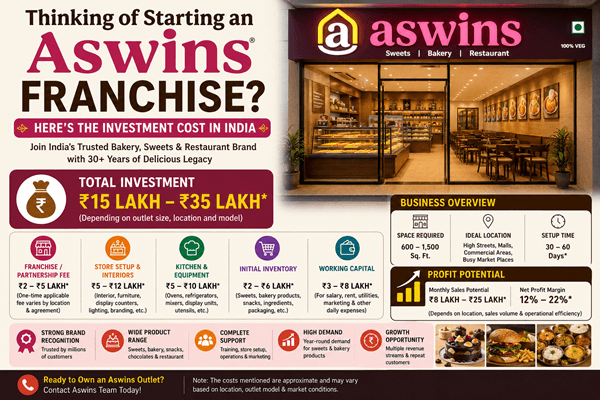
Setting up an authorized retail sweet and bakery counter spanning 600 to 1,200 square feet requires a clear understanding of practical commercial CapEx. The bulk of capital expenditure is absorbed by heavy commercial infrastructure, customer refrigeration, display fixtures, and mandatory working capital reserves rather than brand rights.
| Investment Component | Estimated Outlay (INR) | Operational Focus |
|---|---|---|
| Commercial Real Estate Deposit | ₹3,00,000 – ₹7,00,000 | Refundable security deposit (3 to 6 months’ commercial rent depending on location). |
| Store Interiors, HVAC & Facade | ₹8,00,000 – ₹14,00,000 | Civil work, acoustic/hygienic ceilings, LED lighting, HVAC, and exterior signage. |
| Refrigeration & Counter Equipment | ₹5,00,000 – ₹9,00,000 | Cold/warm display counters, commercial chillers, POS terminals, and backup power generators. |
| Initial Stock & Opening Inventory | ₹3,00,000 – ₹6,00,000 | Fast-moving packaged sweets, traditional savouries, bakery staples, and packaging consumables. |
| Liquidity Buffer (Working Capital) | ₹4,00,000 – ₹8,00,000 | Mandatory operating reserve covering staff wages, electricity, and shrinkage for 90–120 days. |
| Total Projected Outlay | ₹23,00,000 – ₹44,00,000 | Self-funded setup excluding speculative brand royalty charges. |
Operating Margins and Revenue Expectations
Operating a branded traditional sweet and savory retail outlet involves managing delicate shelf-life dynamics. Traditional ghee and milk sweets deliver healthy gross product margins often exceeding 40% to 50%, but overall net operating margins are heavily influenced by unsold return-to-vendor (RTV) allowances, shelf-life wastage, high commercial electricity tariffs from continuous air conditioning and refrigeration, and delivery aggregator commissions.
In mature, prime high-street commercial locations, steady-state monthly gross sales typically track between ₹10 lakh and ₹22 lakh. Factoring in prime real estate overheads, a well-managed retail branch generally yields sustainable net profit margins between 12% and 18%. Sustaining this margin profile requires lean inventory forecasting, strict shrinkage controls, and minimal reliance on high-commission third-party delivery channels for off-the-shelf snacks.
Official Application and Due Diligence Protocol
Prospective investors and commercial landlords should follow a strict due diligence workflow to avoid broker scams:
- Direct Corporate Channel Verification: Never transfer funds to individuals claiming to represent franchise acquisition desks. Initiate inquiries solely through Aswins Home Specials’ registered corporate headquarters in Perambalur or through official contact details listed on their primary web portal.
- Clarity on Model Terms: Request explicit written clarification on whether the proposal is a pure distributorship, a commercial lease, or a retail franchisee agreement before signing non-disclosure agreements or letters of intent.
- Statutory and Legal Verification: Retain independent legal counsel to review brand trademark permissions, lease clauses, non-compete covenants, and credit-settlement periods to protect your working capital.