Executive Overview: Understanding the Amruttulya Business Model
Unlike Western QSR models that demand substantial licensing charges and ongoing royalty cuts, Ashwini Amruttulya operates largely on a turnkey equipment and supply agreement model. The brand promotes zero recurring royalties and zero upfront brand licensing fees, recovering corporate margin through packaged kitchen equipment setup kits, specialized signage, and mandatory proprietary raw materials such as branded tea powders and spice blends.
Capital Expenditure (CapEx) & Equipment Package Breakdown
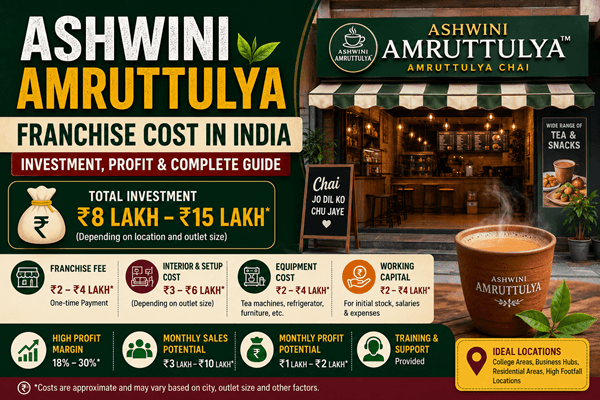
Launching an outlet typically requires a compact commercial space between 100 and 250 square feet with direct street frontage, municipal water connectivity, and three-phase drainage. The primary upfront outlay is the franchisor’s onboarding setup package, historically offered in tiered structures such as Silver, Gold, and Diamond tiers ranging from approximately ₹2.25 lakh to ₹4 lakh. These kits supply the core operational backbone, including heavy-duty brass brewing vessels (pital ganj), multi-burner gas bhattis, custom stainless steel serving counters, CNC/LED facade signage, and branded initial disposables.
Beyond the franchisor equipment package, franchise partners must fund site-specific lease deposits, basic civil finishes, tiling, plumbing, and electrical load upgrades independently. Depending on municipal lease conditions and local contracting costs, a realistic launch budget ranges from ₹4.5 lakh to ₹7.5 lakh all-inclusive.
| Investment Component | Estimated Budget (INR) | Nature of Expense & Operational Scope |
|---|---|---|
| Brand Setup & Equipment Kit | ₹2,25,000 – ₹4,00,000 | One-time package covering bhatti, brass vessels, LED display boards, counter units, uniform, and launch batch materials. |
| Commercial Premises Deposit | ₹50,000 – ₹1,50,000 | Refundable landlord security deposit for 100–250 sq. ft. roadside/junction kiosk (varies by city tier). |
| Civil, Plumbing & Electrical Setup | ₹60,000 – ₹1,20,000 | Drainage plumbing, exhaust ducting, wash counter, 15A electrical lines, POS installation, and anti-skid flooring. |
| Refrigeration & Local Appliances | ₹35,000 – ₹60,000 | Deep freezer/commercial refrigerator for milk storage, water purifier unit (RO), and CCTV system. |
| Statutory Licenses & Registrations | ₹10,000 – ₹20,000 | FSSAI food license, local municipal Gumasta / Shop & Establishment Act registration, and GST enrollment. |
| Buffer Working Capital | ₹50,000 – ₹1,00,000 | Reserve liquidity to absorb initial 60 days of retail milk supplies, daily staff wages, and municipal utility bills. |
| Total Estimated Setup CapEx | ₹4,30,000 – ₹7,50,000 | Comprehensive turn-key launch cost across semi-urban and metro retail micro-markets. |
Unit Economics, Gross Margins, and Operational Viability
Tea retail operates on rapid unit velocity rather than high bill sizes. Amruttulya tea uses a distinctive brewing technique that combines full-cream milk, crushed spices, and heavy caramelization. Because full-cream milk represents the largest recurring operational expense, fluctuating local dairy prices directly determine daily gross margins.
Essential Guide:
Ajay’s Cafe Franchise Cost in India (2026)
A standard cup sold at ₹10 to ₹15 yields an ingredient cost of roughly ₹4.50 to ₹7.00 (encompassing milk, gas, proprietary tea powder, sugar, and single-use biodegradable cups). This leaves a direct product margin of ₹5.00 to ₹8.00 per serving. Outlets that also sell packaged dry snacks, cream rolls, bhakarwadi, and water bottles see stronger average ticket values and diversified revenue streams.
| Daily Sales Volume | Est. Monthly Gross Revenue | Monthly Operating Expenses (OpEx) | Est. Net Profit (Monthly) | Net Margin Band |
|---|---|---|---|---|
| Low Footfall (350 cups/day) | ₹1,25,000 – ₹1,60,000 | Milk, ingredients, ₹20k rent, 1 helper, power/LPG (~₹1,05,000) | ₹20,000 – ₹35,000 | 16% – 22% |
| Moderate Footfall (750 cups/day) | ₹2,70,000 – ₹3,40,000 | Ingredients, ₹35k rent, 2 staff, power/LPG, miscellany (~₹2,10,000) | ₹60,000 – ₹95,000 | 22% – 28% |
| Prime Hub (1,200+ cups/day) | ₹4,50,000 – ₹5,80,000 | Bulk inventory, ₹50k rent, 3 staff, heavy LPG/utilities (~₹3,40,000) | ₹1,10,000 – ₹1,80,000 | 24% – 31% |
Investor Advisory: Third-Party Broker Scams & Due Diligence
Due to the popularity of regional tea franchises, fraudulent intermediaries frequently launch clone web pages and unverified social media profiles targeting prospective franchisees. Operators of these deceptive portals demand token evaluation fees or security deposits ranging from ₹10,000 to ₹50,000 via individual UPI IDs, falsely promising territorial exclusivity.
Legitimate franchisors never solicit application review fees into personal bank accounts. Investors should inspect the franchisor’s official registered corporate entity (such as private limited filings on the Ministry of Corporate Affairs portal), visit operational company-owned or licensed stores in person, and review the commercial master agreement with an independent legal advisor before releasing any funds.
Final Viability Assessment
At an authentic capital outlay between ₹4.5 lakh and ₹7.5 lakh, an Ashwini Amruttulya outlet offers an accessible, low-overhead entry point into India’s commercial food and beverage sector. The absence of recurring percentage-based royalties protects margin retention during slow months. However, the business model provides minimal territorial moat; operational success is governed almost entirely by street-level foot traffic density, milk cost management, and rigid daily kitchen hygiene.