Executive Summary: The Reality Behind the Cost Structure
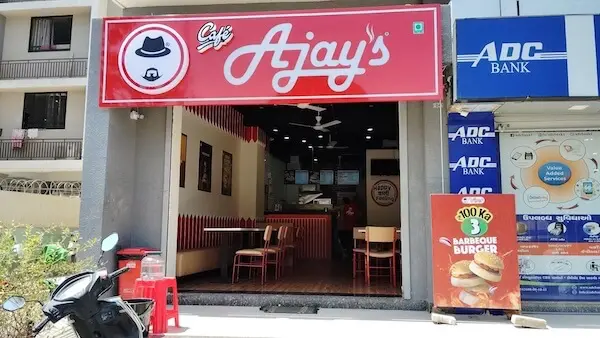
Starting an Ajay’s franchise in India requires an estimated capital expenditure ranging from ₹10 lakh to ₹18 lakh for a typical 200 to 500 square foot quick-service restaurant (QSR) outlet. Unlike full-scale casual dining chains that require heavy interior investments upwards of ₹50 lakh, Ajay’s operates primarily as a high-velocity, small-footprint fast-food brand serving cold coffee, burgers, and pizzas at accessible price points. Investors must note a critical differentiator: Ajay’s Good Food Pvt. Ltd. operates primarily on a ₹0 franchise fee and 0% recurring royalty model, making claims of multi-lakh brand onboarding fees inaccurate.
Scam Alert & Verification Notice
Due to the aggressive expansion of value QSR chains in Tier-1 and Tier-2 cities, prospective investors frequently encounter unauthorized brokers and clone websites demanding upfront “franchise approval fees,” “security deposits,” or “verification charges” between ₹50,000 and ₹5,00,000. Official onboarding for Ajay’s does not require paying upfront brand royalty or unregulated agent brokerage. Never transfer funds via UPI or personal bank accounts without verifying documentation directly with Ajay’s corporate headquarters in Surat/Navsari, Gujarat.
The Ajay’s Business Model: High Volume, Low Ticket Size
The operational philosophy of Ajay’s relies on standardized central-kitchen supply, minimal on-site preparation, and rapid table/counter turnover. Outlets are structured as either compact takeaway kiosks (150–250 sq. ft.) or fast-casual seating formats (300–500 sq. ft.). Because the brand’s core appeal rests on affordable fast food—most notably its signature cold coffee and grilled burgers—profitability is achieved through daily transaction volume rather than high gross margins per bill.
Franchisees sign standard agreements (often structured on single-year or multi-year renewable tenures) where the master franchisor supplies proprietary frozen patties, sauces, packaging, and beverage bases. This removes the need for trained chefs, drastically lowering local labor costs and ensuring consistent taste across branches.
Itemized CapEx and Setup Breakdown (2026 Estimates)
Because there is no upfront franchise fee eating into initial liquidity, capital deployment is directed almost entirely into tangible setup assets, machinery, and compliance. Store fit-outs prioritize clean, hygienic, and branded finishes rather than lavish interior decor.
Commercial equipment represents the largest capital outlay, typically absorbing ₹4.5 lakh to ₹7.5 lakh. This includes commercial under-counter freezers, deep fryers, commercial toasters, automated espresso/coffee dispensers, heavy-duty blenders, and POS billing terminals. Turnkey interior fit-outs, facade branding, menu boards, lighting, and customer counters generally cost between ₹3.5 lakh and ₹6 lakh depending on the physical condition of the leased property.
Statutory approvals—including state FSSAI registration, GST enrollment, local municipal trade licenses, and basic fire safety NOCs—cost between ₹30,000 and ₹80,000. Working capital and initial opening inventory (packaging materials, dry goods, frozen inventory, dairy tie-ups) require an additional liquid reserve of ₹1.5 lakh to ₹3.5 lakh.
Financial Comparison: Standard Formats vs. Market Estimates
| Investment Component | Compact Kiosk / Express (150–250 sq. ft.) | Standard High-Street QSR (300–500 sq. ft.) | Commercial Reality Notes |
|---|---|---|---|
| Franchise / Brand Fee | ₹0 (Zero) | ₹0 (Zero) | Beware of third-party agents quoting ₹4L–₹15L fees. |
| Store Interiors & Branding | ₹2.5 Lakh – ₹4.0 Lakh | ₹4.0 Lakh – ₹6.5 Lakh | Includes counter, flooring, signage, and minimal seating. |
| Kitchen Equipment & Tech | ₹4.0 Lakh – ₹5.5 Lakh | ₹5.5 Lakh – ₹7.5 Lakh | Fryers, refrigeration, blenders, and billing hardware. |
| Initial Stock & Packaging | ₹1.0 Lakh – ₹1.5 Lakh | ₹1.5 Lakh – ₹2.5 Lakh | Centrally supplied raw materials and branded disposables. |
| Statutory Licenses & Legal | ₹30,000 – ₹50,000 | ₹50,000 – ₹80,000 | FSSAI, GST, Trade License, Fire safety clearance. |
| Contingency & Working Capital | ₹1.5 Lakh – ₹2.0 Lakh | ₹2.5 Lakh – ₹3.5 Lakh | Covers first 60–90 days of staff pay, power, and buffer. |
| Total Estimated Outlay | ₹9.3 Lakh – ₹13.0 Lakh | ₹13.5 Lakh – ₹20.0 Lakh | Excludes refundable commercial property security deposit. |
Operating Costs, Unit Economics, and Net Margins
Monthly operational overhead for an Ajay’s outlet ranges from ₹80,000 to ₹2.2 lakh, dictated primarily by prime street rental rates and staffing requirements. A standard unit runs efficiently with 2 to 4 staff members, keeping monthly wage bills between ₹25,000 and ₹55,000. Commercial electricity consumption for continuous refrigeration and fryers averages ₹15,000 to ₹35,000 per month.
Gross food margins on core items remain competitive: beverages like cold coffee deliver strong gross margins exceeding 50% to 60%, while food products like burgers and pizzas operate closer to 35% to 45% due to centralized procurement. After factoring in store rent, payroll, power, maintenance, and delivery aggregator commissions (Zomato/Swiggy), stabilized outlets typically generate a net profit margin of 18% to 26%. On average daily gross sales of ₹10,000 to ₹25,000, monthly net take-home earnings settle between ₹55,000 and ₹1,60,000.
You Might Also Like:
How Much Does a Bidyut Bakery Franchise Cost in India? [2026]
Payback Period and Due Diligence Checklist
Under disciplined operational management and steady daily footfall, most units achieve operational break-even within 3 to 6 months and full capital payback within 12 to 18 months. However, underperforming locations burdened with high rentals (over ₹60,000 per month for small footprints) face significant margin compression.
Prospective operators should conduct pedestrian traffic counts specifically between 4:00 PM and 9:30 PM, verify local delivery aggregator density, and ensure an uninterrupted electrical load of at least 8 kW to 12 kW before executing property leases.
Frequently Asked Questions
What is the real franchise fee for Ajay’s Cafe in 2026?
Ajay’s does not charge an upfront franchise fee or monthly percentage royalty. Capital requirements go toward kitchen machinery, fit-out, opening inventory, and working capital.
How much total investment is needed to open an Ajay’s outlet?
A standard outlet costs between ₹10 lakh and ₹18 lakh in total setup CapEx, depending on square footage, location format, and civil work required.
What is the typical break-even timeline for an Ajay’s franchise?
Capital recovery generally takes 12 to 18 months in high-footfall locations with disciplined rent-to-sales ratios.