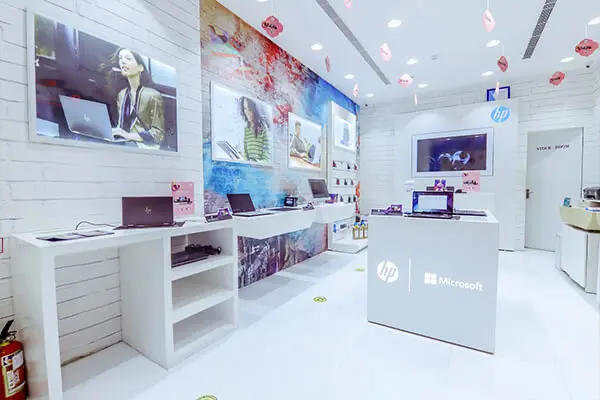
Opening an exclusive HP World showroom in India requires a total capital investment ranging between ₹45 Lakh and ₹1.2 Crore, depending on retail footprint (typically 500 to 1,200 sq. ft.) and city classification (Tier 1 metros vs. Tier 2/3 regional markets). Hewlett-Packard (HP) does not operate on a traditional royalty franchise model; instead, exclusive showrooms run on a FOFO (Franchise Owned, Franchise Operated) authorized retail partnership.
There is no non-refundable franchise fee paid to HP India. The primary capital allocation goes toward corporate-standard interior fit-outs, store security deposits, and rolling wholesale inventory procured through authorized national distribution channels such as Redington, Ingram Micro, or Savex.
⚠️ E-E-A-T Investor Alert: HP Dealership Approval Scams
Multiple fraudulent websites and fake online portals pose as “HP India Franchise Verification Portals,” soliciting ₹50,000 to ₹5,00,000 as registration or application approval fees. HP India never charges upfront franchise allotment fees through third-party websites or personal UPI accounts. Channel partner onboarding occurs exclusively through official HP commercial territory sales managers and authorized tier-1 distributors after physical location inspections.
HP World Business Model: Distributorship vs. Traditional Franchise
In standard franchising, franchisors levy non-refundable licensing fees and take monthly royalty cuts from gross turnover. In contrast, the HP World ecosystem operates through an authorized dealer network governed by partner margin structures and sales-target incentives (rebates).
Retail partners invest in commercial retail real estate, bear full operational overheads, and generate earnings strictly from wholesale-to-retail price differentials, add-on accessories, extended warranties (HP Care Packs), and volume-based quarterly backend rebates.
You Might Also Like:
Dell Exclusive Store in India: Realistic Setup Cost, Dealer Margins, and Business Verification
Realistic CapEx & Setup Cost Breakdown
The upfront expenditure of setting up an HP exclusive experience store breaks down into commercial fit-outs, security deposits, and heavy rotating working capital for high-ticket electronic inventory.
| Investment Component | Tier 2 / Tier 3 Cities (500–800 sq. ft.) | Tier 1 Metros / Prime Malls (800–1,200 sq. ft.) | Nature of Expense |
|---|---|---|---|
| Franchise / Royalty Fee | ₹0 | ₹0 | Not applicable (HP does not charge franchise fees) |
| HP / Distributor Security Deposit | ₹3,00,000 – ₹5,00,000 | ₹5,00,000 – ₹10,00,000 | Refundable / Revolving credit baseline |
| Store Fit-Out & Premium Interiors | ₹12,00,000 – ₹18,00,000 | ₹20,00,000 – ₹32,00,000 | Turnkey branding, live display bays, fixtures, anti-theft pods |
| Commercial Real Estate Deposit | ₹2,00,000 – ₹4,00,000 | ₹6,00,000 – ₹12,00,000 | 3 to 6 months lease security (location dependent) |
| Initial Rolling Hardware Inventory | ₹20,00,000 – ₹30,00,000 | ₹35,00,000 – ₹55,00,000 | Laptops, desktops, AIOs, Smart Tank/LaserJet printers |
| Reserve Working Capital (3 Months) | ₹5,00,000 – ₹8,00,000 | ₹8,00,000 – ₹15,00,000 | Staff payroll, power bills, insurance, marketing, localized B2B credit |
| Total Estimated Investment | ₹42,00,000 – ₹65,00,000 | ₹74,00,000 – ₹1,24,00,000 | Full turnkey operational budget |
Profit Margins, Product Mix & Break-Even Timeline
Electronics hardware retail requires realistic margin expectations. Mainstream consumer laptops (Pavilion, 15s series) yield narrow gross margins of 3% to 6%, while premium and gaming machines (Omnibook, Envy, Spectre, OMEN) offer 5% to 8%. Retail store profitability hinges primarily on high-margin peripheral sales rather than moving core PC units alone.
| Category | Gross Margin Range | Commercial Role in Store Economics |
|---|---|---|
| Consumer Laptops & Desktops | 3% – 7% | Drives high ticket size, store walk-ins, and target volumes |
| Printers (Smart Tank & LaserJet) | 6% – 12% | Steady household and small-office volume driver |
| OEM Inks, Toners & Consumables | 10% – 18% | Generates recurring customer lifetime purchases |
| HyperX Gaming Peripherals & Accessories | 18% – 30% | Essential margin booster (keyboards, bags, mice, adapters) |
| HP Care Packs & Extended Warranty | 25% – 40% | Pure gross margin with zero inventory holding cost |
A well-situated HP World showroom with an average monthly turnover of ₹35 Lakh to ₹60 Lakh achieves operational break-even within 6 to 9 months, recovering complete capital expenditure (ROI) across 24 to 36 months. Success requires supplementing retail footfall with local institutional supply, school/university tie-ups, and corporate small-and-medium business (SMB) billing.
Legitimate Application Procedure
To establish an authorized HP World outlet, prospective partners must bypass retail aggregator directories and engage directly through official business channels. The verified onboarding sequence entails:
First, verify commercial site feasibility. The proposed location should occupy 500 to 1,200 sq. ft. of clear carpet area on high-street retail promenades or inside prominent shopping malls, featuring at least 15 to 20 feet of front facade frontage. Second, contact HP India’s regional channel development division via the official portal (hp.com/in) or connect with regional procurement desk heads at authorized tier-1 IT distributors (such as Redington India or Ingram Micro).
Following territory viability analysis and commercial background checks, HP will provide the standard 3D retail design blueprint for authorized local build-out.