The Business Structure: Why There Is No “Dell Franchise Fee”
Investor Alert: The Fake Dell Dealership Portal Scam
A prevalent scam across India involves fraudulent websites posing as official Dell franchise onboarding portals. Cyber fraudsters create polished forms promising guaranteed territorial rights, subsidized inventory, and Dell Exclusive Store approvals upon payment of an “application processing charge” or “refundable security deposit” ranging between ₹25,000 and ₹2,00,000.
Dell India never requests registration payments via personal UPI handles, bank transfers, or unsecured web forms. All genuine retail affiliations require physical verification, trade compliance reviews (GST, PAN, shop establishment licenses), and formal dealer account creation directly facilitated by recognized regional distributors like Ingram Micro or Redington India. Verification should always be confirmed through Dell’s official domain or an established regional distributor representative prior to parting with capital.
CapEx Breakdown: Realistic Investment to Open a Dell Exclusive Store
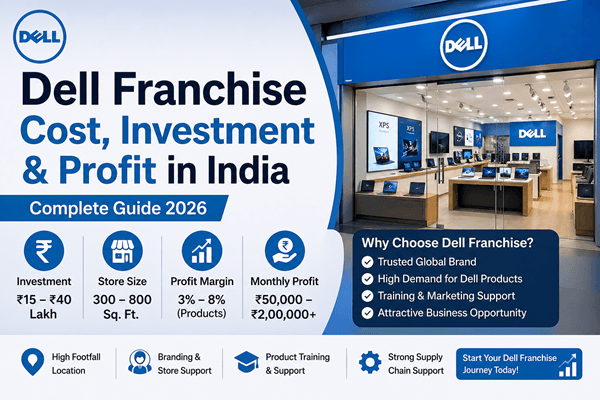
Opening a standalone Dell Exclusive Store covering 400 to 800 square feet in a viable commercial district demands between ₹25 lakh and ₹50 lakh in upfront capital. The initial outlay depends significantly on commercial rental deposits and the scale of opening stock required to maintain an active display showroom across consumer, gaming (Alienware/G-Series), and commercial (Vostro/Latitude) categories.
| Capital Expenditure Component | Tier 1 / Metro Locations | Tier 2 / Tier 3 Towns | Operational Remarks |
|---|---|---|---|
| Store Interiors & Fixtures | ₹8,00,000 – ₹12,00,000 | ₹5,00,000 – ₹8,00,000 | Standardized Dell Experience branding, security display pedestals, lighting, and air conditioning. |
| Opening Inventory (Hardware) | ₹15,00,000 – ₹25,00,000 | ₹10,00,000 – ₹16,00,000 | Demo units, core laptop lines (Inspiron, XPS, Alienware), desktop towers, and high-resolution monitors. |
| High-Margin Accessories Stock | ₹2,50,000 – ₹4,00,000 | ₹1,50,000 – ₹2,50,000 | Docking stations, mechanical keyboards, gaming mice, backpacks, power banks, and adapters. |
| Security Deposit (Real Estate) | ₹4,00,000 – ₹8,00,000 | ₹1,50,000 – ₹3,50,000 | Typically 3 to 6 months of commercial rent held by the landlord in high-street or mall locations. |
| Billing IT, Signage & Surveillance | ₹2,00,000 – ₹3,50,000 | ₹1,50,000 – ₹2,50,000 | ERP terminal, electronic article surveillance (EAS) gates, CCTV arrays, and exterior backlit acrylic signage. |
| Working Capital Reserve | ₹3,00,000 – ₹5,00,000 | ₹2,00,000 – ₹3,50,000 | Sustains operational burn, staff payroll, and utility bills during initial customer acquisition cycles. |
| Total Estimated Initial Outlay | ₹34,50,000 – ₹57,50,000 | ₹21,50,000 – ₹35,50,000 | Excludes ongoing working capital revolving lines with regional inventory distributors. |
Commercial Models: Dell Exclusive Store vs. Authorized Multi-Brand Retailer
Entrepreneurs can engage Dell through two primary distribution paths. Evaluating both formats helps match capital allocation to risk tolerance and local competition.
| Evaluation Parameter | Dell Exclusive Store (DES) | Authorized Multi-Brand Retailer |
|---|---|---|
| Primary Business Focus | 100% Dell-exclusive personal computing, gaming ecosystem, and peripheral showroom. | Multi-brand showroom (Dell, HP, Lenovo, Asus, Apple) sharing store footprint. |
| Brand Footprint & Layout | Strict compliance with global brand manuals, standardized furniture, and display plinths. | Dedicated branded bay, kiosk, or shelf space within a shared retail floor. |
| Procurement Source | Authorized National Distributors (Ingram Micro, Redington) with primary tier allocations. | Sub-distributors or regional wholesale tier-2 channel partners. |
| Marketing & Rebate Access | Direct access to OEM Sell-Out Schemes, Marketing Development Funds (MDF), and display incentives. | Limited volume-based kickbacks and regional dealer promotional price support. |
| Capital Risk Exposure | High: Performance depends entirely on Dell’s competitive pricing against other OEMs in that catchment. | Low to Moderate: Flexibility to pivot inventory toward competing brands during slow quarters. |
Realistic Industry Margins, Rebates, and Unit Economics
Hardware retail margins are notoriously thin, requiring disciplined inventory turnover rather than reliance on heavy front-end markups. Base retail margins on entry-level and mainstream consumer notebooks typically range between 3% and 6%. Premium lines, such as high-performance Alienware systems or XPS enterprise ultrabooks, command margins closer to 6% to 9%, though sales volumes on these units are inherently lower.
True retail profitability stems from back-end distributor incentives and high-margin adjunct categories. Secondary revenue drivers include:
Accessories & Peripheral Attach Rates: First-party Dell sleeves, Bluetooth headsets, docking stations, and ergonomic monitors yield profit margins between 15% and 30%. Ensuring staff cross-sell an accessory with every core computing sale is vital to maintaining healthy blended store margins.
Extended Warranties and Accidental Damage Protection: Selling Dell Premium Support or extended warranty packs delivers healthy margin contributions ranging between 18% and 25%, carrying zero physical inventory carrying cost.
Quarterly Target Rebates and Sell-Through Incentives: Meeting assigned quarterly volume targets established with Redington or Ingram Micro unlocks retroactive price-protection credits and target achievement bonuses ranging from 1.5% to 4% across overall billing volume.
Essential Reading:
Can You Own an Apple Store in India? Cost & Reality [2026]
Channel Conflicts and Retail Competitiveness
Operating a branded IT showroom comes with distinct operational pressures. The most formidable headwind is showrooming—where consumers examine display hardware in-store, only to complete their purchase on platforms like Amazon India, Flipkart, or Dell’s direct web portal during festive discount sales. Store survival requires matching regional corporate-tier pricing, providing instant data migration or operating system configuration, and pitching immediate hands-on availability.
Additionally, territorial exclusivity is not contractually guaranteed by the brand. An independent retailer operating a Dell Exclusive Store often contends with nearby national electronics chains such as Croma, Reliance Digital, and Vijay Sales, which procure hardware in bulk at aggressive enterprise tiers. A standalone DES must counter this by cultivating B2B relationships with local accounting firms, clinics, architecture bureaus, and schools for institutional supply contracts.
Application Roadmap: Establishing an Authorized Store in India
Entrepreneurs intending to set up a Dell Exclusive Store should approach onboarding pragmatically rather than attempting to bypass the supply chain hierarchy. The official route follows these steps:
1. Secure Trade Identifiers: Ensure your enterprise has an active GSTIN registration, an established current business bank account, a local Shop & Commercial Establishment license, and clean credit credentials (CIBIL commercial verification).
2. Lock in Retail Real Estate: Secure a commercial showroom measuring 400 to 800 sq. ft. on a high-street IT corridor, prominent tech bazaar (such as Nehru Place in Delhi, Lamington Road in Mumbai, or SP Road in Bengaluru), or an upscale shopping mall with guaranteed pedestrian density.
3. Engage Authorized Tier-1 Distributors: Connect with the regional commercial retail heads of Ingram Micro India or Redington India. Regional distribution managers audit the proposed location, assess geographic saturation relative to existing Dell outlets, and propose the site to Dell India’s channel sales managers.
4. Portal Registration & Credit Line Setup: Complete formal registration via Dell’s official Solution Provider or Channel Partner Portal using verified enterprise credentials. Establish a working capital revolving credit facility or bank guarantee line with your assigned distributor to manage daily inventory billing.
5. Fit-Out and Authorized Store Launch: Fit out the premises in strict alignment with current Dell Experience Center visual merchandising guidelines, establish real-time billing integration, stock mandatory SKU display clusters, and onboard trained customer floor specialists.