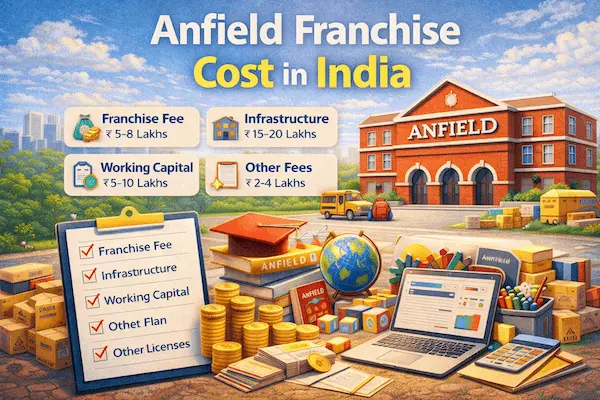
Anfield franchise cost in India in 2026 ranges between ₹18,00,000 and ₹45,00,000, depending on store size, city tier, location type, interior standards, and inventory depth. This investment includes franchise authorization, store interiors, fixtures, initial apparel stock, branding, software systems, staff training, and launch support. Anfield operates as a mid-premium fashion and lifestyle retail brand focused on contemporary clothing, accessories, and seasonal collections. Monthly operating expenses typically range ₹1.5–4.5 lakh, while average monthly revenue varies ₹6–15 lakh in well-located stores. With strong visual merchandising and steady apparel demand, most Anfield franchise outlets achieve break-even within 14–28 months, making it suitable for fashion-focused retail investors seeking scalable growth.
Anfield franchise cost in India 2026 ranges ₹18–45 lakh. Learn franchise fee, store size, interiors, inventory, monthly expenses, revenue, profit margins, ROI, and break-even timeline.
Overview of Anfield Franchise Business
Anfield is positioned as a modern fashion retail brand catering to urban and semi-urban consumers seeking affordable yet stylish apparel. The brand focuses on men’s and women’s casualwear, seasonal collections, and trend-driven designs with frequent refresh cycles. Anfield stores emphasize visual merchandising, clean layouts, and consistent branding to drive walk-in traffic and impulse purchases. The franchise model is structured to support standardized operations, centralized supply, and predictable inventory planning.
• Anfield targets mid-income consumers who prefer branded fashion at accessible price points, ensuring steady year-round demand
• The concept performs best in high-street locations, malls, and emerging retail hubs with strong youth and family footfall
Total Investment Required for Anfield Franchise
The total investment depends on store size, city category, and whether the outlet is located in a mall or on a high street. Apparel inventory and interiors form the largest cost components, as fashion retail relies heavily on presentation and stock depth.
Total investment ranges between ₹18,00,000 and ₹45,00,000, including franchise fee, interiors, fixtures, inventory, and working capital. Mall stores and metro locations typically fall on the higher end due to fit-out standards and security deposits.
Anfield Franchise Fee
The franchise fee provides the right to operate under the Anfield brand and access its product lines, merchandising systems, and operational support framework.
Franchise fee generally ranges ₹4,00,000–₹8,00,000, depending on store format and city tier. Includes brand usage rights, onboarding support, store planning assistance, and initial training for staff.
Store Formats and Space Requirement
Anfield offers standardized store formats to maintain uniform customer experience while allowing flexibility across locations.
Recommended store size ranges 600–1,200 sq.ft, depending on merchandise range and display density. Mall stores typically operate in 700–1,000 sq.ft, while high-street stores may extend beyond 1,200 sq.ft. Adequate frontage and glass visibility significantly improve walk-in conversion rates.
Interior Setup, Fixtures, and Branding Cost
Fashion retail success depends heavily on store aesthetics, lighting, and layout. Anfield mandates modern, minimalistic interiors aligned with brand guidelines.
• Interior and fixture costs range ₹6,00,000–₹15,00,000, depending on material quality and store size
• Includes racks, shelves, mannequins, lighting, trial rooms, counters, and in-store branding
• Mall locations often require higher compliance and finishing standards
Initial Inventory and Apparel Stock Cost
Inventory investment depends on category mix, size variants, and seasonal depth. Anfield follows a centralized supply and replenishment model.
Initial inventory cost ranges ₹6,00,000–₹18,00,000, depending on store size and launch collection. Includes apparel, accessories, display samples, and back-up stock. Regular refresh cycles help maintain customer interest and repeat visits.
Technology, POS, and Software Systems
Retail operations are supported by centralized billing, inventory tracking, and reporting systems.
POS and software setup costs range ₹50,000–₹1,50,000. Includes billing software, inventory management, barcode systems, and sales analytics. Centralized systems improve stock control and reduce pilferage.
Licenses, Permits, and Compliance Cost
Retail apparel stores require basic commercial registrations rather than food-related compliance.
Licensing and registration costs range ₹20,000–₹60,000, including GST, trade license, and local permits. Costs vary slightly based on state and municipal regulations. Renewal expenses are minimal after initial setup.
Location Selection and Monthly Rent
Location plays a crucial role in fashion retail performance, influencing brand visibility and sales volume.
• Monthly rent ranges ₹60,000–₹3,50,000, depending on city tier and location type
• Mall locations charge higher rent but provide consistent footfall
• High-street locations offer flexibility but rely on frontage and surrounding retail mix
Staffing Requirements and Salary Expenses
Anfield stores require trained sales associates focused on customer engagement and upselling.
Monthly salary expenses range ₹60,000–₹1,80,000, depending on store size. Typical staffing includes 2–4 sales executives and one store supervisor. Well-trained staff significantly improve conversion rates and basket value.
Utilities and Monthly Operating Expenses
Operating expenses include electricity, air conditioning, internet, and routine maintenance.
Monthly operating costs range ₹1,50,000–₹4,50,000, including rent, salaries, and utilities, Mall CAM charges may increase fixed monthly expenses. Efficient energy usage helps control long-term costs.
Marketing, Promotions, and Visual Merchandising
While Anfield benefits from brand-level promotions, local marketing boosts store visibility during launch and seasonal sales.
• Initial marketing costs range ₹50,000–₹2,00,000, including launch events and local advertising
• Ongoing promotional expenses range ₹20,000–₹60,000 per month
• Visual merchandising updates drive repeat footfall during new launches
Royalty Fees and Ongoing Charges
Royalty structures are aligned with fashion retail norms and support centralized marketing and design development.
Royalty fees typically range 5%–8% of monthly net sales. Fees cover design support, national promotions, and operational audits. Some agreements may include minimum monthly royalty commitments.
Revenue Potential of Anfield Franchise
Revenue depends on footfall, average ticket size, and merchandise mix.
Monthly revenue ranges ₹6,00,000–₹15,00,000, depending on location and seasonality. Festive and sale periods can significantly boost monthly turnover. Mall stores generally achieve more consistent sales throughout the year.
Profit Margins and Net Earnings
Apparel retail offers healthy margins when inventory is well managed.
Gross margins range 45%–60%, depending on category mix. Net monthly profit typically ranges ₹80,000–₹3,00,000 after all expenses. Effective inventory rotation improves profitability and cash flow.
Break-Even Period and ROI
Break-even timelines depend on investment size and sales performance.
• Break-even period ranges 14–28 months
• High-performing locations recover investment faster
• ROI improves as the store matures and customer loyalty increases
City-Wise Cost and Performance Variation
Costs and performance vary across city tiers.
Metro cities involve higher rent but offer strong sales potential. Tier-1 cities provide balanced cost-to-revenue ratios. Tier-2 cities suit smaller formats with controlled investment.
Risks and Challenges in Anfield Franchise
Fashion retail involves operational and market risks.
Unsold inventory and seasonal fashion shifts can impact margins. High fixed costs increase dependence on consistent footfall. Staff training and retention are critical for customer experience.
Key Success Factors for Franchise Owners
Operational discipline and local market understanding drive success.
Effective visual merchandising and window displays attract walk-ins. Active participation in seasonal promotions boosts sales. Strong customer service improves repeat purchase rates.
Ideal Franchisee Profile
This franchise suits investors with retail interest and moderate capital.
Entrepreneurs with ₹20 lakh+ investment capacity. Experience in retail or fashion preferred but not mandatory. Owners willing to monitor inventory and daily operations.
Is Anfield Franchise Worth It in 2026?
Anfield presents a balanced fashion franchise opportunity in 2026.
Moderate investment with scalable growth potential. Suitable for single-store and multi-store expansion. Best suited for urban and emerging retail markets.
Summary Table about Anfield Franchise Cost
| Cost Component | Estimated Cost (2026) |
|---|---|
| Franchise Fee | ₹4–₹8 lakh |
| Interiors & Fixtures | ₹6–₹15 lakh |
| Initial Inventory | ₹6–₹18 lakh |
| Technology & POS | ₹0.5–₹1.5 lakh |
| Monthly Operating Cost | ₹1.5–₹4.5 lakh |
| Total Investment | ₹18–₹45 lakh |