The Traditional Franchise Fallacy: Understanding the Haier Business Model
Critical Scam Advisory: Fraudulent Dealership Portals
A prevalent cyber scam targets entrepreneurs searching for consumer electronics dealerships. Fraudulent websites mimicking official corporate portals prompt users to submit online application forms and transfer upfront “registration fees” (ranging between ₹15,000 and ₹50,000) or immediate “allotment deposits” via UPI or personal accounts.
Verification Protocol: Haier India never charges an application fee or an initial onboarding charge to evaluate commercial profiles. Dealership appointments occur entirely through physical territory inspections by regional branch managers, corporate background checks, and official RTGS/NEFT payments made strictly to bank accounts registered under Haier Appliances India Pvt. Ltd. Always verify opportunities directly via the verified corporate office in Greater Noida or regional sales depots before transferring capital.
Realistic CapEx Breakdown for a Haier Exclusive Store
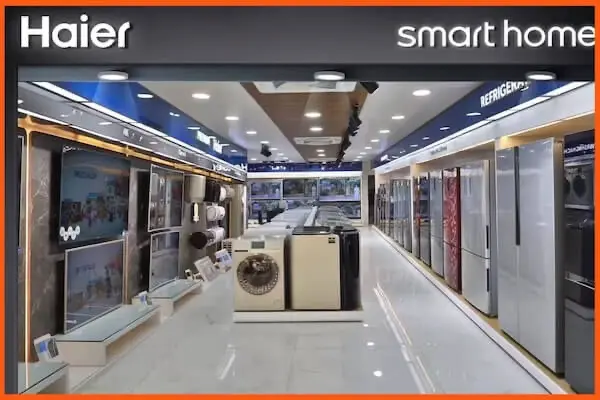
Launching a dedicated Haier Exclusive Experience Store requires substantial upfront capital. Prime high-street or commercial mall locations are mandatory, requiring a minimum carpet area of 800 to 1,500 square feet with prominent frontage.
Unlike standard electronics counters, an exclusive store must adhere strictly to Haier’s visual merchandising norms, involving custom modular fixtures, specialized demo islands for smart appliances, illuminated corporate fascia, and central climate control.
The total capital expenditure generally ranges from ₹30 Lakh to ₹65 Lakh, contingent on the city tier and lease mechanics. Store fit-outs and branded interior infrastructure typically consume ₹1,200 to ₹1,800 per square foot. Furthermore, commercial landlords in Tier 1 cities (such as Delhi NCR, Mumbai, or Bengaluru) standardly mandate three to six months of rental deposit upfront.
The remaining liquidity must be reserved for the initial inventory replenishment cycle across high-ticket categories: side-by-side refrigerators, front-load washing machines, commercial display units, and inverter air conditioners.
Estimated Investment Overview Across Operating Formats
| Operating Format | Carpet Area Required | Store Setup & Interior CapEx | Refundable Security Deposit | Initial Working Capital / Inventory | Total Estimated Outlay |
|---|---|---|---|---|---|
| Authorized Dealer Counter (Multi-Brand Shop-in-Shop) | 200 – 400 sq. ft. (Dedicated Bay) | ₹1.5 Lakh – ₹3 Lakh | ₹2 Lakh – ₹5 Lakh | ₹8 Lakh – ₹12 Lakh | ₹11.5 Lakh – ₹20 Lakh |
| Exclusive Haier Brand Store | 800 – 1,500 sq. ft. | ₹10 Lakh – ₹18 Lakh | ₹5 Lakh – ₹10 Lakh | ₹15 Lakh – ₹35 Lakh | ₹30 Lakh – ₹63 Lakh |
| District Wholesale Distributor | 1,200 – 2,500 sq. ft. (Warehouse) | ₹3 Lakh – ₹6 Lakh (Racking & Office) | ₹10 Lakh – ₹20 Lakh | ₹40 Lakh – ₹75 Lakh | ₹53 Lakh – ₹1 Crore+ |
Gross Margins, Incentive Schemes, and Return on Investment (ROI)
Operating margins in consumer durables reflect unit economics rather than fast-moving consumer goods (FMCG) volume models. For standard white goods (refrigerators, semi-automatic washing machines), core dealer margins typically sit between 7% and 11% on dealer price (DP). Premium smart appliances, OLED televisions, and direct-inverter split ACs yield higher gross margins of 12% to 15%.
However, gross product margins do not represent the entire earning potential. In this segment, net profitability relies heavily on secondary backend incentives, including monthly turnover target rebates, seasonal festival schemes (such as Diwali sales targets), early payment discounts (cash discounts of 1% to 2% for upfront clearance), and local co-op marketing subsidies from the brand.
After accounting for commercial rent, staff salaries, electricity consumption for live product displays, and transit breakage, a well-managed exclusive outlet operates at an average net margin of 3.5% to 5.5%, yielding a capital payback period of 2.5 to 4 years.
Also Worth Reading:
Bajaj Electronics Franchise Cost in India [2026]
Comparative Analysis: Haier vs. Major Electronics Brand Setups
| Brand / Network | Average Outlay (Exclusive Setup) | Base Dealer Margins | Working Capital Velocity | Primary Market Strength |
|---|---|---|---|---|
| Haier India | ₹30 Lakh – ₹65 Lakh | 7% – 14% | Medium to Fast (High cooling & laundry pull) | Competitive pricing, bottom-mount refrigerators, commercial deep freezers |
| LG Electronics India | ₹45 Lakh – ₹85 Lakh | 6% – 11% | Fast (Mass brand loyalty & consumer trust) | Dominant pan-India market share across washing machines and refrigerators |
| Samsung Smart Plaza | ₹50 Lakh – ₹90 Lakh | 6% – 12% | Fast to High (Ecosystem pull) | Cross-selling consumer durables alongside premium smartphones and panels |
| Daikin / Voltas (Cooling Focus) | ₹25 Lakh – ₹45 Lakh | 8% – 15% | Seasonal (Heavy Q1/Q2 peaks, slower off-season) | Commercial air conditioning and residential inverter systems |
Official Verification and Application Workflow
Securing an authorized dealership requires standard corporate evaluation. Investors must bypass third-party agents and execute the onboarding process through established trade channels:
The engagement initiates by submitting a trade inquiry through Haier India’s official corporate channel or by visiting the respective state or regional corporate branch. The regional sales manager (RSM) or area sales manager (ASM) will evaluate your commercial location to confirm that your trade area does not overlap destructively with an existing authorized partner.
Once the site feasibility and credit appraisal succeed, the company generates an official vendor code, issues trade agreements, and completes GST-compliant onboarding.