Starting an Arwa Chawal (rice distribution) franchise in India in 2026 generally requires a cost of around ₹4 lakh to ₹12 lakh investment depending on stock volume, delivery setup, and city size. This is mainly a wholesale or dealership model, so the space requirement is about 200 to 700 sq ft for storage and dispatch.
The company supplies packaged rice varieties and branding support. With steady retailer orders, most dealers aim for break-even within 6 to 14 months. Arwa Chawal franchise cost in India 2026 ranges ₹4–12 lakh with 200–700 sq ft space requirement and expected break-even around 6–14 months.
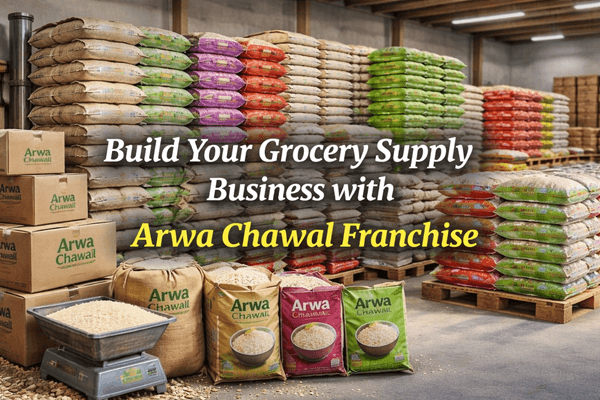
About Arwa Chawal Business
Rice is a daily necessity in most Indian households, making the food grain distribution sector stable throughout the year. Arwa Chawal dealerships typically supply packaged rice to grocery stores, hotels, and small retailers rather than selling directly to consumers. Because demand never stops, repeat orders form the backbone of this business.
Total Investment Breakdown
The overall investment mainly includes security deposit, storage racks, weighing scale, and initial rice stock purchase. Delivery arrangements such as a small vehicle or transport tie-up also add to the startup cost. Since packaging and branding are already provided by the company, setup complexity remains simple compared to retail stores.
Arwa Chawal Franchise Cost in India
Arwa Chawal is typically operated as a rice dealership or distributorship rather than a traditional retail franchise. The business focuses on supplying packaged rice varieties such as basmati, steam rice, and daily-use grains to kirana stores, wholesalers, hotels, and local markets. Since rice is a daily-consumption product in India, demand remains steady throughout the year, making it a stable distribution-type business instead of a walk-in retail shop model.
In 2026, the Arwa Chawal franchise or dealership cost in India generally ranges from ₹7 lakh to ₹30 lakh depending on storage capacity and distribution area. The company usually does not charge a heavy franchise fee; most of the investment goes into stock purchase and logistics setup.
Major expenses include security deposit or company agreement amount, warehouse/godown setup, initial rice inventory in multiple grades, loading equipment, and delivery vehicle. A storage space of around 400 to 1,500 sq ft is commonly required to maintain stock rotation and bulk supply.
Rice distribution works on volume sales, so margins are moderate at 5% to 12% per bag but consistent. With regular retailer orders, many distributors achieve break-even within 12 to 24 months, making it a steady cash-flow wholesale business suitable for traders and logistics-focused investors.
Space Requirement and Location
The space requirement ranges from 200 sq ft for small distribution points to around 700 sq ft for higher stock capacity. Ground-floor godown space with easy loading access works best. Being near grocery markets reduces transportation time and increases retailer connections.
Profit Margin and Earnings
The business operates on steady wholesale commission giving moderate profit margin per bag but consistent volume. Supplying restaurants and bulk buyers improves monthly earnings significantly.
Support from Company
Dealers receive product supply, brand recognition, and packaging standards. Because the product is essential, marketing effort is minimal compared to consumer retail businesses.
Eligibility and Documents
Basic eligibility includes managing stock and delivery coordination. Required documents generally include identity proof, address proof, GST registration, business registration, and local trade license.
Monthly Expenses
Regular costs include rent, helper wages, transport charges, and restocking inventory. Efficient delivery planning keeps operating expenses controlled.
Challenges to Consider
Price fluctuations in grain market and competition from local suppliers can affect margins. Maintaining timely delivery and quality storage helps retain retailers.
Long-Term Business Value
Food grain distribution is considered a stable trade because consumption is continuous. Many dealers expand routes and supply additional grocery items over time.
FAQ about Arwa Chawal Franchise India
Q. Is this a retail shop business?
A. No, it usually works as a distribution or wholesale supply model.
Q. Do I need a vehicle?
A. A delivery vehicle or transport tie-up helps manage regular retailer orders.
Q. How much monthly profit can I earn?
A. Many dealers aim for ₹25,000 to ₹80,000 monthly profit depending on supply volume.
Q. Is demand seasonal?
A. Rice demand remains consistent throughout the year.
Q. Can I expand later?
A. Yes, many dealers add more grocery products once the network grows.