In 2026 in India, the cost of starting a Delhivery franchise (logistics and courier delivery partner) varies widely depending on the type of franchise model you choose and the scale of operations. For simpler pickup/drop-point outlets, investment starts from around ₹50,000 – ₹2,00,000, which usually covers the franchise/onboarding fee, basic setup, and licensing for a small space (200–500 sq ft).
For a more operational delivery franchise or delivery centre, the total estimated investment generally falls between ₹4,50,000 and ₹10,00,000, including franchise fee, office setup, IT systems, initial working capital, and potentially vehicles if you operate deliveries yourself.
Delhivery’s own official franchise partner program highlights that prospective partners can register through their website and typically require a franchise/security deposit and space of 200 – 800 sq ft depending on the model. Smaller franchise models (like local drop-points) remain the most affordable entry point, while delivery centres and hubs that handle higher parcel volumes and larger territories require proportionately higher investment and setup effort.
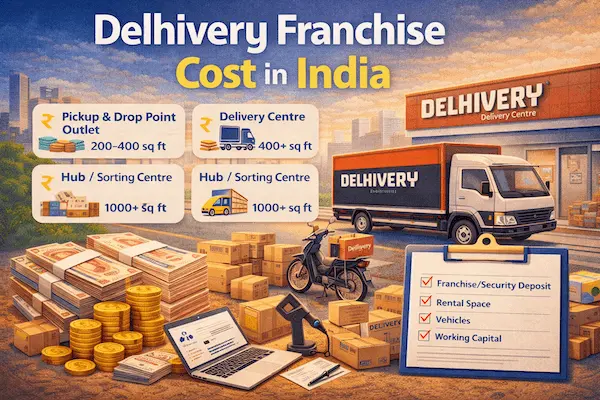
Key Investment Components for Delhivery Franchise Cost in India in 2026
The Delhivery franchise investment in India includes a refundable franchise/security deposit ranging from ₹50,000 to ₹3 lakhs, depending on the franchise model and city category. A major cost component is infrastructure, which includes renting or securing a space—typically 400 sq. ft. or more for larger delivery centers—along with expenses for IT equipment such as laptops, barcode scanners, printers, internet setup, and basic office furniture.
For delivery-center models, vehicles form the most significant additional investment, with costs for two-wheelers or mini-trucks often totaling ₹5 lakh to ₹10 lakh or more, especially if you manage multiple routes. Finally, sufficient working capital is required to cover early-stage operating expenses such as staff salaries, fuel, utilities, maintenance, packaging materials, and day-to-day logistics needs until the franchise achieves stable parcel volume and cash flow.
Franchise Types & Cost for Delhivery Franchise Cost in India in 2026
1. Pickup & Drop Point Outlet
The Pickup & Drop Point Outlet is the most affordable way to operate within the Delhivery network. In this model, the outlet primarily functions as a neighborhood parcel collection and pickup center, where customers can book shipments, drop off packages, and collect incoming parcels.
The estimated investment for this setup is approximately ₹50,000 to ₹2,00,000, depending on the location, shop size, and local operating costs. This investment generally covers the security deposit or onboarding fee (where applicable), a basic retail outlet of around 200–400 square feet, interior branding and signage, a computer or POS system, essential consumables, and initial local marketing activities.
2. Delivery Centre / Last-Mile Delivery Partner
The Delivery Centre or Last-Mile Delivery Partner model requires a larger investment because it involves managing parcel sorting, dispatch operations, and deliveries within a designated service area. This format is suitable for entrepreneurs who want to handle day-to-day logistics operations rather than simply serving as a collection point.
The estimated investment typically ranges from ₹4,50,000 to ₹10,00,000, depending on the size of the facility and the volume of shipments. The budget generally includes a security deposit or onboarding costs, a facility of approximately 400 square feet or more, storage racks, computers, barcode scanners, internet connectivity, packaging materials, employee salaries, and sufficient working capital to support operations during the initial months.
3. Hub / Sorting & Distribution Centre
The Hub or Sorting & Distribution Centre is the largest operational model and is generally intended for experienced logistics operators capable of handling high shipment volumes across multiple delivery routes. These facilities act as regional distribution hubs where parcels are received, sorted, and dispatched to various delivery centers.
The estimated investment usually starts at around ₹10,00,000 and can exceed ₹17,00,000, depending on warehouse size, automation, fleet requirements, and daily shipment capacity. This investment typically covers a large warehouse or industrial space, material handling equipment, sorting infrastructure, computers and shipment-tracking systems, delivery vehicles or fleet support, employee recruitment, and substantial working capital required to efficiently manage large-scale logistics operations.
How to Apply for a Delhivery Franchise in India in 2026?
To apply for a Delhivery franchise in India in 2026, start by visiting Delhivery’s official website and navigating to the Franchise or Partner With Us section, where you’ll find the online franchise application form. On the form, you’ll need to enter your basic details such as name, contact information, preferred location, investment capacity, and any relevant business experience, then submit it for review.
Delhivery’s franchise team will review your application, and if your profile matches their eligibility criteria, they typically contact you for further discussions, interviews, and evaluation of your proposed location and business plan.
What is the earning potential of Delhivery Franchise in India?
Most Delhivery franchise partners report net profit margins in the range of about 15% to 30% after expenses, with smaller or entry-level pickup/drop-point outlets typically closer to the lower end and well-optimized larger delivery centres or hubs achieving higher margins as parcel volumes increase.
According to industry estimates and franchise opportunity analyses, monthly earnings can range from around ₹25,000–₹45,000 for small pickup counters, ₹50,000–₹85,000+ for medium delivery centres, and potentially ₹80,000–₹1,20,000+ (or more) for high-volume hubs in busy metropolitan areas, depending on how effectively the operation is run.
Some franchise data sources also suggest that annual return on investment can materialize within 6–24 months if the business scales and parcel demand is strong.
Typical Eligibility Requirements and Document Checklist
Here’s a concise typical eligibility requirements and document checklist for applying for a Delhivery franchise in India (2026) based on official guidance and industry practice:
Eligibility Requirements:
You must be a legally adult individual or a registered business entity willing to operate in the logistics/courier segment and commit to Delhivery’s operational standards and brand guidelines. Basic familiarity with business operations, logistics, or retail helps, and having access to sufficient investment funds to cover the franchise fee, infrastructure, and working capital is essential.
You should also have or be able to secure a commercial space (typically 200–500+ sq ft depending on model) and staff to manage parcel handling and delivery operations in your chosen territory.
Required Documents Checklist:
You’ll generally need valid identity proof (like PAN Card and Aadhaar Card) and address proof for yourself or your business, business registration / GST registration documents, and bank statements or financial statements showing your ability to fund the investment. For proof of business premise, you’ll need property ownership documents or a commercial lease agreement.
Additional paperwork often includes a NOC from property owner (if leased), a trade license or any required local permits, and sometimes references or a brief business plan outlining your proposed location and operational readiness.
Find here more such franchise opportunities:
Amazon Delivery Franchise Cost in India [2026]
AFX Logistics Franchise Cost in India [2026]