Understanding the Model: Why It Is Not a Traditional Franchise
Prospective logistics business owners often fall into the misconception of buying an “Amazon franchise.” Under traditional business-format franchising, a franchisee purchases brand rights, pays upfront royalty fees, and resells goods or services directly to walk-in consumers. In contrast, Amazon’s logistics ecosystem operates strictly under service agreement contracts: primarily the Amazon Delivery Service Partner (DSP) model for dedicated fleet operations, alongside smaller micro-logistics models such as the I Have Space (IHS) pickup-store program.
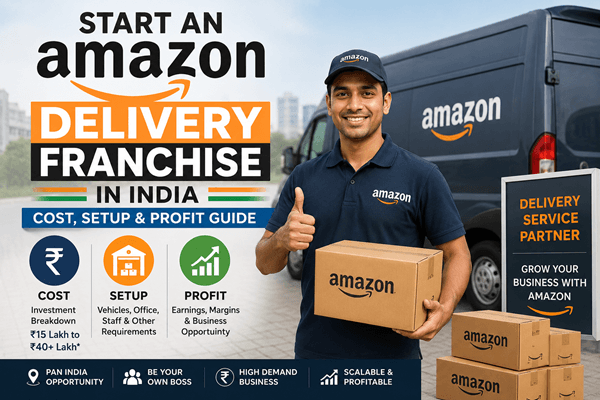
As an authorized Delivery Service Partner, you run an independent logistics corporation. Amazon supplies the daily package volumes, specialized routing software, sorting stations, and driver onboarding blueprints. Your legal entity handles human resources, vehicle leasing or acquisition, regulatory compliances (such as ESIC and PF for drivers), local administrative facilities, and operational performance metrics.
Realistic CapEx and Working Capital Breakdown (2026 Estimates)
The total capital needed to launch an Amazon DSP business in India depends on fleet composition—specifically whether you lease internal combustion commercial vans, deploy electric 3-wheelers (L5M category), or utilize a mixed associate model. Rather than paying money directly to Amazon, your entire capital outlay goes into infrastructure, fleet commitments, and liquid cash flow buffers.
Industry standards indicate that partners require a minimum liquid reserve to sustain two full months of payroll, fuel, and lease obligations before Amazon’s bi-weekly or monthly freight settlement cycles balance out operational expenses.
| Expense Category | Tier-2 / Tier-3 Hub (5–10 Vehicles) | Metro / Tier-1 Hub (15–25 Vehicles) | Nature of Expense |
|---|---|---|---|
| Amazon Franchise / Onboarding Fee | ₹0 | ₹0 | Nil (Amazon charges no franchise fee) |
| Commercial Hub Setup (Deposit & Interior) | ₹1,50,000 – ₹2,50,000 | ₹3,50,000 – ₹6,00,000 | Lease advance, CCTV, tables, racks, power backup |
| Fleet Down Payment / Initial Lease Buffer | ₹4,00,000 – ₹7,00,000 | ₹9,00,000 – ₹15,00,000 | Down payment or upfront commercial lease collateral |
| IT & Handheld Hardware (Scanners, Mobiles) | ₹80,000 – ₹1,50,000 | ₹2,00,000 – ₹3,50,000 | GPS units, rugged smartphones, barcode devices |
| Legal Setup, Insurance & Uniforms | ₹70,000 – ₹1,20,000 | ₹1,50,000 – ₹2,50,000 | Pvt Ltd incorporation, transit & vehicle insurance |
| Working Capital Reserve (60 Days Payroll & Fuel) | ₹6,00,000 – ₹9,00,000 | ₹12,00,000 – ₹18,00,000 | Salaries, fuel/charging, contingency, tyre maintenance |
| Total Estimated Capital Outlay | ₹13,00,000 – ₹21,20,000 | ₹28,00,000 – ₹45,00,000 | Self-managed operations budget |
Revenue Model, Operating Margins, and Breakeven Timelines
Amazon structures DSP compensation using a hybrid formula: a baseline fixed service fee per active scheduled route combined with a variable rate per successfully delivered parcel. Added performance incentives apply when delivery associates maintain high customer satisfaction scores, low package rejection percentages, and consistent on-time delivery rates.
Gross payouts vary between ₹3,00,000 and ₹18,00,000 per month depending on package volumes. However, net margins in contract logistics are typically thin, running between 6% and 14%. Net monthly profits for a well-managed hub running 12 to 18 active routes generally range from ₹75,000 to ₹2,50,000 after deducting fuel bills, vehicle depreciation, staff attrition replacement costs, and driver salaries. Operations reaching peak dispatch efficiency during festive quarters (such as the Great Indian Festival) frequently achieve complete payback on initial setup CapEx within 8 to 14 months.
Comparison: Amazon DSP Fleet vs. “I Have Space” (IHS) Program
Entrepreneurs evaluating an Amazon delivery partnership must distinguish between fleet-scale operations and micro-retail opportunities. The capital and operational requirements differ substantially.
| Parameter | Amazon Delivery Service Partner (DSP) | Amazon “I Have Space” (IHS) |
|---|---|---|
| Business Objective | Full-scale third-party logistics company management | Hyperlocal last-mile delivery using existing retail stores |
| Typical Capital Needed | ₹15 Lakh – ₹45 Lakh | Under ₹20,000 (Uses existing counter space) |
| Fleet Requirement | 5 to 25+ commercial vans / 3-wheelers | None (Deliveries made on foot or personal two-wheeler) |
| Operating Radius | Designated pin codes (10–30 km cluster) | Immediate neighbourhood (2–4 km walking radius) |
| Target Entrepreneur | Logistics operators, fleet managers, transport firms | Kirana store owners, stationary shops, local retail outlets |
Logistics Fraud Alert: How to Identify Fake Amazon Franchise Portals
Due to high search volumes around “Amazon Franchise Cost in India,” fraudulent networks frequently run fake websites claiming to offer “Amazon Dealerships,” “Amazon Delivery Hub Allotments,” or “Courier Franchises.” These scammers issue forged approval certificates bearing Amazon logos and demand registration deposits ranging from ₹25,000 to ₹2,00,000 into private bank accounts.
Key Rules for Verification: Amazon India never charges an application processing fee, approval charge, or security deposit via personal UPI IDs or unrelated bank accounts. All legitimate registrations are routed strictly through official subdomains. If an agency demands an upfront payment to guarantee territory allotment, it is an illegal scam.
Official Application & Eligibility Criteria
Securing a spot in the Amazon DSP network involves an extensive background and financial capability assessment. Applicants must satisfy several key conditions before invitation:
Candidates must hold an incorporated Indian commercial entity (Private Limited, LLP, or registered Partnership) with a clear GST registration and valid MSME/Udyam certificates. Amazon prioritizes founders who display direct experience hiring and leading teams of 15 or more field employees, managing fleet assets, and maintaining regulatory compliance with EPF, ESIC, and labor directives. Applications must be completed online via the official Amazon Logistics portal; approved candidates then undergo structured background checks and logistical immersion before route assignment.
In Case You Missed It:
AJIO Franchise Cost in India (2026)
Frequently Asked Questions
Does Amazon charge a franchise fee for delivery operations in India?
No. Amazon does not collect any franchise fee or recurring royalty. The startup cost consists entirely of independent business setup expenses, fleet down payments, technology equipment, insurance policies, and operational working capital.
Can I start an Amazon DSP business with two-wheelers only?
Standard Amazon DSP hubs are built around commercial 3-wheelers and 4-wheel vans to handle parcel dimensions safely. Two-wheeler logistics are generally reserved for Amazon Flex independent gig contractors or micro-delivery models rather than standard dedicated DSP fleet owners.
How much net profit can an Amazon delivery partner expect monthly?
A typical Amazon DSP operating 10 to 15 active daily routes can generate between ₹75,000 and ₹2,20,000 in monthly net profit, representing an industry-standard 6% to 14% net operating margin after all vehicle, driver, and facility expenses are settled.