The Business Reality: Retail Parlour vs. Distributorship
Aspiring business owners evaluating a Dinshaw’s ice cream opportunity in 2026 must first navigate a common industry misconception: Dinshaw’s Dairy Foods operates primarily through a traditional FMCG distribution and authorized retail dealer model rather than a standard corporate franchise with upfront royalty structures.
In the Indian cold-chain ecosystem, generic business blogs frequently list a flat “franchise fee” of ₹2 lakh to ₹5 lakh. In practice, genuine FMCG brands like Dinshaw’s generally do not charge non-refundable brand licensing fees; instead, they require refundable security deposits, working capital commitments, and authorised retail infrastructure.
Entrepreneurs can partner with Dinshaw’s through two primary avenues: an Exclusive Brand Outlet (EBO / Ice Cream Parlour) or a regional wholesale distributorship. A retail parlour operates as a customer-facing shop focusing on scoop sales, sundaes, packaged tubs, and impulse novelty sticks, where earnings stem from retail margins. Conversely, a wholesale distributorship is a B2B logistics model requiring multi-point cold storage infrastructure, commercial deep freezers, and delivery vehicles to service local grocery stores, supermarkets, and catering vendors across an allocated territory.
Scam Alert: How to Avoid Fraudulent Franchise Portals
Due to the enduring reputation of heritage brands like Dinshaw’s, cyber syndicates frequently set up fraudulent domain names mimicking corporate registration portals. These lookalike websites claim to offer instant “Dinshaw Franchise Allotments” and demand immediate advance payments of ₹25,000 to ₹1,50,000 under headings such as “NOC charges,” “agreement booking fees,” or “site inspection clearance.”
Neither Dinshaw’s Dairy Foods nor any authentic Indian dairy conglomerate issues dealership licenses via WhatsApp or requests payment into personal savings bank accounts. Commercial partnerships are vetted by local territory sales managers (TSMs) and company sales depots. Entrepreneurs must submit trade inquiries exclusively through the verified company domain or engage directly with regional distribution depots. Never transfer funds to third-party consulting websites or unverified UPI handles claiming priority onboarding.
Realistic CapEx Breakdown for 2026 (Kiosk vs. Exclusive Parlour)
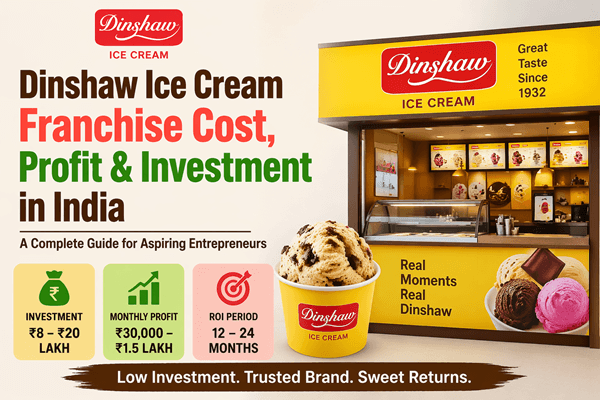
Opening an authorized Dinshaw’s ice cream retail counter requires a calibrated capital outlay focused predominantly on cold-chain hardware, commercial lease deposits, and shop branding. A compact mall kiosk or high-street counter (100 to 150 sq. ft.) requires between ₹4.5 lakh and ₹8.5 lakh in total initial investment, depending on city tier and equipment specifications. Expanding to a standalone ice cream parlour with customer seating (300 to 500 sq. ft.) typically scales the overall project cost between ₹10 lakh and ₹17.5 lakh.
Unlike dry retail businesses, ice cream operations demand heavy electrical infrastructure and uninterrupted cooling backbones. Commercial hard-top freezers, curved glass display dipping counters, commercial air conditioning, back-up generators or high-capacity inverter setups, and company-specified illuminated signage account for the bulk of physical setup expenses.
| Capital Expenditure Component | Kiosk / Compact Counter (100–150 sq. ft.) | Exclusive Parlour / Lounge (300–500 sq. ft.) |
|---|---|---|
| Security Deposit (Brand / Distributor) | ₹50,000 – ₹1,00,000 (Refundable) | ₹1,00,000 – ₹2,00,000 (Refundable) |
| Refrigeration & Equipment | ₹1,50,000 – ₹2,50,000 | ₹3,50,000 – ₹5,50,000 |
| Store Interiors, Fixtures & Signage | ₹1,00,000 – ₹2,00,000 | ₹2,50,000 – ₹4,50,000 |
| Commercial Lease Security Deposit | ₹50,000 – ₹1,50,000 | ₹1,50,000 – ₹4,00,000 |
| Opening Inventory & Working Capital | ₹1,00,000 – ₹1,50,000 | ₹1,50,000 – ₹2,50,000 |
| Estimated Total CapEx | ₹4,50,000 – ₹8,50,000 | ₹10,00,000 – ₹17,50,000 |
Monthly Operating Expenses and Cold-Chain Overhead
Operational sustainability in frozen desserts hinges heavily on utility containment. Deep freezers, dipping cabinets, and ambient room air conditioning run around the clock to preserve product texture and prevent ice crystallisation or thermal shock.
Commercial electricity bills for an active parlour run between ₹15,000 and ₹35,000 per month, varying according to state electricity board industrial tariffs and generator fuel usage during power disruptions.
Commercial rent varies sharply by geography, consuming anywhere from ₹25,000 per month for neighbourhood high-street counters in Tier-2 cities up to ₹90,000 or more in high-footfall metro retail zones. Staffing generally requires two to three attendants for scoop operations, cashier duties, and sanitisation, representing an aggregate monthly payroll of ₹25,000 to ₹45,000. Incorporating local marketing, maintenance, and stock transit, total monthly operating overhead generally averages between ₹75,000 and ₹1,80,000.
Related Franchise Audits:
About Amul Ice Cream Franchise Cost in India
Realistic Profit Margins, Seasonality, and ROI Timeline
Ice cream margins differ based on product classification. Pre-packaged standard impulse units (cones, cups, candies) deliver gross retail margins between 18% and 22%, whereas bulk scoop cabinets, value-added sundaes, thick shakes, and ice cream sodas yield gross margins between 45% and 55%. For a balanced retail mix consisting of both impulse sales and parlour desserts, an operator typically captures an average gross margin of 28% to 35%.
After accounting for fixed overhead, an outlet achieving monthly gross billings of ₹2.5 lakh to ₹5.5 lakh nets an operational profit of ₹35,000 to ₹90,000 per month. Under healthy sales volume, this yields a capital recovery period of 14 to 22 months.
However, business models must factor in severe seasonality. In northern and central Indian markets, summer quarters (March through June) generate over 50% to 60% of annual turnover, while winter months see significant drops in footfall. Outlets must accumulate surplus cash flow during peak seasons to offset ongoing utility, wage, and rental commitments during cold or monsoon lulls.
Editorial Verdict: Is Dinshaw’s the Right Choice in 2026?
A Dinshaw’s exclusive parlour or dealership represents a viable, lower-risk venture for entrepreneurs who already possess high-visibility retail space or established regional cold-chain capabilities. The absence of royalties provides a distinct financial edge over fast-casual Western dessert franchises. Nonetheless, success is strictly local: securing a sustainable lease, preventing temperature fluctuations during supply handovers, and surviving off-peak winter lulls determine whether the outlet delivers steady cash flow or becomes an operational burden.