Executive Summary: Baap of Rolls Franchise Overview
Unlike vague industry speculations, the brand operates primarily on a FOFO (Franchise-Owned, Franchise-Operated) business model that charges a one-time brand licensing franchise fee of ₹7,00,000 plus 18% GST (totaling ₹8,26,000).
While competitive roll brands often levy steep 4% to 8% ongoing monthly royalty cuts on gross sales, Baap of Rolls frequently utilizes a zero-royalty structure in specific regional expansions, relying instead on central supply chain margins for proprietary marinades, spices, and paratha bases.
For prospective franchise partners, understanding the precise split between non-negotiable brand fees, kitchen fit-outs, and early working capital is critical to avoiding mid-launch liquidity issues.
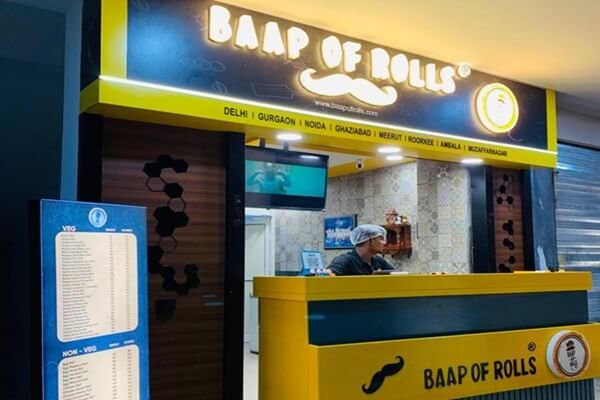
Complete Capital Expenditure (CapEx) Breakdown
A turnkey QSR counter typically requires between 250 and 500 square feet of usable commercial floor area. Because kitchen utility requirements for rolls and shawarmas demand heavy-gauge exhaust hoods, commercial gas banks, and cold-table prep stations, setup expenses fall into distinct operational buckets rather than general estimates.
| Investment Component | Estimated Outlay (INR) | Scope & Deliverables |
|---|---|---|
| Franchise Licensing Fee | ₹8,26,000 | Includes 18% GST (Base ₹7.00L), trademark rights, operational SOPs, initial staff training, and master recipes. |
| Kitchen Equipment & Appliances | ₹3,50,000 – ₹4,50,000 | Commercial tawa, deep fryers, shawarma rotisseries, deep freezers, prep counters, exhaust system, and fire safety gear. |
| Interior Fit-Out & Front Facade | ₹2,50,000 – ₹3,50,000 | Aesthetic customer front, counter tiling, menu displays, signage boards, architectural branding, and ambient lighting. |
| Technology, POS & Surveillance | ₹50,000 – ₹75,000 | Cloud billing system, thermal receipt printers, network routers, and high-definition CCTV security apparatus. |
| Initial Stock & Packaging Inventory | ₹1,00,000 – ₹1,50,000 | Proprietary spice blends, frozen items, printed food-grade butter paper, carry boxes, and branded containers. |
| Licensing & Regulatory Formalities | ₹30,000 – ₹50,000 | FSSAI state license, municipal trade/health trade license, fire NOC, and local labor registrations. |
| Working Capital Buffer (Month 1–3) | ₹1,50,000 – ₹2,00,000 | Cash reserve covering initial store wages, early commercial lease obligations, utilities, and launch flyers. |
| Total Estimated CapEx | ₹17,56,000 – ₹21,01,000 | Standard 250–500 sq. ft. high-street or food-court delivery unit. |
Prospective owners must note that commercial landlord security deposits (which vary from 3 to 6 months of rent depending on state practices) are intentionally excluded from the above table. A metropolitan retail high-street site in cities like Mumbai, Delhi-NCR, or Bengaluru will require a separate real estate liquidity pool.
Realistic Operating Margins and Unit Economics
In street-food roll franchises, gross menu margins frequently look attractive at 55% to 65% when measured purely against raw ingredient input costs. However, true store-level net profitability in 2026 is governed heavily by delivery channel reliance.
Online aggregators such as Zomato and Swiggy routinely charge between 18% and 24% in platform commissions, accompanied by delivery discounts and packaging costs that compress overall returns.
A healthy franchised outlet achieving an average daily turnover of ₹18,000 to ₹25,000 across dine-in, takeaway, and cloud delivery typically delivers an actual bottom-line net profit margin of 14% to 18% after factoring in commercial rent, power tariffs (which run steep due to non-stop refrigeration and commercial kitchen load), local staff wages, and minor inventory spoilage.
Under consistent operational execution, expected payback on the invested capital realistically spans 14 to 22 months.
Competitor Benchmarking: Organized Roll & QSR Franchises
Evaluating Baap of Rolls alongside established brands in the organized quick-service segment allows investors to weigh capital exposure against brand recognition.
| Brand Name | Approx. Initial Investment | Franchise Fee Structure | Royalty Model | Ideal Format |
|---|---|---|---|---|
| Baap of Rolls | ₹17L – ₹20L | ₹8,26,000 (inc. GST) | Zero royalty / Supply-margin model | Takeaway, Kiosk, Dine-in (250–500 sq.ft) |
| Rolls Mania | ₹18L – ₹25L | ₹5,00,000 – ₹6,50,000 | Fixed monthly royalty / revenue share | High-street kiosk or express lounge |
| Faasos (Rebel Foods) | ₹30L+ (Multi-brand) | Proprietary partnership | Shared margin / Dark kitchen model | Cloud kitchen / Delivery only |
| The Roll Kitchen | ₹12L – ₹16L | ₹3,00,000 – ₹4,00,000 | 4% – 6% on gross sales | Express compact counter (150–300 sq.ft) |
Investor Advisory & Franchise Scam Alert
The Indian franchise marketplace has experienced a sharp increase in cyber fraud involving illegitimate middlemen, fraudulent booking sites, and bogus “franchise consultancy” agencies. Unsuspecting investors searching online for application forms are frequently directed to fake lead-generation portals mimicking brand identities, where perpetrators demand “refundable inspection fees” or “priority territory reservation tokens” ranging from ₹25,000 to ₹1,00,000 via individual UPI IDs or private personal savings accounts.
Neither Baap of Rolls nor any legitimate corporate QSR system requests initial token payments to personal bank accounts before executing discovery meetings, sharing formal franchise disclosure kits, and conducting site feasibility surveys.
All monetary transfers for franchise fees should occur only through registered corporate bank accounts accompanied by valid GST invoices and stamp-paper legal agreements.
Big Fat Roll Franchise Cost in India 2026
Official Application Process & Verification Steps
Securing an outlet rights agreement requires methodical due diligence rather than hasty deposits. Prospective operators should execute the following verification steps:
First, initiate contact solely through verified corporate channels—specifically the brand’s primary digital portal (baapofrolls.com) or authorized regional representatives—bypassing unverified third-party franchise brokerage directories.
Second, insist on a face-to-face discovery meeting at an operating corporate outlet or head office to review the standard draft agreement, specifically scrutinizing the clauses governing raw material supply mandates, minimum order guarantees, and territory exclusivity radii.
Finally, conduct independent footfall and competitor density mapping at your proposed retail site before signing leases. An optimal catchment area features heavy daytime foot traffic from coaching institutes, colleges, or corporate office clusters with robust late-night delivery density.
Ensure local municipal zoning permissions permit commercial food preparation, commercial cooking gas usage, and external duct installations prior to releasing capital.