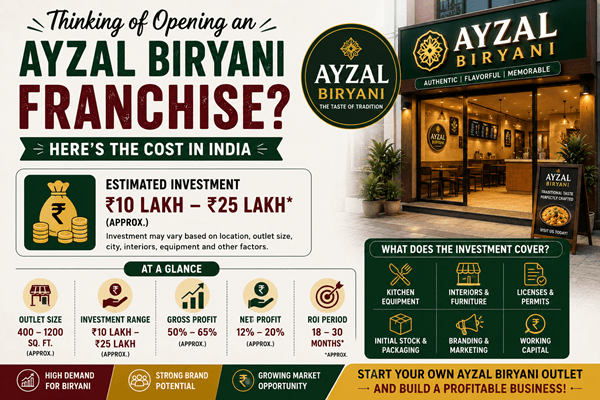
Investor Advisory & Franchise Scam Alert (2026)
The Ministry of Corporate Affairs and retail business watchdogs have flagged repeated fraudulent schemes targeting prospective food business owners. Unscrupulous brokers frequently build clone portals, issue fake letters of intent (LOI), and solicit refundable processing fees or kitchen blueprint charges under popular regional restaurant trademarks.
Neither Ayzal Biryani nor established cloud kitchen conglomerates solicit onboarding payments via personal bank accounts, UPI handles, or unverified intermediaries. If you encounter an agent demanding upfront franchise documentation fees or kitchen equipment procurement deposits under the name of Ayzal Biryani, refrain from transferring funds and verify corporate credentials via registered company registrar records.
Realistic CapEx Breakdown for a Comparable Biryani Outlet
Entrepreneurs targeting the QSR or cloud kitchen biryani category can benchmark their financial models against standardized Indian culinary infrastructure. A commercial setup serving dum biryani, kebabs, and accompaniments requires heavy-duty gas banks, blast chillers, commercial exhaust hoods, and grade-304 stainless steel prep counters to maintain consistent quality.
The overall capital requirement divides into hard assets, regulatory clearance, digital billing infrastructure, and initial leasehold commitments. Outlets positioned in prime high-street corridors or corporate IT hubs inevitably incur higher rental deposits, which must be modeled outside baseline civil construction costs.
| Investment Component | Estimated Outlay (Cloud / Takeaway) | Estimated Outlay (Dine-in / QSR) | Commercial Context & Considerations |
|---|---|---|---|
| Commercial Kitchen Equipment | ₹3,50,000 – ₹5,00,000 | ₹6,00,000 – ₹9,00,000 | High-pressure burners, brass/copper dum vessels, deep freezers, prep tables, wet grinders. |
| HVAC & Exhaust Ducting | ₹1,20,000 – ₹2,00,000 | ₹2,50,000 – ₹4,50,000 | Centrifugal exhaust blowers, fresh air systems, fire-rated ducting mandated by municipal fire norms. |
| Civil Works, Interiors & Branding | ₹1,50,000 – ₹2,50,000 | ₹4,00,000 – ₹7,50,000 | Epoxy flooring, washable wall tiles, counter fascias, display signage, dining furniture. |
| Statutory Licenses & Legal Compliance | ₹30,000 – ₹60,000 | ₹50,000 – ₹1,20,000 | FSSAI State license, GST registration, trade license, Shop & Establishment, fire clearance. |
| Billing Tech, CCTV & Peripherals | ₹40,000 – ₹70,000 | ₹80,000 – ₹1,40,000 | POS hardware, thermal receipt printers, kitchen display systems (KDS), cloud inventory sync. |
| Opening Stock & Packaging | ₹80,000 – ₹1,50,000 | ₹1,50,000 – ₹2,50,000 | Aged basmati rice, bulk spices, edible oils, tamper-evident biodegradable meal boxes. |
| Working Capital Reserve (3 Months) | ₹2,50,000 – ₹4,00,000 | ₹4,50,000 – ₹7,00,000 | Buffer capital for initial payroll, rent, utilities, and vendor payouts during operational ramp-up. |
| Total Capital Outlay | ₹10,20,000 – ₹16,30,000 | ₹19,80,000 – ₹33,10,000 | Excludes commercial lease security deposits (varies from 3 to 10 months of rent by city). |
Realistic Profitability & Operating Margins in the Indian Biryani Sector
Biryani boasts among the highest gross contribution margins in the Indian food and beverage landscape due to the cost efficiency of bulk-cooked rice, central gravies, and predictable protein yields. Raw material expenses (Cost of Goods Sold or COGS) typically account for 32% to 38% of total revenue when standardized recipes and batch marinades are observed.
However, net bottom-line realizations are heavily influenced by the distribution channel mix. Walk-in dining orders preserve profit margins, whereas food delivery platforms extract 18% to 26% in merchant commissions alongside sponsored listing deductions. When assessing the viability of an unverified brand like Ayzal Biryani versus established alternatives, investors must model operations against standard food service profit and loss benchmarks.
| Financial Metric | Industry Range (%) | Operational Impact & Practical Benchmarks |
|---|---|---|
| Gross Profit Margin | 60% – 68% | Driven by wholesale procurement of rice, whole spices, poultry, and meat. |
| Food Cost (COGS) | 32% – 38% | Must account for packaging (4% – 6% on delivery orders) and daily portion control. |
| Prime Staff Costs | 12% – 16% | Includes head ustad/dum master, kitchen assistants, dishwashers, and service staff. |
| Rent & Utility Overhead | 8% – 14% | Rental occupancy cost should not breach 12% of gross revenue for sustainable health. |
| Aggregator Fees & Marketing | 8% – 15% | Commissions for Swiggy/Zomato onboarding plus local hyper-targeted digital advertising. |
| Net Operating Margin (EBITDA) | 12% – 18% | Pure net realization before income tax and debt servicing, assuming stabilized volume. |
Viable Alternatives: Independent Setup vs. Verified Indian Biryani Franchises
Rather than chasing speculative franchise applications for brands without validated franchise disclosure, investors should evaluate active, legitimate market opportunities.
Established Indian restaurant franchisors operate under clearly articulated Franchise-Owned, Franchise-Operated (FOFO) or Franchise-Owned, Company-Operated (FOCO) models, featuring defined territory rights, central supply-chain guarantees, and certified training infrastructure.
Alternatively, building an independent homegrown biryani brand grants full freedom over sourcing, menu innovation, and pricing, while eliminating mandatory recurring royalties and non-negotiable central sauce base purchases.
| Brand / Operating Model | Official Expansion Status | Indicative Setup Cost | Fee & Royalty Structure | Primary Advantage |
|---|---|---|---|---|
| Ayzal Biryani | Unconfirmed / No Public Program | Not Disclosed (Estimated ₹12L – ₹25L) | None Published / Third-party risk | Local brand recognition in isolated micro-markets. |
| Behrouz Biryani (Rebel Foods) | Cloud Kitchen Multi-Brand | Access via enterprise model | Shared kitchen / Revenue share | Massive algorithmic delivery scale and centralized prep. |
| Bikkgane / Biryani By Kilo | Active Franchise Programs (FOFO/FOCO) | ₹25,00,000 – ₹45,00,000 | Brand fee ₹3L – ₹5L; 6% – 8% Royalty | Standardized clay-pot logistics and national brand equity. |
| Independent Biryani Brand | Self-Started / Proprietary | ₹8,00,000 – ₹18,00,000 | Zero Franchise Fees or Royalties | 100% margin retention; custom recipes tailored to local palates. |
Mandatory Regulatory & Statutory Approvals
Regardless of whether you establish an independent restaurant or partner with a vetted food franchisor, running a commercial kitchen in India requires strict statutory compliance. Non-compliance exposes the business to sudden sealing notices, heavy penalties, and immediate removal from delivery aggregators.
Every operator must secure an FSSAI State License (mandatory once annual turnover crosses ₹12 lakh), Goods and Services Tax (GST) registration, and a municipal trade health license issued by the local municipal corporation.
Operators operating dining spaces exceeding specified seating thresholds must also obtain a formal No Objection Certificate (NOC) from the local fire safety department, accompanied by an approved layout showing compliant emergency exits and grease traps.
How to Verify Franchise Legitimacy Before Committing Funds
When investigating opportunities in the restaurant domain, perform systematic due diligence before executing non-disclosure agreements or depositing financial tokens. Begin by searching the Ministry of Corporate Affairs (MCA) database to confirm the registered corporate identity, active directors, and paid-up capital of the parent entity.
Demand a formal Franchise Disclosure Document (FDD), verify current trademark status on the Intellectual Property India portal, and personally visit at least three operational franchisee kitchens without company handlers present.
Cross-examine actual store-level economics against brochure claims to uncover hidden inventory markups, delivery shrinkage, and real working capital demands.
Essential Guide:
Planning a Behrouz Biryani Franchise? Complete Cost & Investment Guide [2026]
Frequently Asked Questions
Is Ayzal Biryani currently offering franchises in India?
There is no verified, public franchise network or authorized corporate application protocol for Ayzal Biryani as of 2026. Prospective investors should avoid third-party brokers offering guaranteed allotments.
How much does it realistically cost to start a biryani restaurant in India?
Setting up a standard 300 to 800 sq. ft. commercial biryani kitchen requires between ₹12 lakh and ₹28 lakh, covering professional kitchen fabrication, exhaust setups, statutory licensing, point-of-sale systems, and working capital buffers.
What is the typical net profit margin for a biryani QSR?
A well-managed biryani quick-service outlet typically operates at a net profit margin of 12% to 18%, balanced by gross margins of 60% to 68% against staff overheads, rentals, and delivery platform commissions.
How can I protect myself from restaurant franchise scams?
Never transfer advance processing or franchise evaluation fees to personal bank accounts or unverified corporate entities. Always authenticate registered company details via MCA records, review registered trademarks, and inspect operational outlets directly.