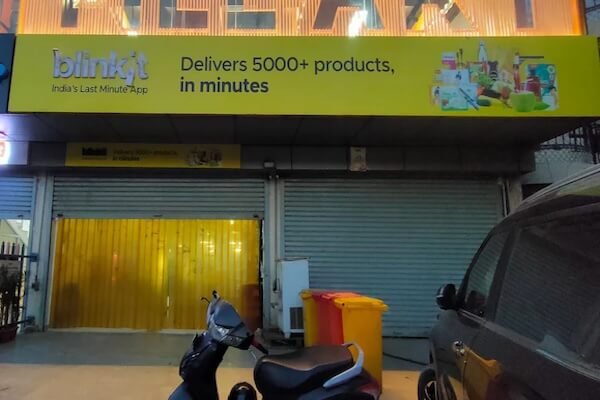
Quick-commerce has permanently altered urban grocery shopping in India, with Blinkit leading the market through hyperlocal fulfillment centers known as dark stores. Unlike traditional retail outlets, customers never walk into these facilities; instead, orders placed on the Blinkit app are picked, packed within minutes, and handed over to delivery riders.
Because of Blinkit’s rapid expansion across more than 200 Indian cities, thousands of entrepreneurs search online every month for the “Blinkit franchise cost.”
Before committing capital, prospective investors must understand a crucial commercial distinction: Blinkit does not offer a traditional retail franchise. Instead, the company operates through the official Blinkit Partners Program—a structured, operator-led dark store partnership model—alongside company-leased warehouse arrangements.
Setting up and operating a compliant dark store in 2026 typically requires an estimated capital outlay of ₹20 lakh to ₹50 lakh or more, depending on city tier, real estate deposits, and working capital requirements.
partners.blinkit.com) and never transfer money before signing a vetted, direct commercial agreement.How the Blinkit Partner Program Actually Works (Avoiding the “Franchise Trap”)
In a conventional retail franchise, a franchisee pays a brand fee, buys wholesale inventory, sets local prices, and retains retail product margins. Blinkit’s quick-commerce ecosystem functions very differently. Under the official Blinkit Partners Program, Blinkit handles brand marketing, app traffic, pricing algorithms, product curation, and last-mile rider fleet allocation.
The partner’s core responsibility is ground-level execution and real estate readiness. Depending on the specific city contract, partners either source a compliant ground-floor commercial property (typically 1,500 to 3,000 sq. ft.) or operate an assigned fulfillment center.
You hire, train, and manage a full-time team of pickers, packers, and inventory supervisors to maintain strict Service Level Agreements (SLAs)—such as under-two-minute packing times and FIFO (First-In, First-Out) perishable hygiene. Rather than earning retail markups on groceries, partners earn a commission percentage on net monthly order value (turnover) alongside performance incentives.
Blinkit Dark Store Investment & CapEx Breakdown (2026 Estimates)
Because Blinkit evaluates every catchment area individually, there is no single flat price tag across India. However, auditing real-world dark store launches across Tier-1 and Tier-2 markets reveals a clear capital expenditure (CapEx) and working capital structure.
Commercial real estate deposits and civil modifications represent the largest initial hurdle, often absorbing ₹5 lakh to ₹18 lakh upfront. Heavy-duty industrial shelving, cold-storage chillers for dairy and frozen goods, packing tables, barcode scanners, and backup power infrastructure add another ₹6 lakh to ₹15 lakh.
Finally, depending on whether your contract requires inventory financing, security deposits, or a bank guarantee, you must ring-fence ₹8 lakh to ₹20 lakh in working capital and operational reserves to survive the initial ramp-up months.
| Cost Component | Tier-2 / Emerging Cities | Tier-1 / Metro Cities | Operational Purpose & Notes |
|---|---|---|---|
| Property Security Deposit & Lease Prep | ₹4 Lakh – ₹8 Lakh | ₹10 Lakh – ₹18 Lakh+ | 3 to 6 months rent deposit, flooring, electrical load upgrade, and shutter/loading bay work. |
| Racking, Cold Storage & Fit-Outs | ₹5 Lakh – ₹8 Lakh | ₹8 Lakh – ₹15 Lakh | High-density slotted racks, deep freezers, chillers, CCTV, and ergonomic packing stations. |
| IT Hardware & Warehouse Tech | ₹1.5 Lakh – ₹2.5 Lakh | ₹2.5 Lakh – ₹4 Lakh | Handheld barcode scanners, POS terminals, label printers, high-speed dual ISP internet, and UPS/inverter. |
| Partner Security / Bank Guarantee & Onboarding | ₹3 Lakh – ₹6 Lakh | ₹5 Lakh – ₹15 Lakh+ | Contractual financial security or bank guarantee against stock custody and SLA compliance (varies by contract). |
| Working Capital & Launch Reserve | ₹6.5 Lakh – ₹8.5 Lakh | ₹12.5 Lakh – ₹18 Lakh | Covers 3 months of staff salaries, rent, electricity, shrinkage buffer, and initial stock commitments. |
| Total Estimated Project Outlay | ₹20 Lakh – ₹33 Lakh | ₹38 Lakh – ₹70 Lakh+ | Indicative 2026 planning budget; exact figures depend on Blinkit’s final commercial term sheet. |
Monthly Operating Expenses (OpEx) & Realistic Profit Margins
Many online blogs exaggerate dark store profits by confusing gross order turnover with partner income. If a busy dark store processes ₹60 lakh worth of groceries in a month, that ₹60 lakh belongs to the platform—not the store operator.
Under typical quick-commerce partner agreements, operator commissions generally hover between 2% and 3.5% of net order value, supplemented by efficiency bonuses for low order-cancellation rates and minimal inventory shrinkage.
From that gross commission payout, you must pay fixed monthly operating expenses (OpEx) ranging from ₹2.5 lakh to ₹6.5 lakh per month. A standard 2,200 sq. ft. dark store operating 16 to 18 hours a day requires 10 to 16 full-time staff across two shifts, alongside steep commercial electricity bills from continuous refrigeration and air conditioning.
Mature, high-density dark stores processing 900 to 1,400+ orders per day typically generate a net monthly profit of ₹1.2 lakh to ₹2.8 lakh, translating to an annualized ROI of roughly 22% to 30% over an 18-to-30-month payback window. Conversely, stores in low-density neighborhoods that fail to cross 450 daily orders often struggle to break even.
| Store Performance Tier | Daily Order Volume | Monthly Gross Merchandise Value (GMV @ ₹520 AOV) | Est. Partner Commission (~2.5% – 3%) | Monthly OpEx (Rent, Staff, Utilities) | Estimated Net Monthly Profit |
|---|---|---|---|---|---|
| Ramp-Up / Low Density | 400 orders/day | ₹62.4 Lakh | ₹1.56 Lakh – ₹1.87 Lakh | ₹1.60 Lakh – ₹2.10 Lakh | Break-even to ₹25,000 |
| Moderate / Stabilized Store | 800 orders/day | ₹1.25 Crore | ₹3.12 Lakh – ₹3.75 Lakh | ₹2.20 Lakh – ₹2.80 Lakh | ₹75,000 – ₹1.35 Lakh |
| High-Volume Metro Hub | 1,300 orders/day | ₹2.03 Crore | ₹5.07 Lakh – ₹6.09 Lakh | ₹3.20 Lakh – ₹4.10 Lakh | ₹1.50 Lakh – ₹2.60 Lakh |
City-Wise Blinkit Dark Store Setup Cost in India (2026)
Real estate deposits, municipal trade compliance, and blue-collar wage inflation vary sharply across India’s major quick-commerce hubs. Entrepreneurs budgeting for a dark store in 2026 should calibrate their capital reserves to local market realities rather than relying on national averages.
| Metro / City | Estimated Total Investment | Avg. Monthly Dark Store Rent (2,000–2,500 sq. ft.) | Key Local Cost Drivers |
|---|---|---|---|
| Mumbai (MMR) | ₹35 Lakh – ₹65 Lakh+ | ₹1.40 Lakh – ₹2.75 Lakh | Heavy 6-month security deposits, scarce ground-floor loading access, and high municipal licensing costs. |
| Delhi NCR | ₹28 Lakh – ₹55 Lakh+ | ₹95,000 – ₹1.85 Lakh | High demand in Gurugram, Noida, and South Delhi; strict commercial power load and fire NOC rules. |
| Bengaluru | ₹30 Lakh – ₹60 Lakh+ | ₹1.10 Lakh – ₹2.20 Lakh | Historically high landlord security deposits (6–10 months) and higher warehouse picker attrition/wages. |
| Hyderabad | ₹24 Lakh – ₹50 Lakh | ₹75,000 – ₹1.50 Lakh | Rapidly expanding residential corridors (Gachibowli, Kondapur, Kukatpally) with relatively balanced rentals. |
| Chennai | ₹24 Lakh – ₹48 Lakh | ₹75,000 – ₹1.45 Lakh | Competitive commercial lease rates in suburban hubs, though summer cooling and backup power CapEx are higher. |
Property Requirements, Compliance & Official Onboarding Process
Blinkit rejects a high percentage of property submissions because dark stores operate under strict hyperlocal logistics constraints. A viable site must sit inside or immediately adjacent to a dense residential catchment capable of supporting 10-to-15-minute delivery radii.
Ground-floor access with an unobstructed 15-to-20-foot approach road is essential so mini-trucks can unload morning replenishment stock while 20 to 40 delivery riders park safely without triggering neighborhood traffic disputes.
From a regulatory standpoint, the operating entity must hold active GST registration, a state FSSAI license for packaged and perishable food storage, a Shops and Establishment Act certificate, local municipal trade licenses, and basic fire safety clearance.
Blinkit also mandates full-time, hands-on operational involvement—passive investors looking to hand over keys to a junior manager rarely pass the interview and assessment rounds.
To apply legitimately, entrepreneurs must submit their profile and property details through Blinkit’s official partner portal. Blinkit’s business development and supply chain teams then conduct a GIS catchment feasibility check, inspect the physical property, issue a commercial term sheet detailing payout slabs and SLA penalties, and oversee racking and ERP software integration prior to launch.
Is a Blinkit Dark Store Partnership Worth It in 2026?
Partnering with Blinkit offers a rare advantage in Indian retail: zero customer-acquisition spending and immediate order flow powered by one of the country’s largest consumer apps. For hands-on operators who understand warehouse discipline, shift rostering, and inventory shrinkage control, a well-located dark store can deliver steady, predictable cash flows within 18 to 30 months.
However, it is not a passive income asset. Margins are thin, SLA penalties for delayed packing or expired stock directly reduce monthly payouts, and competition from Swiggy Instamart, Zepto, and Flipkart Minutes keeps pressure on order volumes.
Before signing any commercial lease or committing ₹20 lakh to ₹50 lakh+, always have a commercial lawyer review Blinkit’s termination clauses, minimum guarantee terms, and equipment buyback policies.
Recommended Guides:
DMart Franchise Cost in India (2026)
Frequently Asked Questions (FAQ)
Does Blinkit charge a franchise fee in India?
No, Blinkit does not operate a conventional retail franchise model and does not charge a standard retail brand franchise fee. Instead, approved entrepreneurs join the Blinkit Partners Program, where capital goes toward dark store infrastructure, real estate security deposits, working capital, and contractual security guarantees.
What is the minimum investment required to open a Blinkit dark store?
In Tier-2 cities with lower commercial rents, the minimum practical investment starts around ₹20 lakh to ₹25 lakh. In Tier-1 metros like Mumbai, Bengaluru, and Delhi NCR, higher landlord deposits and fit-out expenses typically push the total capital requirement to ₹35 lakh to ₹60 lakh+.
How much commission does a Blinkit dark store partner earn?
Blinkit dark store partners generally earn a commission ranging between 2% and 3.5% of net monthly sales turnover, plus performance-linked incentives for fast order dispatch and high inventory accuracy. After deducting rent, staff salaries, and utilities, net profit margins typically settle around 8% to 12% of gross commission payouts, or ₹1.2 lakh to ₹2.6 lakh per month for high-volume stores.
Can I lease my commercial property directly to Blinkit without running operations?
Yes. Alongside the operator-run Blinkit Partners Program, Blinkit actively leases ground-floor commercial spaces (1,500–3,500 sq. ft.) in high-demand neighborhoods for company-operated dark stores. Property owners can submit their space directly on Blinkit’s official website without investing in store equipment or staffing.