Blinkit operates as one of India’s largest quick-commerce networks, fulfilling rapid deliveries through hyperlocal micro-warehouses rather than walk-in retail outlets. Because customers place orders exclusively through the mobile app, partnering with Blinkit differs fundamentally from buying a traditional retail franchise.
Instead of paying a conventional brand licensing fee to open a customer-facing storefront, entrepreneurs participate through the Blinkit Partners Program—operating a dark store (local fulfillment center) or leasing commercial real estate to the company.
For prospective operators evaluating the Blinkit dark store business model in 2026, total capital expenditure (CapEx) and working capital generally fall between ₹20 lakh and ₹50 lakh depending on city tier, warehouse footprint, and commercial terms.
Larger metro facilities with heavier inventory loads or stricter security deposits can exceed ₹50 lakh. Treating this range as an operational capital budget—rather than a fixed “franchise fee”—is essential before submitting an application.
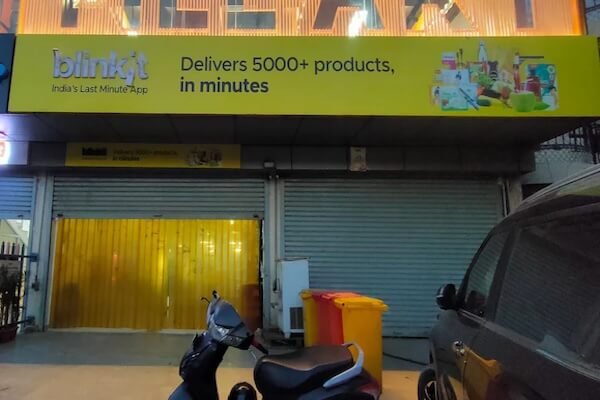
Does Blinkit Offer a Traditional Franchise in India?
A common misconception among Indian investors is searching for a “Blinkit franchise fee” as if the brand were a quick-service restaurant or walk-in supermarket. Technically, Blinkit does not run a conventional retail franchise model. Under the official Blinkit Partners Program, the platform centralizes customer acquisition, app technology, supply-chain procurement, and last-mile rider dispatch.
The local partner’s core responsibility is facility operations: securing a compliant ground-floor space (typically 1,500 to 3,000 sq. ft.), hiring and managing a team of 8 to 12 pickers and packers, maintaining strict inventory hygiene, and meeting tight dispatch Service Level Agreements (SLAs). Property owners who do not wish to manage daily store operations can alternatively explore leasing commercial spaces directly to Blinkit for company-operated fulfillment hubs.
Blinkit Dark Store Investment Breakdown (2026 Estimates)
Because Blinkit customizes commercial agreements based on local catchment demand and existing infrastructure, there is no universal price tag across India. In some partner arrangements, Blinkit directly handles store fit-outs and inventory while the partner funds property deposits, bank guarantees, and operational manpower; in other setups, partners bear partial infrastructure and stock costs.
The table below outlines realistic planning allocations for a comprehensive dark store launch.
| Investment Component | Tier-2 / Emerging Cities | Tier-1 / Metro Cities | Operational Purpose |
|---|---|---|---|
| Onboarding & Security Deposit | ₹2 lakh – ₹4 lakh | ₹4 lakh – ₹8 lakh | Commercial lease deposit, legal documentation, and partner onboarding formalities |
| Warehouse Fit-Out & Racking | ₹5 lakh – ₹9 lakh | ₹8 lakh – ₹15 lakh | Heavy-duty storage racks, picking aisles, packing tables, flooring, and electrical upgrades |
| Cold Storage & IT Hardware | ₹3 lakh – ₹6 lakh | ₹5 lakh – ₹10 lakh | Commercial chillers/freezers, barcode scanners, POS terminals, CCTV, and enterprise Wi-Fi |
| Initial Inventory Allocation | ₹8 lakh – ₹12 lakh | ₹12 lakh – ₹20 lakh | Fast-moving groceries, dairy, fresh produce, beverages, and household essentials (model-dependent) |
| Working Capital Reserve | ₹4 lakh – ₹6 lakh | ₹6 lakh – ₹10 lakh | 3 to 4 months of picker/packer payroll, monthly rent, power backup, and shrinkage buffer |
| Estimated Total Capital | ₹22 lakh – ₹37 lakh | ₹35 lakh – ₹63 lakh | Note: Certain partner agreements also require a refundable Bank Guarantee. |
Core Cost Drivers Explained
1. Commercial Real Estate & Location Dynamics
Quick-commerce unit economics rely heavily on delivery radius—typically 1.5 to 3 kilometers around dense residential clusters. Unlike high-street retail shops, a Blinkit dark store does not require expensive glass frontage or foot traffic, which helps keep monthly rentals lower than prime mall spaces.
However, the property must sit on the ground floor with wide road access for tempo unloading and dedicated parking bays for 15 to 30 delivery bikes without triggering residential society disputes.
2. Infrastructure, Refrigeration & Tech Stack
Fulfilling orders within minutes requires an engineered warehouse layout rather than standard grocery shelving. Operators must install multi-tier slotted angle racks, dedicated cold rooms or deep freezers for dairy and frozen foods, industrial power backup, and high-speed internet.
Entrepreneurs should never purchase scanners, servers, or racking before signing an official Letter of Intent (LoI), as Blinkit mandates specific Warehouse Management System (WMS) hardware compatibility.
3. Inventory Ownership & Working Capital
Depending on the specific partnership contract executed during onboarding, inventory may either be supplied on a consignment/company-owned basis or funded directly by the partner. Even when Blinkit manages stock replenishment centrally, partners must maintain a liquid working capital reserve of ₹4 lakh to ₹10 lakh.
Dark stores operate 16 to 24 hours a day, meaning monthly payroll for store managers, loaders, and picking staff—alongside commercial electricity bills for round-the-clock refrigeration—must be paid regardless of initial order ramp-up.
More Guides:
BigBasket Franchise Cost in India (2026)
City-Wise Blinkit Dark Store Cost Comparison in India
Commercial rentals, municipal compliance costs, and minimum wage structures vary sharply across India’s major consumption hubs. High-density cities generate faster order velocity, but elevated real estate deposits push the entry threshold higher.
| City / Metro Region | Estimated Setup Range | Property Deposit & Fit-Out | Inventory & Working Capital | Key Local Market Factor |
|---|---|---|---|---|
| Mumbai (MMR) | ₹30 lakh – ₹60 lakh+ | ₹12 lakh – ₹22 lakh | ₹18 lakh – ₹32 lakh | Highest commercial rentals and strict society parking norms |
| Delhi NCR | ₹25 lakh – ₹55 lakh | ₹10 lakh – ₹19 lakh | ₹15 lakh – ₹30 lakh | High average order values (AOV) and rapid suburban |