Critical Audit & Brand Verification Alert
Before committing capital or submitting personal documentation, prospective entrepreneurs must distinguish between corporate enterprise providers and retail education networks. AQM Technologies Pvt. Ltd. is primarily an established enterprise software testing, BFSI quality assurance, and digital assurance consultancy based in Mumbai.
The brand does not operate an authorized, publicly available retail computer coaching franchise network for retail storefronts. Many internet listings promising retail coaching authorizations under this brand name are third-party aggregators or unauthorized licensing solicitations. Always verify company incorporation credentials and corporate channels directly before remitting any application or franchise fees.
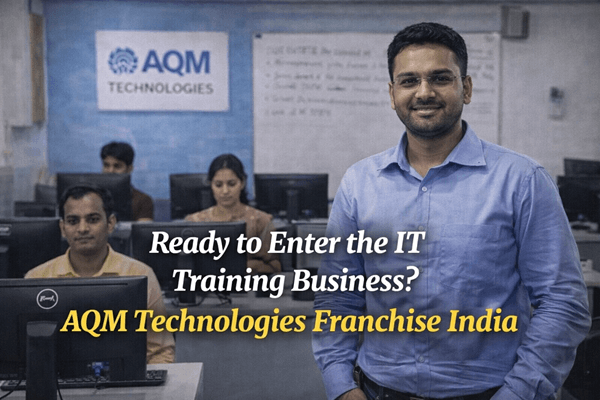
The Realities of the IT Training and Skill Development Sector in India
The demand for vocational IT education, software quality testing, accounting tools like Tally, data analytics, and digital marketing remains resilient across Tier-1, Tier-2, and Tier-3 Indian cities.
Unlike asset-heavy retail and food-service ventures, educational and vocational training institutes do not suffer from physical inventory spoilage or perishable shelf-life concerns. Revenue depends almost entirely on rolling student admissions, structured batch schedules, and regional reputation.
However, running an independent or franchised computer training center requires significant hands-on operational management. Sustainable enrollment rates require continuous marketing expenditure, high-speed networking, reliable computing hardware, and dependable faculty who can deliver hands-on practical learning.
While early marketing brochures often promise passive income, an educational institute functions as an active service business with recurring overheads.
Realistic Capital Expenditure (CapEx) for an IT Training Center (2026)
Setting up a standard 500 to 1,000 sq. ft. computer training center with 15 to 25 operational terminals requires a pragmatic budget. While outdated estimates cite nominal setups under ₹4 lakh, commercial-grade hardware, licensed software stacks, air conditioning, and professional interior acoustics elevate baseline entry costs. Below is a structured breakdown reflecting authentic market prices in India for 2026.
| Cost Component | Estimated Investment (₹ INR) | Nature of Expense & Operational Details |
|---|---|---|
| Commercial Premises Deposit | ₹1,00,000 – ₹3,00,000 | Security deposit for 500–900 sq. ft. commercial space (3 to 6 months’ advance rent depending on the city tier). |
| Hardware & IT Infrastructure | ₹3,50,000 – ₹7,00,000 | 15 to 20 refurbished or entry-level desktop PCs/terminals, dedicated server/router, LAN cabling, and projector. |
| Power Backup (Online UPS / Inverter) | ₹60,000 – ₹1,20,000 | Crucial for lab continuity during power outages to prevent hardware and session disruption. |
| Classroom Interiors & Fit-Outs | ₹1,50,000 – ₹3,00,000 | Computer desks, ergonomic lab chairs, whiteboards, reception desk, air conditioning, and partition drywall. |
| Software Licensing & Curriculum Setup | ₹50,000 – ₹1,50,000 | Official software subscriptions, operating system licenses, LMS tools, and student study manuals. |
| Initial Branding & Launch Marketing | ₹40,000 – ₹1,00,000 | Exterior ACP signage, local college paper inserts, digital ads, and introductory launch seminars. |
| Reserve Working Capital (3–4 Months) | ₹1,50,000 – ₹3,00,000 | Buffer fund to cover trainer salaries, electricity, and lease costs prior to stable batch cash flows. |
| Total Estimated Setup Outlay | ₹9,50,000 – ₹19,70,000 | Comprehensive turnkey setup for a compliant, functional computer education center in 2026. |
Operating Costs (OpEx), Real Margins, and Unit Economics
A frequent error among new education entrepreneurs is projecting a 60% to 70% pure net profit margin. While gross margins on course fees appear substantial because there is no direct cost of goods sold (COGS), operating overheads consume a significant portion of incoming revenue.
Faculty salaries for specialized disciplines like Python, full-stack web development, or advanced software testing command competitive market pay. Furthermore, continuous commercial air-conditioning and heavy computer load result in steep monthly electric utility bills.
A well-run regional center operating at 60% to 75% seat capacity typically yields an authentic net profit margin ranging between 22% and 35%.
Monthly operating expenses typically demand ₹80,000 to ₹1,80,000, distributed between faculty payroll (₹40,000–₹80,000), commercial rent (₹25,000–₹60,000), electricity and high-speed leased line internet (₹12,000–₹25,000), and sustained hyper-local digital advertising (₹10,000–₹20,000).
Business Model Comparison: Commercial Franchise vs. Independent Center
Entrepreneurs must evaluate whether affiliating with an accredited brand network delivers sufficient student recruitment leverage to offset brand royalties and entry fees, or if establishing an independent academy is financially superior.
| Strategic Parameter | Accredited National Brand Franchise | Independent IT Academy / Self-Brand |
|---|---|---|
| Upfront Royalty / Affiliation Fee | ₹1,00,000 – ₹3,00,000 non-refundable fee. | Zero affiliation fee; 100% of capital funds personal assets. |
| Course Content & Certification | Standardized courseware and recognized certificate. | Must create proprietary syllabus or tie up with third-party testing bodies. |
| Ongoing Royalties / Sharing | 15% to 25% revenue share or fixed annual renewal. | Zero revenue share; owner retains 100% of student fee collections. |
| Student Acquisition Advantage | High initial trust due to established brand recall. | Requires substantial local promotional effort to build trust. |
| Break-Even Horizon | Typically 10 to 16 months depending on catchment area. | Typically 8 to 14 months due to a leaner fixed cost burden. |
Essential Due Diligence Checklist Before Signing Any Agreement
Before signing an agreement or transferring funds for an IT training or certification center, follow a standard verification protocol:
First, verify whether the company operates on a legitimate franchise disclosure model or merely sells non-exclusive courseware packs disguised as a franchise. Authentic education franchisors provide transparent student management systems (LMS), faculty upskilling modules, standardized examination portals, and verified placement support ties.
Second, inspect municipal zoning permits, commercial power load clearances (a minimum 5 kW to 8 kW sanctioned commercial load is necessary for 20 systems plus air conditioning), and mandatory fire-safety NOCs for educational occupancies. Ensuring these statutory requirements are met before paying a lease deposit protects your venture from sudden regulatory closures.
Explore Further:
Apple Store Franchise Cost in India
Frequently Asked Questions (FAQs)
Can I run an IT training institute without a technical engineering background?
Yes. Many successful training institute owners act primarily as business directors managing student counseling, marketing, local college tie-ups, and daily center logistics, while employing certified subject-matter trainers to teach programming, cloud, or accounting courses.
What is the minimum physical space required to launch a viable computer coaching center?
A minimum carpet area of 500 to 700 square feet is recommended. This layout comfortably accommodates a 15-seater computer lab, a dedicated counseling/reception desk, a small theory classroom or faculty cabin, and basic washroom amenities.
How can I protect my investment from training institute franchise scams?
Always inspect the corporate entity’s Ministry of Corporate Affairs (MCA) filings, ensure the official corporate domain matches communication emails, physically visit at least two established operational centers run by existing partners, and never transfer franchise fees into personal bank accounts.