Business Model Clarification: The “Franchise Fee” Myth in Battery Retail
Prospective investors frequently search for an “Amaron franchise cost,” but in the Indian energy storage sector, business-format franchising does not exist.
Amara Raja Energy & Mobility operates an extensive aftermarket sales and service network comprising authorized local dealers, territory distributors, and exclusive Amaron PitStop customer-experience touchpoints. Independent retailers purchase stock directly from primary regional stockists or company distribution centers at established wholesale Dealer Transfer Prices (DTP).
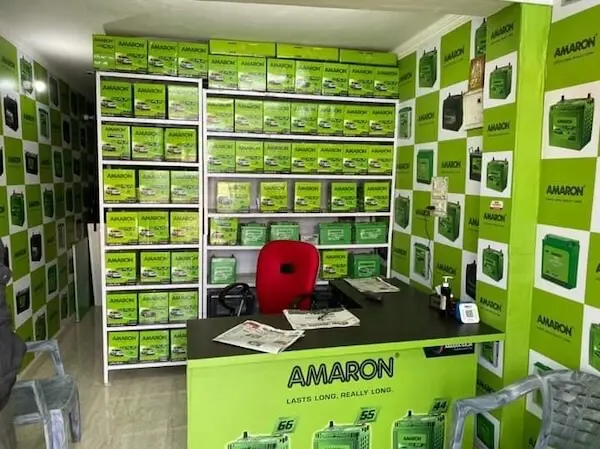
A standard dealership allows retailers to sell automotive, two-wheeler, and home inverter batteries alongside other lines. The branded Amaron PitStop format serves as an exclusive retail and service lounge, providing diagnostic evaluations, rapid on-vehicle installation, paperless warranty claim settlements, and roadside dispatch support.
Retailers manage their pricing within corporate maximum retail price (MRP) caps, set local payment terms for neighborhood mechanics, and retain full equity in their businesses without paying recurring royalties to the brand.
Scam Warning & Commercial Due Diligence: Amara Raja Energy & Mobility never solicits dealer application fees, registration tokens, or site evaluation charges via third-party websites or unverified UPI channels. Official dealership and PitStop authorization is handled through territory Area Sales Managers (ASMs) following an on-site commercial audit. Never transfer security deposits to individuals; all authorized payments must be made to verified corporate or primary distributor bank accounts via RTGS or crossed account-payee cheques.
Capital Expenditure (CapEx) & Working Capital Breakdown
Opening an authorized Amaron retail counter or dedicated PitStop requires capital allocation across heavy-duty physical infrastructure, digital testing and charging equipment, safety installations, and inventory.
While slow-moving automotive batteries can be introduced with lower stock commitments, maintaining an operational business that services inverter power-cuts and commercial fleets requires a realistic capital deployment of ₹7.70 Lakh to ₹22.60 Lakh.
| Capital Head | Semi-Urban / Tier-3 Counter | Urban / Metro Amaron PitStop | Deployment Terms |
|---|---|---|---|
| Refundable Security Deposit | ₹50,000 – ₹1,00,000 | ₹1,00,000 – ₹2,00,000 | Interest-free refundable commercial deposit with distributor/company |
| Testing, Charging & Service Bay | ₹40,000 – ₹75,000 | ₹80,000 – ₹1,60,000 | Digital conductance testers, carbon-pile load testers, hydrometers, bench chargers |
| Store Interior, Signage & Heavy Racking | ₹80,000 – ₹1,50,000 | ₹1,80,000 – ₹3,00,000 | Heavy-gauge angle iron racks, corporate fascia signage, branded customer counter |
| Opening Inventory (Automotive & Tubular) | ₹4,50,000 – ₹7,00,000 | ₹8,00,000 – ₹12,00,000 | Fast-moving Hilife, Pro, Flo, Go, and current tubular inverter units |
| Working Capital & Scrap Reserve | ₹1,50,000 – ₹2,50,000 | ₹2,50,000 – ₹4,00,000 | Absorbs mechanic credit cycles and old-battery scrap buyback float |
| Total Estimated Setup Investment | ₹7,70,000 – ₹12,75,000 | ₹14,10,000 – ₹22,60,000 | Excludes commercial property rental advances |
Space Requirements, Safety Protocols, and Shop Layout
A standard Amaron dealership functions efficiently within 250 to 500 sq. ft. of ground-floor commercial space, while a full-format Amaron PitStop ideally requires 500 to 800 sq. ft. Ground-floor access is critical: automotive batteries weigh between 10 kg and 25 kg, and tall-tubular inverter models frequently exceed 55 kg.
Locations with multi-step stairs or basement storage pose inventory handling risks and slow down daily operations.
The shop floor requires acid-resistant epoxy coatings or high-density vitrified industrial floor tiles to prevent chemical corrosion from electrolyte spillage.
Lead-acid batteries release hydrogen gas during bench charging, making cross-ventilation and commercial exhaust systems mandatory.
Outlets must also comply with the Batteries (Management and Handling) Rules under the Ministry of Environment, Forest and Climate Change, which mandate dedicated, sealed secondary storage areas for spent lead-acid units awaiting authorized scrap collection.
Realistic Profit Margins, Trade Discounts, and the Scrap Battery Economy
Industry claims suggesting margins of 30% to 50% on branded batteries are inaccurate. Real-world gross trade margins on factory-fresh Amaron products range from 8% to 14% across two-wheeler, passenger car, and tubular inverter categories. The commercial strength of a battery dealership relies on stock turnover, manufacturer target schemes, and the lead-acid scrap buyback economy.
When vehicle owners purchase a replacement battery, they typically trade in their depleted unit. Lead scrap has high commodity value, allowing dealers to recover ₹400 to ₹1,500 per scrap battery, depending on weight and plate mass. These cores are returned through Amara Raja’s reverse supply chain under formal credit-note schemes or supplied to licensed lead smelters.
After factoring in commercial rent, utility overheads, technician pay, and commissions paid to local auto mechanics (often 3% to 5%), a well-managed store yields a net profit margin of 4% to 7%.
| Product Category | Representative Series | Gross Margin Range | Commercial Dynamics |
|---|---|---|---|
| Two-Wheeler VRLA | Amaron Pro Bike Rider (AP-BTX) | 10% – 14% | High-volume sales driven by partnerships with neighborhood two-wheeler mechanics |
| Passenger Vehicle Batteries | Amaron Pro, Flo, Go, Black | 8% – 12% | Long warranties (up to 72 months); solid trade-in values on old battery cores |
| Home Inverter & UPS Units | Amaron Current, Shield Tubular | 9% – 14% | Higher value sales; demand spikes sharply ahead of summer power outages |
| Commercial & Tractor Lines | Amaron Harvest, Hi-Way | 7% – 11% | Heavy-weight units; tied to fleet operators, transporters, and agricultural cycles |
Competitive Analysis: Amaron vs. Exide vs. Emerging Inverter Brands
Amaron’s market standing is driven by its patented SilvenX alloy technology, offering low-maintenance life cycles, high vibration resistance, and extended warranty options (up to 72 months on premium lines). This strong consumer recall allows Amaron dealers to command retail prices with less discounting than lesser-known competitors. However, the brand faces steady competition from Exide Industries, which holds a substantial share of original equipment manufacturer (OEM) supply agreements and operates the widespread Batmobile roadside breakdown service.
In the home power backup segment, Amaron competes with dedicated inverter manufacturers such as Luminous, Microtek, and Livguard. While residential inverter brands often offer higher trade margins on combo packages (inverter plus battery), Amaron’s build quality in tall-tubular units makes it a preferred option for customers prioritizing longevity.
An authorized Amaron counter generally sees consistent, year-round battery replacement demand that helps offset off-season dips in inverter sales.
Don’t forget to check out other franchise, dealership, distributorship opportunities in India: Exide Battery Dealership: How to Apply
Step-by-Step Authorized Application & Verification Workflow
Securing an authorized dealership or Amaron PitStop code requires direct commercial clearance from Amara Raja’s local sales branch, rather than purchasing a pre-packaged franchise. The onboarding process follows four key steps:
1. Commercial Documentation & Inquiry: The prospective merchant registers an inquiry through the official Amaron channel portal (amaron.in) or engages the regional distributor. Required documentation includes a valid Goods and Services Tax (GST) certificate, business entity PAN, municipal trade license, and proof of commercial property ownership or a registered lease deed.
2. Territory Viability & ASM Site Survey: The local Area Sales Manager (ASM) visits the location to evaluate market feasibility. The assessment checks for minimum safe distances from existing Amaron PitStop outlets to prevent territory cannibalization, while examining neighborhood vehicle density and proximity to auto repair clusters.
3. Security Deposit & Dealership Code Generation: Upon site approval, the applicant deposits the refundable corporate security guarantee with the distributor or direct depot. The company issues a unique Dealer ERP Code, granting access to corporate billing software, promotional point-of-sale schemes, and the paperless digital warranty claim settlement network.
4. Infrastructure Setup & Opening Stock Billing: The dealer installs branded external fascia, heavy-duty shelving, and diagnostic testing equipment according to brand guidelines. An opening inventory order consisting of fast-moving passenger car, two-wheeler, and tubular inverter batteries is dispatched from the regional warehouse to launch operations.