Before budgeting capital for an Avadh Food franchise, commercial investors must navigate critical brand distinctions, third-party misinformation, and the reality of QSR versus FMCG distributorship models in the Indian food and beverage sector.
Market Reality Check: Does Avadh Food Offer a Franchise in 2026?
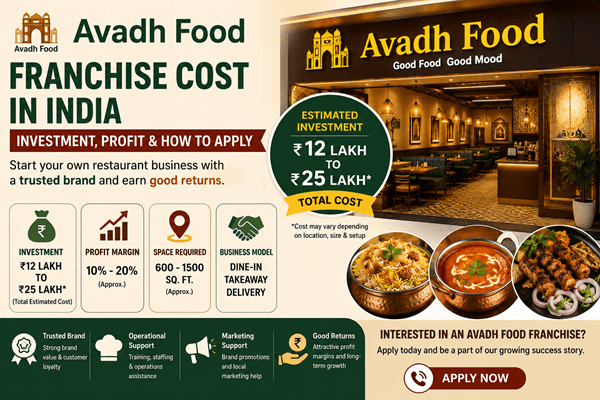
Prospective entrepreneurs frequently search for the Avadh Food franchise cost in India, expecting a standardized quick-service restaurant (QSR) or cloud kitchen franchise disclosure. However, commercial audits indicate that Avadh Food has no officially verified, nationwide third-party franchise program in active public rollout.
A common source of confusion in investor searches is the distinction between two distinct corporate entities: Avadh Snacks (a major Gujarat-based namkeen and savory brand under Prataap Snacks operating on an FMCG wholesale dealership network) and localized quick-service eateries operating under variants of the Avadh Foods / Shaan-e-Awadh banner.
FMCG brands appoint stockists and clearing-and-forwarding (C&F) partners under trading agreements, whereas restaurant brands license dining operations. Conflating these corporate formats leads many first-time entrepreneurs into misleading fee structures published by unverified online directories.
Scam Advisory: Beware of Unofficial Franchise Portals & Advance Fees
The Indian franchise ecosystem currently experiences significant predatory behavior through counterfeit lead-generation portals and domain squatters. These fraudulent entities frequently list unauthorized brand names, promise guaranteed daily footfalls, and demand advance “franchise agreement registration fees” or refundable security deposits ranging from ₹50,000 to ₹2,00,000 via digital payment links.
Neither legitimate FMCG corporate boards nor established F&B franchisors request direct token transfers into personal savings accounts without issuing a verifiable Franchise Disclosure Document (FDD), conducting commercial property site audits, and formalizing physical lease agreements.
Aspiring operators must never transfer funds to third-party consultants claiming exclusive allotment quotas for Avadh Food or related brand assets.
Realistic Industry Setup Costs: QSR vs. FMCG Distributorship
To build an actionable business plan, capital allocations must be evaluated against standard commercial benchmarks rather than hypothetical franchise packages.
Setting up a commercial casual dining or fast-casual North Indian eatery in India requires calculating heavy mechanical, electrical, and plumbing (MEP) infrastructure, exhaust ducting, commercial refrigeration, and POS software.
Conversely, acquiring an authorized FMCG food distributorship involves working capital tied up in secondary sales cycles, rotational inventory, and local transport logistics rather than consumer-facing interior fit-outs.
| Investment Component | Standard QSR / Fast-Casual Format (600–1,200 sq. ft.) | FMCG Brand Distributorship (400–800 sq. ft. Godown) |
|---|---|---|
| Initial Brand Fee / Security Deposit | ₹0 to ₹3,00,000 (Subject to direct brand contract) | ₹2,00,000 to ₹5,00,000 (Refundable security deposit) |
| Interior Fit-outs & Civil Works | ₹3,50,000 to ₹6,50,000 (HVAC, false ceiling, dining seating) | ₹50,000 to ₹1,50,000 (Racks, basic office, CCTV) |
| Kitchen / Commercial Equipment | ₹4,00,000 to ₹7,50,000 (Commercial burners, chillers, exhaust hood) | ₹1,00,000 to ₹2,00,000 (Billing terminal, barcode scanners, pallet jacks) |
| Initial Stock & Raw Materials | ₹1,50,000 to ₹2,50,000 (Perishables, dry rations, packaging) | ₹3,00,000 to ₹6,00,000 (Prepaid packaged stock rotation) |
| Working Capital Reserve (3–6 Months) | ₹3,00,000 to ₹5,00,000 (Rent advances, payroll, utility runway) | ₹2,50,000 to ₹4,00,000 (Market credit, fuel, logistics buffer) |
| Estimated Total Capital Requirement | ₹12,00,000 to ₹24,50,000 | ₹9,00,000 to ₹18,50,000 |
Financial Viability: Operating Margins & ROI Realities
Unrealistic sales projections frequently cause new retail food businesses to fail within the first 18 months of operation. In quick-service restaurant operations, high gross margins on paper do not always translate into substantial bottom-line cash flow once prime retail occupancy and utility overheads are deducted.
Food businesses typically maintain raw food costs between 32% and 38%, which leaves a gross margin of roughly 62% to 68%.
However, after factoring in prime commercial rentals (typically accounting for 12% to 18% of monthly turnover), staff wages, electricity at commercial tariffs, platform commissions for Swiggy and Zomato (which can exceed 20% to 26% on aggregate delivery sales), and unavoidable food wastage, net profit margins realistically settle between 12% and 18%.
In contrast, an FMCG distribution agency runs on volume-driven economics. Gross operating commissions range from 4% to 8%, but return on capital is driven by inventory turnover rather than individual unit markups, yielding net margins between 2.5% and 4.5% with significantly lower front-end real estate costs.
Commercial Property & Infrastructure Parameters
If entering a QSR model, site selection dictates unit-level profitability far more than brand signage. Outlets serving roll, kebab, biryani, or fast-casual items demand a ground-floor presence on high-density high streets or food hub clusters with a minimum front facade width of 12 to 15 feet.
Crucially, the location must support 15 to 25 kW of dedicated commercial 3-phase power load to run heavy induction warmers, commercial fryers, and continuous refrigeration.
Urban lease agreements in Tier-1 cities (Delhi NCR, Mumbai, Bengaluru) generally require 3 to 6 months of security deposit alongside a standard lock-in period of 3 years.
Investors must calculate these security deposits into total Day-One capital deployment, as they lock up liquidity that cannot be used for inventory churn.
How to Verify and Apply for Legitimate Food Business Rights
Entrepreneurs who want to evaluate corporate partnerships with food brands should execute direct corporate due diligence rather than relying on automated registration portals:
First, verify corporate registration details on the Ministry of Corporate Affairs (MCA) portal. Review the company’s designated corporate identification number (CIN) and registered office address to ensure authenticity.
Second, contact corporate brand headquarters directly through verified enterprise communication channels or official LinkedIn company registries. Inquire whether their channel expansion is structured under Company-Owned Company-Operated (COCO), Franchise-Owned Franchise-Operated (FOFO), or regional stockist distributorship models.
Third, inspect standard statutory compliances. Any authorized food manufacturing or catering operator in India must furnish an active FSSAI Central/State license, GSTIN credentials, and explicit terms regarding trademark usage rights before requesting any upfront legal consideration.
Recommended Guides:
Balaji Wafers Distributorship Cost, Margins, and Application Process
Frequently Asked Questions for Commercial Investors
What is the official Avadh Food franchise fee in India for 2026?
As of 2026, there is no verified, public disclosure establishing an official franchise fee for an Avadh Food retail outlet. Any site asserting a mandatory upfront franchise registration fee is operating without verified corporate backing, and investors should exercise extreme caution.
What is the difference between Avadh Snacks and Avadh Food?
Avadh Snacks is an established regional FMCG namkeen manufacturer operating under the umbrella of Prataap Snacks Ltd., distributing packaged goods through authorized dealers and stockists. Localized businesses named Avadh Foods typically refer to regional restaurants, cloud kitchens, or small QSR outlets serving North Indian street food. Their business agreements, CapEx requirements, and legal frameworks are entirely separate.
How much working capital is recommended before launching a restaurant franchise?
Seasoned hospitality consultants recommend holding at least 4 to 6 months of fixed operating expenses in liquid reserves. For a standard 800 sq. ft. QSR outlet, this amounts to roughly ₹3,00,000 to ₹5,00,000 to absorb commercial rent, staff payroll, and utility obligations while customer footfalls stabilize.