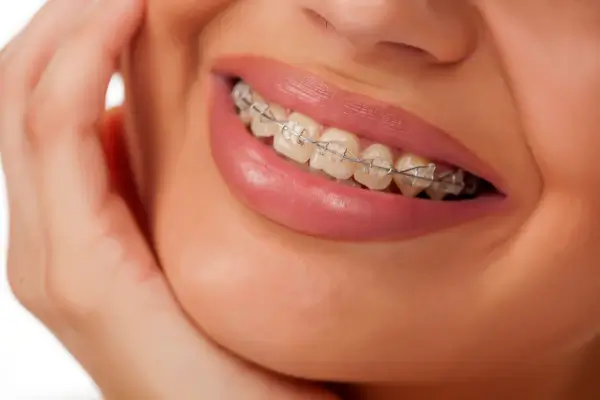
Comprehensive Braces Cost Comparison in India (2026)
Treatment expenses vary significantly based on whether the selected mechanism relies on conventional labial brackets, hidden lingual systems, or clear sequential thermoplastic trays. The following benchmark outlines the baseline financial commitment for dual-arch (both jaws) orthodontic treatments across leading Indian clinics.
| Braces Type | Typical Cost Range (INR) | Aesthetic Visibility | Average Duration | Best Suited For |
|---|---|---|---|---|
| Traditional Metal Braces | ₹25,000 – ₹55,000 | High (Silver brackets & bands) | 14 – 24 Months | Complex malocclusions, severe rotations, cost-conscious patients |
| Ceramic Braces | ₹40,000 – ₹85,000 | Low (Tooth-coloured brackets) | 16 – 24 Months | Aesthetic alignment for teenagers and adults |
| Self-Ligating Braces (Metal/Ceramic) | ₹55,000 – ₹1,20,000 | Moderate to Low | 12 – 20 Months | Patients seeking shorter chair time and fewer clinic visits |
| Lingual Braces (Incognito/Custom) | ₹1,20,000 – ₹2,50,000 | Zero (Fitted behind the teeth) | 18 – 30 Months | High-profile professionals demanding complete concealment |
| Clear Aligners (Indian Brands) | ₹60,000 – ₹1,60,000 | Invisible (Clear medical-grade polymer) | 6 – 18 Months | Mild-to-moderate crowding and spacing cases |
| Clear Aligners (Global Brands / Invisalign) | ₹1,50,000 – ₹3,50,000 | Invisible (Proprietary aligner material) | 9 – 24 Months | Comprehensive bite corrections and complex arch expansion |
Ceramic Braces Cost and Clinical Profile
Ceramic braces typically cost between ₹40,000 and ₹85,000 in India, though premium ceramic self-ligating variations can reach ₹1,20,000 in tier-1 metro practices.
These brackets are manufactured from polycrystalline or monocrystalline alumina, blending seamlessly with the patient’s natural enamel shade. They offer an optimal balance between the structural durability of fixed appliances and the cosmetic discretion desired by working adults.
While the ceramic material itself resists external discoloration, patients must maintain rigorous oral hygiene because clear elastic ligatures can absorb pigments from turmeric, coffee, and tea. Treatment durations typically run parallel to metallic brackets, though excessive debonding or bracket fracture can occasionally prolong clinical timelines.
Clear Aligners vs. Fixed Braces: Clinical & Financial Trade-Offs
The decision between clear aligners and fixed bracket systems balances lifestyle convenience against case complexity. Traditional braces, ranging from ₹25,000 to ₹1,20,000, exert non-removable bodily force, giving the orthodontist three-dimensional mechanical control over severe vertical discrepancies, skeletal overbites, and impacted canines.
Conversely, clear aligners represent an investment ranging from ₹60,000 to ₹3,50,000, providing removable flexibility, easier oral hygiene maintenance, and virtually unnoticeable wear.
Aligner success depends entirely on patient compliance, requiring at least 20 to 22 hours of daily wear. In severe cases involving premolar extractions or surgical jaw preparation, traditional fixed braces remain the clinical standard, often delivering more predictable torque control at a substantially lower capital expense.
Adult Orthodontics: Complexity and Fee Structuring
Adult braces in India generally range from ₹35,000 to ₹2,50,000 depending on the selected mechanism. Adult orthodontic biomechanics differ significantly from adolescent treatment because jawbones are fully calcified, eliminating growth modification as a viable treatment path.
Consequently, tooth movements occur at a slower cellular pace, necessitating delicate force application to protect periodontal integrity.
Furthermore, adult treatment often requires multidisciplinary coordination. Pre-existing periodontal bone loss, single-tooth implants, restorations, or temporomandibular joint (TMJ) dysfunction routinely necessitate periodontal clearance or endodontic preparation before bracket placement, adding variable diagnostic and therapeutic costs to the initial clinical quote.
Short-Term Corrections: 1-Year Fast-Track Treatment Pricing
For patients requiring limited anterior cosmetic corrections, a 1-year orthodontic plan generally costs between ₹20,000 and ₹75,000. These targeted procedures focus exclusively on aligning the visible aesthetic zone—social six teeth—rather than overhauling posterior molar interdigitation or severe skeletal malocclusion.
Fast-track options often employ light-force ceramic brackets or minor aligner packages (ranging from 10 to 14 sets of trays), cutting down total chairside adjustments and overall laboratory fabrication expenses.
Consumer Alert: The Risks of Direct-to-Consumer (DTC) At-Home Aligners
Prospective dental patients must remain vigilant against mail-order or “at-home aligner kits” heavily advertised across social media channels. These direct-to-consumer schemes typically mail impression putty to the patient’s residence or perform quick, non-clinical showroom scans, circumventing mandatory in-person evaluation by a qualified specialist (MDS Orthodontics).
Applying mechanical orthodontic forces without pre-treatment panoramic OPG radiographs, lateral cephalograms, and clinical periodontal evaluation can trigger catastrophic dental complications. These include irreversible root resorption (shortening of roots), rapid alveolar bone loss, localized gum recession, and iatrogenic open bites that can leave teeth loose or incapable of normal mastication.
Orthodontic alignment is a prescription-grade medical procedure requiring periodic chairside supervision, bite verification, and interproximal reduction (IPR). Bypassing clinic-supervised care to save upfront capital frequently leads to corrective orthodontic procedures costing double the original estimate.
Aligners Cost in India [2026]: Find Here Average Cost of Invisalign Aligners and Various Types of Aligners Cost
Ancillary Expenses & CapEx: Itemizing the Total Bill
When reviewing orthodontic estimates, verify whether the clinic provides an all-inclusive quotation or bills auxiliary milestones separately. The base quote for brackets frequently excludes essential diagnostic and maintenance procedures that accumulate over a two-year timeline.
| Diagnostic / Procedure Item | Typical Additional Cost (INR) | Clinical Necessity |
|---|---|---|
| Initial Specialist Consultation | ₹500 – ₹1,500 | Comprehensive oral evaluation by an MDS Orthodontist |
| Diagnostic Suite (OPG, Ceph, 3D Scan) | ₹2,000 – ₹5,000 | Essential for measuring bone volume, jaw angles, and root anatomy |
| Orthodontic Extractions (If Crowded) | ₹800 – ₹2,500 per tooth | Creating perimeter arch space in non-expansion cases |
| Temporary Anchorage Devices (TADs / Mini-Implants) | ₹2,500 – ₹6,000 per unit | Anchorage hardware for complex intrusion or retraction biomechanics |
| Post-Treatment Retainers (Hawley / Essix / Fixed) | ₹3,000 – ₹10,000 per arch | Non-negotiable post-treatment retention to prevent relapse |
| Emergency Repairs (Broken Brackets / Poking Wire) | ₹300 – ₹800 per incident | Billed at some clinics if caused by patient non-compliance with diet |
Health Insurance & Financing Alternatives in India
Standard retail health insurance policies and indemnity mediclaim schemes in India exclude orthodontic treatment under general aesthetic and cosmetic exclusions. Third-party administrators (TPAs) only entertain dental alignment claims when mandated by reconstructive maxillofacial surgery following severe trauma, road accidents, or congenital cleft lip and palate anomalies.
Certain corporate group medical covers (GMC) and outpatient department (OPD) dental riders provide partial allowances—typically capped between ₹10,000 and ₹25,000 annually—which can offset consultation, scaling, or extraction expenses.
To mitigate upfront capital strain, top orthodontic centers partner with healthcare non-banking financial companies (NBFCs) like Bajaj Finserv or private banks to offer zero-percent interest Equated Monthly Installment (EMI) arrangements spread over 10 to 18 billing cycles.