FMCG Business Reality: Franchise Myth vs. True Distributorship Model
Prospective entrepreneurs evaluating fast-moving consumer goods ventures frequently encounter misleading terms such as “Anmol Franchise.” In India’s packaged food and confectionery industry, established manufacturers like Anmol Industries Limited do not operate standard retail franchise systems requiring upfront franchise royalty fees. Instead, the operational architecture functions strictly through an authorized three-tier FMCG wholesale distribution mechanism: Super Stockists, Carrying & Forwarding (C&F) agents, and localized primary Distributors (Redistribution Stockists or RDS).
Classifying this commercial partnership as a retail franchise misrepresents both capital deployment and operational obligations. In an authentic FMCG distributorship, capital is dedicated primarily to working capital, revolving credit cycles, warehouse infrastructure, and motorized distribution logistics, rather than proprietary store aesthetics or recurring brand royalty payments. Clarifying this structural distinction safeguards applicants from financial loss and ensures realistic operational planning.
Critical Advisory: Countering FMCG Dealership & Security Deposit Fraud
A prevalent internet fraud involves unauthorized third-party websites and spoofed domains offering “instant Anmol biscuit agency franchises” or “exclusive retail dealership certificates.” Perpetrators demand advance payments disguised as “franchise registration fees,” “refundable allotment tokens,” or “regional NOC fees” via personal UPI IDs or dubious current accounts.
Anmol Industries Limited processes distribution applications exclusively through corporate territory sales managers (Area Sales Managers/TSIs) and verified portals at official enterprise domains. Verified corporate protocols never mandate cash deposits or personal account wire transfers before field verification, territory viability assessments, and reciprocal physical contract executions. Never release capital without direct liaison with an authorized company territory executive at a registered regional office.
Realistic CapEx & Working Capital Breakdown (2026 Estimates)
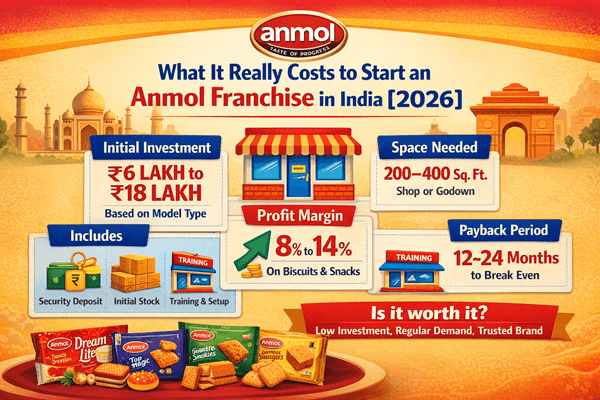
Initiating a regional FMCG distribution firm requires an aggregate capital commitment ranging from ₹6,00,000 for rural or tier-3 clusters to ₹18,00,000 for high-throughput urban routes. Unlike conventional retail establishments, capital expenditure remains asset-light, focusing heavily on inventory liquidity and logistical coverage.
| Investment Component | Rural / Tier-3 Territory (₹) | Urban / High-Volume Cluster (₹) | Nature & Purpose |
|---|---|---|---|
| Security Deposit | ₹1,00,000 – ₹1,50,000 | ₹2,50,000 – ₹4,00,000 | Refundable corporate deposit directly with the manufacturer. |
| Initial Stock Procurement | ₹2,50,000 – ₹4,00,000 | ₹6,00,000 – ₹8,00,000 | Fast-moving stock covers (biscuits, rusks, cakes, and confectionery). |
| Warehousing Setup & Pallets | ₹50,000 – ₹80,000 | ₹1,00,000 – ₹1,80,000 | Moisture-proof commercial racking, crates, rodent barriers, and desk setup. |
| Billing Hardware & FMCG Software | ₹35,000 – ₹50,000 | ₹50,00,0 – ₹80,000 | Computer, thermal invoice printers, UPS, and inventory billing software. |
| Delivery Logistics (Capex / Deposit) | ₹50,000 – ₹1,00,000 | ₹1,50,000 – ₹2,50,000 | Down payment on 3-wheeler loading vehicle or outsourced fleet retainer. |
| Working Capital Reserve (Rotational) | ₹1,50,000 – ₹2,50,000 | ₹3,50,000 – ₹5,00,000 | Covers 7–14 days retailer market credit and transit pipeline liquidity. |
| Total Initial Outlay | ₹6,35,000 – ₹10,30,000 | ₹15,00,000 – ₹22,10,000 | Full initial operating commitment. |
Commercial Profit Margins and P&L Structure
Realistic margins in branded mass-market FMCG distribution are structurally tighter than speculative retail reports often suggest. Primary distributor billing margins for packaged food brands usually settle between 4.5% and 6.5% gross on standard core products, with blended returns reaching 7.5% to 8.5% when accounting for manufacturer volume rebates, target achievements, and prompt payment trade discounts. Retailers, in contrast, command trade margins between 12% and 18%.
Because distributor profitability depends on velocity rather than heavy unit margins, working capital velocity is the deciding metric. A distributor rotating ₹8,00,000 of stock three times a month generates ₹24,00,000 in gross trade throughput. At a 5.5% blended gross margin, this yields ₹1,32,000 in monthly gross profit. After deducting delivery vehicle fuel, driver and loader wages, warehouse rent, damaged goods allowances, and financing expenses, sustainable net earnings typically sit between 1.8% and 2.6% of turnover—translating to roughly ₹45,000 to ₹65,000 net monthly income.
Infrastructure, Territory Licensing & Compliance
Securing a certified FMCG distributorship entails compliance verification rather than simple retail lease agreements. The prospective distributor must provide a dry, secure warehouse space measuring approximately 300 to 800 square feet, depending on market classification. Because packaged confectionery items are perishable and highly sensitive to external contaminants, dampness, and heat, storage facilities must pass food hygiene inspections.
Mandatory business documentation includes an active Goods and Services Tax (GST) registration, a valid Food Safety and Standards Authority of India (FSSAI) State or Central Distribution License, local municipal Trade Licenses, MSME/Udyam documentation, and a commercial current account backed by audited financial returns. Demonstrated logistical capacity—either through owned cargo vehicles or reliable regional transport logistics—is essential for approval by area sales executives.
Similar Business Breakdowns:
24×7 Convenience Store Franchise Cost in India (2026)
Operational Distribution Protocols
The onboarding progression requires clear physical verification steps before any commercial capital changes hands:
Phase 1: Territory Gap Assessment. The applicant liaises with the authorized corporate field territory manager (Sales Officer or ASM) to verify unserved or split retail routes (beats) in the designated district. FMCG manufacturers avoid overlapping primary routes within identical urban sectors to prevent territory friction.
Phase 2: Commercial Scrutiny and Credit Assessment. The regional sales head conducts a physical inspection of the proposed warehouse facility, reviews three years of audited accounts or banking turnover, and checks financial viability for stock rotation.
Phase 3: Direct Corporate Allotment & Settlement. Documentation, including distributor agreements, GST e-invoicing declarations, and standard security deposits, is executed directly in the name of Anmol Industries Limited. Payments are deposited exclusively into verified corporate accounts via RTGS or NEFT, bypassing intermediaries or commission agents.
Phase 4: Route Allocation & Order Execution. Company-employed sales reps (Order Bookers/TSIs) are assigned to work alongside the distributor’s delivery staff, mapping retailer counters, processing order calls, and scheduling daily beat dispatches.
Distribution Risk Assessment: Challenges to Evaluate
While steady consumer demand for packaged baked goods offers consistent turnover, distributor failure commonly stems from uncontrolled market credit. Neighborhood general stores and kirana outlets frequently expect 7 to 15 days of unsecured revolving credit. If credit oversight falters, a distributor’s working capital can lock up quickly, leaving them unable to place required stock replenishment orders with the factory.
Additionally, damage allowances and near-expiry product claims require systematic handling according to regional distributor policies. Mismanaging stock age rotation (FIFO – First In, First Out) can trigger inventory loss if expired cases accumulate in storage. Success in this vertical requires operational discipline, route logistics management, and cash collection control rather than passive investment expectations.