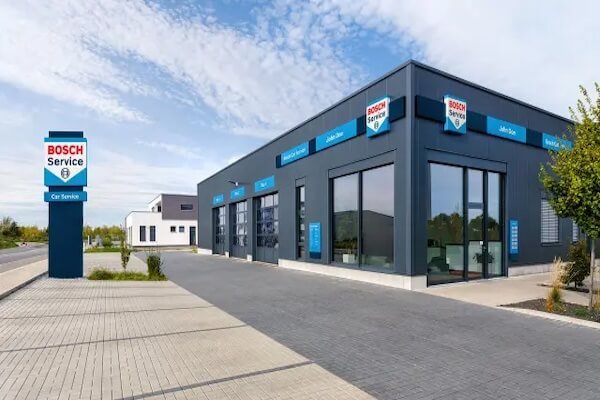
Prospective garage owners and entrepreneurs frequently seek a “Bosch franchise,” expecting a traditional turn-key model with a fixed brand fee and uniform royalties. In practice, Bosch operates primarily through partnership networks, most notably Bosch Car Service (BCS) for multi-brand passenger vehicles and specialized Bosch Diesel Service (BDS) units.
Rather than selling exclusive territory rights, Bosch enters into commercial agreements with existing independent garages or well-capitalized entrepreneurs willing to build a facility to strict technological standards.
Under this arrangement, capital expenditure does not disappear into a non-recoverable franchise fee. Instead, the bulk of your capital directly finances Bosch-certified automotive hardware—including computerized wheel aligners, two-post and scissor vehicle lifts, AC recovery stations, and proprietary OBD-II diagnostic scanners—alongside an ongoing license for the proprietary ESI[tronic] diagnostic diagnostic library.
Urgent Scam Alert: Fake Bosch Allotment Portals
Several fraudulent websites, fake Google ads, and unauthorized third-party broker agencies solicit applications under names like “Bosch India Dealership Online” or “Bosch Workshop Allotment Portal.” These syndicates often issue forged Letters of Intent (LOIs) and demand refundable security deposits ranging from ₹1,50,000 to ₹5,00,000 into private bank accounts.
Bosch India never allots service centers via quick online forms, nor does it demand unverified upfront registration fees through UPI or individual accounts. Field territory managers conduct physical site inspections, verify local vehicle population metrics, and validate technical capabilities before issuing formal corporate paperwork.
Detailed Capital Expenditure Breakdown (2026 Estimates)
A standard 3-to-4 bay multi-brand Bosch Car Service center typically requires a capital outlay ranging from ₹25 lakh to ₹48 lakh, excluding real estate acquisition costs. Variations depend heavily on whether you are converting an existing workshop with baseline structural infrastructure or outfitting a bare-shell industrial plot from scratch.
| Expense Head | Estimated Outlay (INR) | Operational Purpose & Key Components |
|---|---|---|
| Brand Signage & Onboarding | ₹2,00,000 – ₹4,00,000 | Standardized Bosch network corporate identity (pylon signs, bay branding, reception fascia). |
| Lifting & Workshop Mechanical Tools | ₹6,00,000 – ₹11,00,000 | Two-post hydraulic electro-mechanical lifts, pit equipment, pneumatics, multi-purpose shop presses. |
| Advanced Diagnostic Systems | ₹5,50,000 – ₹10,00,000 | Bosch KTS series diagnostic scanners, ECU flash toolkits, oscilloscope, battery testers, smoke leak detectors. |
| Tyre & AC Care Machinery | ₹4,00,000 – ₹8,00,000 | Automatic wheel aligner, dynamic wheel balancer, refrigerant recovery and recharging station. |
| Workshop Civil, Flooring & Bay Fitments | ₹3,50,000 – ₹7,00,000 | Heavy-duty epoxy floor coating, oil-water drainage separator trenches, customer waiting lounge. |
| Initial Parts & Consumables Stock | ₹3,00,000 – ₹6,00,000 | High-turnover fast-moving inventory: brake pads, wiper blades, filters, spark plugs, synthetic lubricants. |
| Working Capital Reserve | ₹3,00,000 – ₹5,00,000 | Cash runway covering initial staff salaries, utility overheads, local marketing, and supplier credit cycles. |
| Total Setup Estimate | ₹27,00,000 – ₹51,00,000 | Excludes commercial land lease deposits and paint booth installation. |
Space Planning and Facility Requirements
Automotive servicing requires specific yard geometries rather than standard commercial showroom shapes. An optimal facility requires between 2,500 to 4,500 square feet of covered workspace, accompanied by an open yard of at least 1,000 square feet for unhampered vehicle staging, maneuvering, and parking.
Ceiling height is a critical operational bottleneck: hydraulic two-post lifts hoisting full-size SUVs require clear vertical clearance of not less than 14 to 16 feet.
In addition, local municipal norms demand an industrial three-phase commercial power connection (typically 15 to 25 kW, higher if an electric paint-curing booth is installed), certified oil-sludge separation chambers to meet Pollution Control Board guidelines, and adequate road approach width to handle tow trucks and low-clearance passenger sedans.
Regional Cost Dynamics: Tier 1 Metros vs. Tier 2 Hubs
While equipment and authorized software costs remain largely standardized nationwide, regional property dynamics introduce significant variability in overall investment viability. In major automotive corridors, high security deposits and high square-foot rental rates shorten operational runways, requiring higher monthly throughput to break even.
| Cluster | Primary Hubs | Commercial Rent (Sq. Ft.) | Security Deposit Profile | Key Operational Driver |
|---|---|---|---|---|
| Tier 1 Tier-A Metros | Mumbai MMR, Delhi-NCR, Bengaluru | ₹45 – ₹85 / month | 6 to 10 months upfront | Higher average ticket size on German and luxury multi-brand mechanical repair. |
| Emerging Tech/Auto Hubs | Hyderabad, Pune, Chennai | ₹30 – ₹55 / month | 3 to 6 months upfront | Balanced vehicle density; high fleet servicing and mid-segment SUV volume. |
| Tier 2 Industrial Centers | Coimbatore, Surat, Jaipur, Lucknow | ₹18 – ₹32 / month | 2 to 4 months upfront | Low property overhead; high demand for aftermarket spare parts and general maintenance. |
Profit Margins and Revenue Architecture
Unlike single-line retail franchises, an automotive workshop runs on a blend of distinct revenue channels, each carrying fundamentally different gross margins. Sustained profitability depends on optimizing technician efficiency while maintaining healthy markups across mechanical labour, diagnostics, and inventory turns.
| Service Vertical | Realistic Gross Margin | Economic Contribution |
|---|---|---|
| Labour & Periodic Maintenance | 60% – 75% | Core profitability driver; costs are limited primarily to technician billable hours. |
| Electronic Diagnostics & Scanning | 70% – 85% | High return on asset after amortizing the Bosch KTS scanner and ESI[tronic] software cost. |
| OEM & Aftermarket Spare Parts | 15% – 28% | Slower margins driven by trade discounts, distributor terms, and inventory holding expenses. |
| Lubricants & Engine Consumables | 20% – 35% | Predictable, repeat-volume stream associated with routine service oil changes. |
Under sound management, a mature workshop maintaining an average load of 8 to 12 vehicles per day generally targets a net operating profit margin of 14% to 22% before income taxes. Cash-flow stabilization typically takes 9 to 15 months, determined largely by customer retention, insurance tie-ups, and the speed at which the workshop builds trust in its local catchment area.
More Guides:
Bosch Power Tools Dealership in India
Official Protocol: How to Apply Legitimate Channels
To avoid intermediaries, commercial candidates should follow the direct route established by the company’s automotive aftermarket division:
First, compile a preliminary business dossier documenting the proposed site layout, photographs of the access road, local vehicle density indicators, and your professional background in fleet, mechanical, or service management. Next, submit your expression of interest exclusively through the official Bosch Mobility Aftermarket division web portal or through an authorized regional distributor.
Following a desk review, a regional sales engineer or territory manager conducts an in-person site audit to verify structural viability, power lines, and clearances. If approved, technical training for your mechanics is scheduled through the Bosch Training Centre, and an equipment