Network Partnership vs. Traditional Franchise: Debunking the Fee Myth
Prospective workshop operators frequently fall into the misconception that Bosch Car Service (BCS) operates like a fast-food or retail franchise where one pays an exorbitant, non-refundable brand fee simply for trademark rights. In practice, Bosch operates an authorized workshop network partnership and technical affiliation model.
The commercial arrangement centers on technical compliance, certified Bosch diagnostic tooling, shop-floor standardization, technician training, and supply-chain procurement rather than an arbitrary royalty-heavy franchise fee.
While a nominal network induction, software subscription, and corporate identity (CI) audit fee exists, the lion’s share of upfront deployment goes directly into physical assets, infrastructure, and working capital.This distinction is vital for commercial feasibility.
Unlike independent operators locked into revenue-share master agreements, a Bosch service partner retains operational independence while leveraging Bosch’s global automotive engineering prestige.
Consequently, setting up a competitive 3- to 6-bay workshop requires a realistic capital outlay between ₹25 lakh and ₹65 lakh, largely determined by whether the project is a greenfield establishment or a conversion/upgradation of an existing, fully functional multi-brand workshop.
Scam Alert: Fake Franchise Portals and Verification Safeguards
The surging demand for organized multi-brand automobile servicing in Tier 1 and Tier 2 cities has led to a proliferation of fraudulent intermediary websites, fake “Bosch Dealership/Franchise Application” landing pages, and deceptive registration schemes.
Unauthorized agents routinely demand initial “allotment fees” or “site survey charges” ranging between ₹25,000 and ₹1,500,000 paid into individual savings accounts or bogus shell entities.
Bosch Limited does not solicit franchise allotment money via unofficial tele-callers, social media forms, or generic UPI addresses. Genuine business inquiries, partner evaluations, and geographic feasibility checks are conducted strictly through official regional offices and verified domain portals under boschcarservice.com or Bosch’s corporate communication infrastructure.
Investors should never transfer funds before meeting a verified territorial business manager in person, conducting joint site audits, and receiving official vendor onboarding documentation.
Realistic CapEx Breakdown: Equipment, Civil Infrastructure, and Working Capital
Underestimating workshop establishment capital is the primary reason automotive service startups experience early liquidity crunches. Multi-brand servicing demands advanced vehicle diagnostic computers, heavy-duty mechanical lifts, wheel service assemblies, air reticulation pipelines, and heavy electrical load configurations.
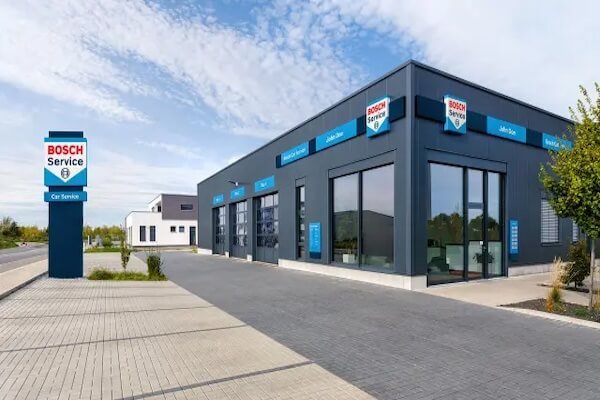
Civil execution must accommodate oil separators, high-load industrial epoxy flooring, proper drainage troughs, and dedicated corporate reception suites conforming to Bosch visual standards.
Equally critical is liquid working capital. An automotive service center operates on delayed fleet payments, inventory holding for fast-moving spare parts and fluids, technician payroll, and municipal overheads. A minimum contingency buffer of ₹6 lakh to ₹10 lakh should be cordoned off exclusively for cash flow support during the initial 6 to 9 months while building steady bay occupancy.
| Component | Existing Garage Upgradation | New Greenfield Setup (3–5 Bays) | Key Inclusions & Specifications |
|---|---|---|---|
| Network Induction & CI Signage | ₹2,50,000 – ₹4,00,000 | ₹3,50,000 – ₹6,00,000 | Corporate external pylon, fascia boards, reception branding, technician workwear, and initial induction. |
| Diagnostic & Workshop Machinery | ₹6,00,000 – ₹12,00,000 | ₹14,00,000 – ₹22,00,000 | Bosch KTS scanners/ECU diagnostics, two-post lifts, wheel aligner/balancer, A/C recovery station, compressor. |
| Civil, Flooring & MEP Work | ₹3,00,000 – ₹6,00,000 | ₹7,00,000 – ₹14,00,000 | Heavy industrial epoxy flooring, 3-phase high-amp cabling, pneumatic lines, bay layout, customer lounge. |
| Initial Spares & Consumables | ₹2,50,000 – ₹4,50,000 | ₹4,00,000 – ₹7,00,000 | Oils, brake pads, filters, wipers, spark plugs, sensors, and essential fast-moving SKUs. |
| Premises Deposit (Varies by City) | Existing leasehold | ₹4,00,000 – ₹10,00,000 | 3 to 6 months commercial security deposit for 3,000–6,000 sq. ft. industrial/commercial land. |
| Operational Working Capital Buffer | ₹3,50,000 – ₹5,50,000 | ₹6,00,000 – ₹10,00,000 | Salaries for service advisors and diagnostic technicians, rent, software licenses, and utility bills. |
| Total Estimated Capital Outlay | ₹17,00,000 – ₹32,00,000 | ₹38,50,000 – ₹69,00,000 | Subject to localized rental norms and specific scope of testing hardware purchased. |
City-Wise Commercial Feasibility and Real Estate Dynamics
Real estate overhead represents the single largest variable determining whether a workshop achieves operating break-even within 8 months or struggles with negative cash burn.
A standard Bosch Car Service workshop demands a minimum footprint of 3,500 to 6,000 sq. ft. to house multiple active service bays, dedicated wheel alignment ramps, safe turning radiuses, parking zones for incoming vehicles, and a modern customer lounge.
| Metro / City | Average Total Investment | Recommended Industrial Pockets | Key Operational Nuance |
|---|---|---|---|
| Mumbai MMR | ₹45,00,000 – ₹70,00,000 | Navi Mumbai (Turbhe, MIDC), Thane, Kandivali/Goregaon industrial clusters | High commercial deposits require strategic location inside industrial estates with clear road ingress. |
| Delhi NCR | ₹38,00,000 – ₹60,00,000 | Okhla, Mayapuri, Gurugram Udyog Vihar, Noida Sector 16/63 | Heavy multi-brand volume; high competition demands focus on electronic diagnostics and fleet tie-ups. |
| Bengaluru | ₹35,00,000 – ₹58,00,000 | Whitefield, Peenya, Electronic City, HBR/Kalyan Nagar corridors | High concentration of premium mid-segment cars; strong customer appetite for transparent periodic service packages. |
| Hyderabad | ₹30,00,000 – ₹50,00,000 | Kukatpally, Uppal, Gachibowli peripheries, Sanathnagar | Expanding urban peripheral belts allow larger workshop footprints at lower rent-to-revenue ratios. |
| Pune | ₹30,00,000 – ₹48,00,000 | Bhosari, Hadapsar, Hinjawadi access roads, Wagholi | Strong technical talent availability; auto enthusiast hub with steady demand for detailing and mechanical repairs. |
Operating Economics: Revenue Drivers, Blended Margins, and Payback Reality
Sustainable workshop profitability relies on maintaining a healthy ratio between low-margin consumable sales and high-margin specialized labor charges. In routine periodic maintenance (engine oil, filters, basic mechanical tune-ups), gross margins on spare parts and lubricants typically hover between 15% and 25%.
Conversely, specialized diagnostic scanning, ECU troubleshooting, engine overhaul, suspension rectification, and body-shop repairs yield labor margins between 60% and 80%.
A balanced workshop servicing 8 to 15 cars daily typically realizes a blended operating margin of 18% to 26% after deducting rent, technician salaries, utility costs, inventory carrying expenses, and software subscriptions. Assuming steady capacity utilization of 65% within 12 months, full capital expenditure recovery generally occurs between 24 and 36 months.
Workshops that focus solely on periodic oil changes struggle to absorb commercial rent, underscoring the absolute necessity of leveraging Bosch’s diagnostic systems to capture complex, high-billing electronic repair work.
Related Deep Dive:
Bosch Power Tools Dealership in India
Due Diligence Checklist for Prospective Workshop Partners
Prior to signing commercial property leases or ordering workshop machinery, prospective entrepreneurs should perform rigorous due diligence to ensure alignment with Bosch technical standards and local regulatory frameworks:
First, verify that the property has proper commercial or light-industrial zoning approval with permission to operate vehicle repair facilities. Automotive workshops generate hazardous chemical effluents, requiring dedicated oil-water separators, local pollution control board consents, and standard fire safety clearances.
Ensure the electrical connection supports a three-phase power supply with sufficient connected load (typically 15 kW to 25 kW) to drive high-capacity vehicle lifts, diagnostic equipment, and industrial air compressors concurrently.
Second, secure access to skilled diagnostic technicians before commissioning the site. A workshop’s market reputation rests entirely on first-time-fix rates; having certified mechanics trained in ECU scanning, common-rail diesel systems, and modern auto-electrical circuitry is indispensable.
Finally, obtain an itemized commercial proposal directly from authorized Bosch regional executives that outlines mandatory brand fixtures versus open-market tooling options, guaranteeing your startup capital is deployed with maximum efficiency.