Executive Summary & Industry Positioning
The rapid expansion of domestic e-commerce and direct-to-consumer (D2C) brands across India has created a steady demand for regional logistics aggregators and parcel booking points. Book My Ship (incorporated under Book My Ships Private Limited) operates primarily as a multi-carrier booking aggregator and parcel forwarding agency, rather than a full-stack end-to-end logistics carrier like Blue Dart or Delhivery.
In this operational format, local business owners function essentially as retail booking outlets or Master Service Level aggregators, contracting shipments out to primary commercial transit partners.
For potential entrepreneurs evaluating this segment, clarity on commercial definitions is essential. Logistics aggregators often position their business opportunities under the umbrella term “franchise.” However, prospective operators must differentiate between paying a standard franchise licensing fee and entering a commercial retail booking partnership or distributorship.
A comprehensive evaluation requires inspecting realistic capital expenditures (CapEx), regional operating margins, and structural contract commitments.
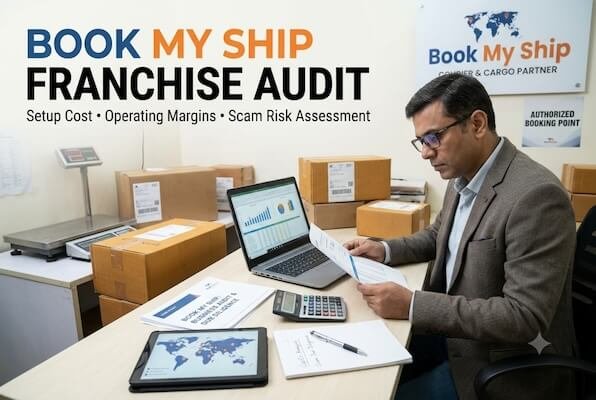
Business Model Clarity: Franchise vs. Booking Distributorship
A frequent error in retail logistics evaluation is conflating traditional franchise networks with aggregator partnerships. In a conventional franchise, brand royalties, exclusive territorial delivery hubs, and direct line-haul logistics infrastructure are granted under a strict operating manual.
In contrast, parcel booking outlets frequently operate under an agency or booking distributorship model. Under this arrangement, local units collect parcels from retail consumers and small businesses, print shipping labels via a central software dashboard, and dispatch shipments through third-party express couriers.
Before transferring initial setup capital, prospective partners must clarify whether they are securing an exclusive geographical territory or merely purchasing commercial access to an aggregator software portal.
Outlets that rely strictly on software margins generally require significantly less upfront capital than full-line hub-and-spoke sorting centers. Understanding this classification protects entrepreneurs from overpaying for what might effectively be a white-labeled software subscription and retail agency contract.
Realistic CapEx and Capital Allocation
Initial promotional projections often quote a broad investment range between ₹5 lakh and ₹15 lakh without delineating where that capital is deployed. In reality, launching a standard 150 to 300 sq. ft. commercial parcel collection point requires disciplined budget allocation across real estate security deposits, interior fit-outs, IT hardware, and legal agreements.
| Investment Component | Tier 2 / Tier 3 City (₹) | Tier 1 Metros (Mumbai, Delhi, Bengaluru) (₹) | Expense Description |
|---|---|---|---|
| Agency / Onboarding Fee | ₹1,00,000 – ₹1,50,000 | ₹1,50,000 – ₹2,50,000 | One-time administrative onboarding, software portal credentials, and introductory training modules. |
| Office Interiors & Exterior Signage | ₹80,000 – ₹1,20,000 | ₹1,20,000 – ₹2,00,000 | Customer booking counter, branded fascia board, parcel racking shelves, and security partitions. |
| Hardware, Weighing & IT Setup | ₹60,000 – ₹90,000 | ₹70,000 – ₹1,00,000 | Commercial weighing scale, thermal barcode label printer, desktop PC, handheld scanner, and CCTV. |
| Commercial Property Deposit | ₹50,000 – ₹1,00,000 | ₹1,50,000 – ₹3,50,000 | Refundable security deposit (usually 3 to 6 months of commercial rent depending on location). |
| Initial Consumables & Packaging | ₹20,000 – ₹30,000 | ₹25,000 – ₹40,000 | Branded flyer bags, bubble wrap, corrugated boxes, security tamper tape, and documentation pouches. |
| Reserve Working Capital (3–6 Months) | ₹1,00,000 – ₹1,50,000 | ₹1,50,000 – ₹2,50,000 | Cash buffer to cover early staff wages, electricity, commercial internet, and courier top-up wallet balances. |
| Total Estimated Project Outlay | ₹4,10,000 – ₹6,40,000 | ₹6,65,000 – ₹11,90,000 | Realistic capital required until unit reaches operating cash-flow break-even. |
Operating Margins and Unit Economics
Retail logistics profitability is fundamentally driven by dispatch volume and shipment categorization rather than flat retail markups. In standard domestic express bookings, typical operator gross margins range between 15% and 25% of the gross booking value, whereas international parcels and niche cargo movements can yield between 25% and 40%. However, gross margins must not be confused with net take-home earnings.
A standard collection counter must clear substantial fixed monthly overheads before turning a net profit. A typical retail outlet handling 25 to 40 daily parcel bookings faces monthly rent (₹15,000 to ₹35,000), single staff wages (₹10,000 to ₹16,000), commercial broadband, and utility bills. Consequently, net profit margins in standard courier booking agencies commonly settle in the 8% to 14% range during steady-state operations.
Claims suggesting effortless passive returns of ₹1 lakh to ₹2 lakh monthly from month one usually depend on unrealistically high daily commercial volumes (exceeding 250 to 300 parcels daily) and must be rigorously stress-tested against localized market competition.
Next Steps in Your Research:
APX Logistics Franchise Cost in India (2026)
Scam Alert & Logistics Investment Due Diligence
The Indian logistics and express parcel sector has witnessed widespread fraud involving impersonators exploiting established logistics brands and unauthorized third parties peddling fake delivery franchises on social platforms. Investors must maintain sharp due diligence before executing agreements or transferring funds.
| Risk Category | Warning Sign / Red Flag | Mandatory Investor Action |
|---|---|---|
| Entity Legitimacy | Pressure to transfer security fees to individual savings accounts via UPI or personal IMPS. | Verify corporate records on the Ministry of Corporate Affairs (MCA) portal. Only transfer funds to a verified corporate Current Account matching the exact legal entity name. |
| Guaranteed Volume Promises | Verbal guarantees of mandatory corporate delivery quotas or assured minimum daily parcel volumes. | Demand clear contractual clauses detailing delivery minimums. In practice, retail booking revenue depends entirely on local customer footfall and proactive B2B merchant acquisition. |
| Territorial Exclusivity | Vague contractual phrasing regarding territory boundaries or pin-code protections. | Ensure the commercial agreement specifies non-compete buffers by postal code (PIN code) to prevent overlapping authorized agents on the same commercial street. |
| Software & API Reliability | Lack of live API demonstrations or inability to verify operational dispatch integrations. | Request a full working demonstration of the shipment creation, manifest generation, and tracking API engine before paying any onboarding or franchise fees. |
Is It Worth the Investment?
Entering the parcel booking sector through an aggregator model like Book My Ship can serve as a viable commercial venture for entrepreneurs who already operate retail stationery shops, cyber cafés, or local consulting outlets seeking an incremental revenue stream. In such hybrid setups, shared overhead costs drastically lower break-even hurdles.
However, setting up an independent, standalone commercial office with investments exceeding ₹8 lakh requires high parcel turnover to offset recurring metro lease commitments. Prospective partners should obtain a legally binding cost-and-commission matrix, verify active operating outlets in their state, and avoid committing capital based on generalized marketing presentations.