Due Diligence & Logistics Franchise Scam Advisory
Before transferring any refundable security deposit or onboarding fee, prospective operators must exercise extreme caution. Fraud syndicates frequently float cloned portals, spurious Google ads, and WhatsApp-driven approval letters impersonating third-party logistics (3PL) brands. Legitimate logistics companies never demand verification fees via personal UPI accounts, instant phone calls, or unverified mobile wallets prior to in-person operational vetting. Always verify corporate credentials via the Ministry of Corporate Affairs (MCA) database and cross-check the parent entity’s regional branch office physically before entering any commercial lease or partnership agreement.
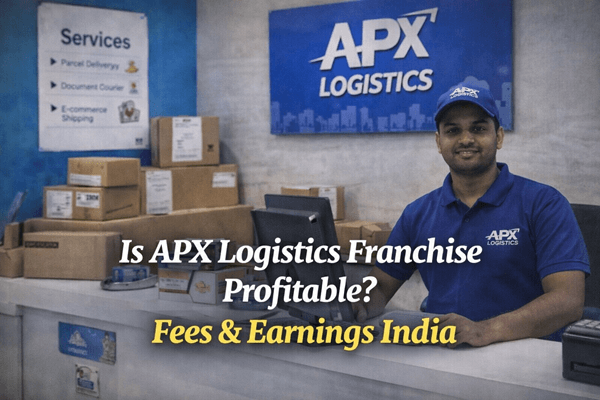
Understanding the Business Model: Agency Partnership vs. Traditional Franchise
A prevalent misconception in the express freight sector is confusing brand licensing with retail agency distribution. APX Logistics functions fundamentally as an Authorized Channel Partner or Booking Agent. Franchisees do not hold proprietary transport corridors or own linehaul fleet assets; instead, the outlet operates as a first-mile aggregation point where retail customers, local B2B vendors, and e-commerce merchants drop off documents and commercial freight. Revenue is generated purely as a direct cut from the declared consignor tariff minus the wholesale freight rate billed by the parent logistics network.
Unlike asset-heavy capital franchises, the commercial health of this enterprise is not tethered to finished-goods inventory or perishable retail stock. However, this structure means that gross margins are strictly tied to physical parcel volumes and volumetric weight accuracy. Securing recurring corporate billing accounts—such as local manufacturing units, wholesale apparel merchants, legal offices, and online sellers—is indispensable to counteract quiet counter days and absorb fixed commercial lease obligations.
Comprehensive CapEx & Startup Cost Breakdown (2026 Estimates)
Launching a viable 150 to 250 sq ft counter demands strategic resource allocation across regulatory compliances, digital infrastructure, interior security, and operational safety nets. Below is the realistic capital expenditure model benchmarked against prevailing Indian urban and semi-urban commercial rates.
| Capital Expenditure Head | Scope & Description | Estimated Budget (INR) |
|---|---|---|
| Refundable Security Deposit / Network Fee | Contract security and integration onto proprietary dispatch software (portal access) | ₹50,000 – ₹1,000,000 |
| Shop Civil Work & Signage | Exterior ACP glow signboard, standard counter, durable storage rackings, vinyl branding | ₹40,000 – ₹75,000 |
| Hardware & IT Peripherals | Refurbished desktop/laptop, laser receipt printer, 4×6 thermal barcode printer, electronic weighing scale (up to 100 kg), barcode scanner, 2-camera CCTV setup | ₹45,000 – ₹70,000 |
| Initial Packaging & Stationery Inventory | Branded tamper-proof polybags, document envelopes, thermal roll stock, carton taping rolls | ₹15,000 – ₹25,000 |
| Commercial Space Rental Advance | Deposit for 150–250 sq ft ground-floor commercial unit (subject to locality) | ₹30,000 – ₹80,000 |
| Contingency Reserve & Initial Working Capital | Buffer to fund early utility bills, SIM connectivity, and cash-on-delivery handling | ₹30,000 – ₹60,000 |
| Total Estimated Setup CapEx | Turnkey commercial launch budget (Tier-1 to Tier-3) | ₹2,10,000 – ₹4,10,000 |
Operating Costs, Revenue Channels, and Profitability Margins
Operational economics in courier retail are straightforward yet sensitive to volume fluctuations. Monthly operating expenditures (OpEx) for a self-managed or single-assistant center typically average between ₹22,000 and ₹45,000, covering commercial premises rent, power consumption, high-speed broadband, thermal labels, and miscellaneous conveyance.
Gross margins on spot retail bookings—such as documents, non-commercial parcels, and personal dispatches—range between 25% and 35%, yielding healthy unit revenue. In contrast, bulk contracts negotiated with e-commerce aggregators and regional small businesses yield lower gross spreads (typically 10% to 16%), but compensate through high volumetric velocity and reliable daily cash throughput. Outlets achieving 40 to 70 processed consignments daily generally generate gross revenues of ₹1.10 lakh to ₹1.80 lakh, translating into net distributable monthly cash flows of ₹35,000 to ₹70,000 after deducting all baseline operating expenses.
Compare Other Opportunities:
Flipkart Delivery & Logistics Partner Cost (2026)
Direct Comparison: APX Logistics vs. Major Express Networks
To help you evaluate whether an APX distribution center or an established tier-1 competitor matches your capital threshold and target demographic, review the cross-brand structural comparison below.
| Evaluation Metric | APX Logistics (Booking Agent) | DTDC (Channel Partner) | Delhivery / Blue Dart Outlets |
|---|---|---|---|
| Estimated Initial Investment | ₹2.10 Lakh – ₹4.10 Lakh | ₹2.00 Lakh – ₹5.50 Lakh | ₹3.50 Lakh – ₹8.50 Lakh |
| Primary Business Model | Counter booking & first-mile intake | Franchise retail & commercial express | Enterprise partner / 3PL service hub |
| Direct Brand Recall | Regional / Emerging | Very high pan-India recall | Dominant enterprise & corporate footprint |
| Typical Retail Commission | 25% – 35% | 20% – 30% | Structured corporate billing margins |
| Target Territory Suitability | Tier-2, Tier-3, industrial clusters | Urban, semi-urban, rural hubs | Commercial zones, prime markets |
Site Selection, Infrastructure, and Regulatory Eligibility
Siting represents the primary determinant between a flourishing franchise and an underutilized counter. The selected premises should occupy a ground-floor commercial unit measuring between 120 and 300 square feet, featuring prominent fascia road frontage to attract walk-in domestic parcel senders. Positioning near light manufacturing corridors, coaching centers, wholesale markets, or wholesale trade centers provides immediate daytime foot traffic. Direct road accessibility for pickup vans and motorbikes during late afternoon aggregation runs is mandatory.
Administrative onboarding mandates standard enterprise identification proofs, including the applicant’s Aadhaar and PAN credentials, property title deeds or a registered commercial lease agreement, a cancelled business bank cheque, and local municipal trade licenses. While GST registration is not strictly compulsory prior to reaching the statutory ₹20 lakh service turnover threshold, obtaining voluntary GST registration and an MSME Udyam certificate is strongly advised to facilitate direct corporate B2B contracts, formal invoice discounting, and clean input tax reconciliation.
Financial Prudence and Final Assessment
An APX Logistics center presents a low-overhead, manageable entry point into the Indian parcel dispatch industry for micro-entrepreneurs comfortable handling daily customer interactions. Because commercial success depends on continuous consignment volume rather than passive walk-ins, this venture is best suited to hands-on operators who actively pursue local business contracts rather than relying solely on residential retail demand.