Opening a fast-casual or quick-service restaurant (QSR) outlet under the Boston Bites brand in India typically requires a total capital expenditure (CapEx) and operational liquidity cushion between ₹12 lakh and ₹26 lakh. The final financial commitment is governed by real estate format choices—ranging from compact 150 sq. ft. kiosk/takeaway booths to 750+ sq. ft. sit-down dining spaces.
Prospective franchise partners should expect gross food margins around 50% to 60%, resolving into a realistic net operating margin of 14% to 22% once property leases, royalties, and utility loads are factored in.
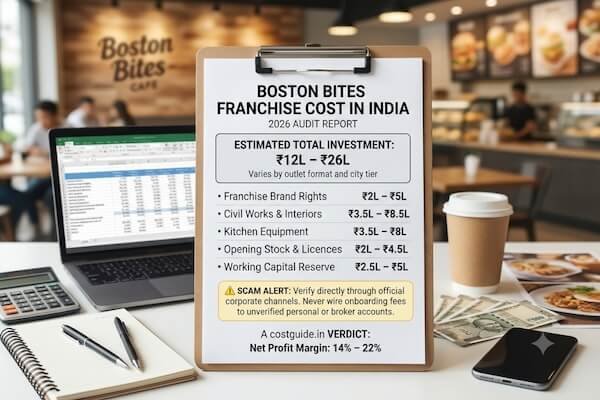
Advisory Notice: Scam Alert & Verification Guardrails
The food and beverage franchising sector in India frequently encounters fraudulent third-party brokers issuing fake allotment letters and unauthorized bank payment links. Investors must note that genuine franchisors never demand initial onboarding deposits or brand agreement payments via personal savings accounts or unsecured UPI IDs. All verification, agreement reviews, and disclosure talks should occur through official corporate domain emails and authorized executive meetings.
Demand a formal Franchise Disclosure Document (FDD), verify the registered corporate trademark on the IP India portal, and never wire onboarding fees prior to site evaluation and physical legal verification.
Operating Frameworks: FOFO vs. FOCO Models
Food retail expansion across Indian metros and tier-2 cities usually operates on one of two foundational models: Franchise Owned, Franchise Operated (FOFO) or Franchise Owned, Company Operated (FOCO). In a standard FOFO agreement, the franchisee bears complete operational accountability—managing crew rosters, shift supervisors, local stock purchases within approved vendor lists, and day-to-day profit-and-loss variance while remitting a recurring royalty of 4% to 8% on gross monthly sales.
Conversely, a FOCO or hybrid management structure delegates labor handling and kitchen floor protocols to central management, paying the investor an agreed revenue split or minimum floor guarantee. Verifying which framework applies is crucial to prevent operating friction.
Realistic Capital Expenditure (CapEx) Breakdown
Launching an F&B unit requires distributing capital across heavy machinery, architectural interiors, and structural utility lines rather than spending solely on decor. Kitchen equipment commands roughly ₹3.5 lakh to ₹8 lakh, covering industrial deep fryers, commercial refrigeration, sandwich grillers, prep tables, three-compartment sink systems, and adequate HVAC/ducting.
Civil interior setup—encompassing anti-skid kitchen tile flooring, grease-trap plumbing, fire-suppression equipment, 3-phase commercial electrical wiring, cash counters, and branded external LED signage—demands ₹3.5 lakh to ₹8.5 lakh. Initial dry/wet inventory and branded packaging reserves absorb an upfront ₹1.5 lakh to ₹3 lakh.
| Investment Component | Kiosk / Takeaway (150–250 sq. ft.) | Express Dine-In (350–550 sq. ft.) | Full Casual Dine-In (600–850+ sq. ft.) |
|---|---|---|---|
| Franchise Fee / Brand Rights | ₹2,00,000 – ₹3,50,000 | ₹3,00,000 – ₹5,00,000 | ₹4,00,000 – ₹6,00,000 |
| Civil Works, Interiors & Signage | ₹2,50,000 – ₹4,50,000 | ₹4,50,000 – ₹7,00,000 | ₹7,00,000 – ₹10,00,000 |
| Commercial Kitchen Equipment | ₹3,00,000 – ₹4,50,000 | ₹5,00,000 – ₹7,50,000 | ₹7,50,000 – ₹10,00,000 |
| POS Hardware, CCTV & Licences (FSSAI/Fire/GST) | ₹80,000 – ₹1,20,000 | ₹1,00,000 – ₹1,50,000 | ₹1,20,000 – ₹2,00,000 |
| Opening Stock & Packaging | ₹1,00,000 – ₹1,80,000 | ₹1,80,000 – ₹2,50,000 | ₹2,50,000 – ₹4,00,000 |
| Working Capital & Contingency Reserve | ₹1,50,000 – ₹2,50,000 | ₹2,50,000 – ₹4,00,000 | ₹4,00,000 – ₹6,00,000 |
| Total Estimated CapEx (Excl. Rental Deposit) | ₹10,80,000 – ₹18,00,000 | ₹17,80,000 – ₹27,50,000 | ₹26,20,000 – ₹38,00,000 |
OpEx, Working Capital & Real Estate Dynamics
A frequent error among first-time restaurant operators is committing 100% of liquid reserves into front-of-house finishing, leaving zero runway for gestation lags. A dedicated liquid cushion of ₹2.5 lakh to ₹5 lakh is critical to cover negative operational cash flow across months one through four. Commercial landlord security deposits introduce wide geographic variance:
High-street markets in Mumbai (Bandra, Andheri) or South Delhi demand 6 to 10 months of rent upfront (often ₹3 lakh to ₹9 lakh), whereas prime high-street locations in Hyderabad, Bengaluru, or Chennai usually negotiate at 3 to 6 months of security deposit. Lease outlays must strictly remain under 12% to 15% of projected monthly gross turnover to preserve profitability.
Realistic Unit Economics, Margins & Break-Even Timelines
While generic promotions often advertise unrealistic margins above 35%, verified industry accounting shows standard fast-casual unit operations deliver net EBITDA margins between 14% and 22%. Raw material cost of goods sold (COGS) averages 38% to 44% of top-line revenue under strictly audited portion controls. O
nline food aggregators (such as Swiggy and Zomato) apply commissions spanning 18% to 26% on delivery orders, meaning outlets overly dependent on off-premise sales experience compressed bottom lines compared to high walk-in counters. A properly located outlet maintaining daily sales of ₹15,000 to ₹28,000 typically hits operational break-even within 3 to 5 months, with capital expenditure payback expected across 18 to 28 months.
More Guides:
Bawarchi Franchise Cost in India
Mandatory Licenses & Pre-Launch Due Diligence
Before executing commercial leases or wiring brand commitments, the investor must secure regulatory clearances to avoid municipal closure. Compliance prerequisites include an FSSAI State Food Business License, a municipal Health Trade License, an NOC from the state Fire Department (mandatory for units operating commercial gas setups or exceeding designated square footage), local Police Eating House Registration, and proper Goods and Services Tax (GST) registration.
Ensure every commercial supplier tie-up and raw material source conforms to brand-mandated food safety protocols.
Editorial Evaluation & CostGuide Audit Verdict
Boston Bites presents a viable proposition for hands-on entrepreneurs prepared to manage daily inventory shrinkage, crew turnover, and local delivery delivery performance. It is unsuited for entirely absentee investors expecting passive dividends.
Prospective owners should review verified unit profit-and-loss statements from existing operational franchisees, cross-check territory exclusivity clauses to avoid self-cannibalization, and confirm that all financial transactions occur through official, verified corporate channels.