Ajit Zone does not operate a standardized turnkey retail franchise or licensing network in India. In the Indian textile and fashion industry, Ajit Zone (based out of the textile manufacturing center of Surat, Gujarat) is widely known as a manufacturer, B2B wholesale supplier, and direct-to-retail vendor of women’s ethnic wear, sarees, kurtis, and bridal collections. It is not an organized chain offering franchised retail stores or territory licenses.
Third-party websites quoting “Ajit Zone franchise fees” ranging from ₹3.5 lakh to ₹14 lakh represent a severe misinterpretation of the garment trade. Entrepreneurs do not purchase territorial franchise rights from Ajit Zone; instead, they source wholesale inventory in bulk to sell through their own independently branded retail showrooms, boutiques, or e-commerce storefronts.
Investor Advisory: Beware of Advance-Fee “Dealership & Franchise” Solicitations
Surat wholesale manufacturers and prominent garment suppliers frequently have their brand names and social media video catalogs mimicked by fraudulent digital brokerages. Unverified middlemen create fake landing pages promising exclusive district-level “Ajit Zone authorized franchises,” guaranteed 50% profit returns, and buyback options on unsold garments. These schemes invariably demand an upfront “refundable security deposit” or “brand authorization processing fee” of ₹1,00,000 to ₹5,00,000 deposited into personal or current bank accounts unconnected to verified corporate entities.
Legitimate Surat textile suppliers operate strictly on commercial wholesale purchase terms: merchants procure fabric or ready-to-wear lots against standardized GST tax invoices and transport receipts (bilty). They never demand recurring franchise royalty cuts or intellectual property fees. Never transfer funds for “franchise allotment letters” without conducting on-site due diligence at verified textile markets in Surat.
Commercial Model Comparison: Wholesale Retail vs. Franchise Claims
Understanding the distinction between an actual B2B garment supply agreement and a formal franchise contract prevents costly legal and operational missteps. While a franchisee cedes operational autonomy, store decor choices, and product margins to a parent franchisor, an independent apparel retailer sourcing from manufacturers retains complete control over pricing, local branding, and stock liquidation.
| Operational Factor | B2B Wholesale / Dealer Reality (Actual) | Purported “Franchise” Offer (Unverified) |
|---|---|---|
| Upfront Brand Licensing Fee | ₹0 (Zero brand royalty or licensing fee) | Demands ₹3,50,000–₹14,00,000 upfront |
| Store Identity & Signage | Merchant’s own proprietary boutique or shop brand | Falsely claims authorized branded retail boards |
| Procurement Exclusivity | Free to source across multiple mills, hubs, and brands | Strict, unviable single-vendor supply restriction |
| Stock Risk & Dead Inventory | Liquidated via end-of-season sales by the retailer | Fraudulent promises of 100% stock buyback |
| Commercial Margin Control | Retailer sets dynamic markups (30%–80%) | Fixed, franchisor-controlled maximum retail pricing |
Capital Expenditure: Launching an Independent Apparel Retail Outlet (2026)
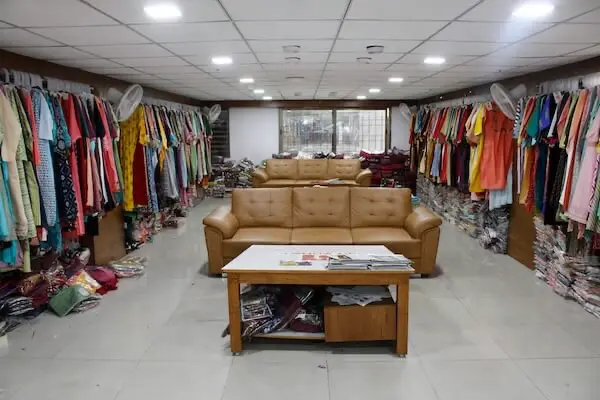
Launching an apparel showroom utilizing bulk supply networks requires realistic capital allocation. Without the burden of artificial franchise entry fees, an entrepreneur directs the bulk of their capital directly into commercial lease deposits, premium interior shop-fitting, and diversified inventory depth to handle sizing, colors, and design variants.
| Investment Head | Compact Boutique (300–500 sq. ft.) | Prime Showroom (800–1,500 sq. ft.) | Industry Allocation Rationale |
|---|---|---|---|
| Commercial Lease Deposit | ₹1,50,000–₹3,50,000 | ₹5,00,000–₹12,00,000 | 3 to 6 months refundable advance rent depending on market tier |
| Store Fit-Out & Illumination | ₹3,50,000–₹6,00,000 | ₹10,00,000–₹22,00,000 | Display racks, high-CRI trial lighting, mannequins, trial rooms |
| Initial Wholesale Stocking | ₹5,00,000–₹9,00,000 | ₹15,00,000–₹32,00,000 | Sarees, lehengas, kurtis, and gowns sourced at factory prices |
| POS, IT & Surveillance | ₹75,000–₹1,50,000 | ₹2,00,000–₹4,50,000 | Barcode printers, inventory software, CCTV security network |
| Statutory Registrations | ₹15,000–₹30,000 | ₹35,000–₹75,000 | GSTIN, municipal Shop & Establishment license, trade permit |
| Initial Working Capital Reserve | ₹2,00,000–₹4,00,000 | ₹6,00,000–₹12,00,000 | Absorbs payroll and utility costs during the initial stabilization phase |
| Total Realistic Capital | ₹12,90,000–₹24,30,000 | ₹38,35,000–₹83,25,000 | Excludes speculative franchise markups |
Before You Invest: Further Due Diligence
Apparel Retail Economics: Realized Margins, Operating OpEx, and Cash Cycles
In women’s ethnic fashion, profitability depends entirely on stock velocity, catalog freshness, and markup strategy rather than fixed parent-brand royalties. When sourcing directly from Surat manufacturing hubs, wholesale purchase prices allow for significant initial gross markups, often between 40% and 75% on premium bridal and festive wear, and 25% to 40% on daily-wear cotton kurtis and printed sarees.
However, net margins face downward pressure from commercial real estate leases, utility overheads (notably store air-conditioning), staff sales incentives, and dead-inventory aging. Approximately 15% to 25% of ethnic stock inevitably ages past the 90-day mark, necessitating clearance markdowns at near-cost rates to free up working capital. Successful store owners maintain healthy margins by avoiding reliance on a single wholesale vendor, cycling collections frequently during festive seasons, and tracking inventory turnover using dedicated POS software.
| Store Format & Footprint | Monthly Revenue Run-Rate | Monthly Overhead (OpEx) | Net Realized Margin | Monthly Net Profit Range |
|---|---|---|---|---|
| Neighborhood Boutique (Tier-2/3 City) | ₹3,50,000–₹7,00,000 | ₹75,000–₹1,40,000 | 18%–25% | ₹65,000–₹1,75,000 |
| High-Street Retail Store (Tier-1/Metro) | ₹12,00,000–₹26,00,000 | ₹2,80,000–₹5,50,000 | 15%–22% | ₹1,80,000–₹5,70,000 |
How to Correctly Source from Surat Garment Hubs
Entrepreneurs looking to build a profitable retail catalog without intermediary markups should follow standard industry procurement practices:
- Obtain Statutory Documentation: Ensure your enterprise has an active GSTIN certificate and a commercial business current account, both required to procure tax-compliant wholesale dispatches.
- Conduct Direct Factory Visits: Rather than paying digital middlemen, travel directly to manufacturing hubs in Surat, Gujarat, to inspect fabric weaves, embroidery quality, dye consistency, and minimum order quantities (MOQs).
- Establish Clear Freight and Transport Terms: Clarify whether pricing is ex-mill or includes logistics. Partner with reputable textile parcel transport agencies for reliable tracking.
- Maintain Multi-Hub Sourcing: Balance your catalog by pairing Surat synthetic and silk collections with cotton blocks from Jaipur, knitwear from Tirupur, or ethnic garments from Kolkata.
Frequently Asked Questions About the Ajit Zone Business Model
Is Ajit Zone a recognized retail store franchise in India?
No. Ajit Zone is primarily a textile manufacturing and B2B wholesale supply firm operating from Surat. They supply garments in bulk to independent clothing shops and retailers, rather than running a franchised retail network.
Why do some websites advertise an Ajit Zone franchise fee of ₹3.5 to ₹14 lakh?
These figures are published by generic business portals that confuse standard B2B wholesale procurement with franchise licensing, or by fraudulent brokers attempting to collect upfront registration fees. Real wholesale suppliers do not charge franchise licensing fees.
What is the actual cost to open a ladies’ garment store with Surat inventory?
A compact boutique in a Tier-2 or Tier-3 city can be launched for ₹12 lakh to ₹24 lakh, including lease deposit, interior fixtures, billing systems, working capital reserves, and initial wholesale stock.
Can retailers sell under their own brand name when sourcing from Ajit Zone?
Yes. Retailers who purchase wholesale garments typically sell them under their own store name and boutique branding, retaining full freedom over consumer pricing and local marketing.