The “Franchise Fee” Trap: FOFO, FOCO, and Wholesale Dealership Realities
A recurring trap in franchise reporting is assuming that every commercial arrangement uses a traditional Franchise-Owned, Franchise-Operated (FOFO) licensing structure with a flat upfront franchise fee. In corporate retail beauty and luxury cosmetics, brands regularly alter their expansion model based on geographic maturity. For prime airport concessions, top-tier metro malls, and flagship centers, brands often prefer Company-Owned Company-Operated (COCO) locations or invite pure real estate leasing partnerships rather than granting third-party operational rights.
Where third-party investor participation is accepted, the structure generally diverges into two operational paths: a traditional FOFO framework or an authorized retail dealership/distributorship model. In an authorized dealership, there is rarely an arbitrary “franchise brand fee”; instead, capital flows into refundable security deposits and mandatory upfront inventory purchase quotas. Conversely, where formal FOFO or Franchise-Owned Company-Operated (FOCO) retail licenses are granted, a formal brand onboarding fee ranging from ₹4,00,000 to ₹10,00,000 covers technical layout sign-offs, centralized ERP integration, and multi-week perfume consultant training.
Scam Alert: How to Verify Legitimate Brand Partnerships
Due to the prestige and nationwide consumer demand for Ajmal fragrances, unauthorized brokerages, fraudulent lead-generation portals, and fake franchise websites regularly target prospective investors. Fraudsters routinely demand upfront “application processing fees” or “token allotment payments” ranging from ₹25,000 to ₹2,00,000, promising guaranteed store approvals via unverified Google Ads or spoofed social media campaigns.
Ajmal Perfumes India operates through formal corporate offices in Mumbai and official regional distribution channels. Legitimate retail authorizations never demand non-refundable application charges to individual bank accounts or via unverified payment gateways. Due diligence requires that prospective operators verify all corporate contact information directly through official corporate domains, request in-person meetings at official regional headquarters, and execute formal legal review with independent commercial counsel prior to disbursing token funds.
Capital Expenditure (CapEx) Breakdown
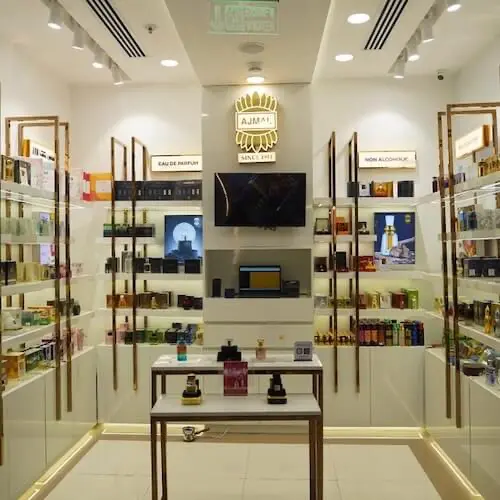
Fit-out expenditures represent the single largest variable in setting up a fragrance showroom. Perfumery requires controlled ambiance, specialized HVAC cooling to preserve perfume notes, dust-free acrylic and toughened-glass cabinets, and high-CRI recessed architectural lighting to accentuate luxury packaging. For a standard 250 to 500 sq. ft. boutique, interior fabrication, HVAC installation, visual merchandising, and POS infrastructure range between ₹8,00,000 and ₹30,00,000.
Initial merchandise stock represents the second primary cost pillar. A balanced product mix must incorporate concentrated perfume oils (mukhallats, pure dehn al oudh), commercial Eau de Parfums (EDP), deodorants, and premium seasonal gift packaging. Initial stock allocation requires ₹5,00,000 to ₹20,00,000 depending on floor area and product depth, with fast-moving stock replenished on a rolling credit or advance-order cycle.
Essential Reading:
Beardo Business Franchise in India
Investment Comparison Table by Retail Format (2026 Projections)
| Format Type | Carpet Area (Sq. Ft.) | Total Setup Investment (CapEx) | Initial Stock Allocation | Target Location Profile |
|---|---|---|---|---|
| Island Kiosk | 80 – 150 | ₹20,00,000 – ₹32,00,000 | ₹5,00,000 – ₹8,00,000 | Tier-1/Tier-2 High-Density Malls, Transit Hubs |
| Standard High-Street Boutique | 200 – 450 | ₹35,00,000 – ₹55,00,000 | ₹8,00,000 – ₹14,00,000 | Established Retail Markets, Luxury High Streets |
| Flagship Luxury Outlet | 500 – 1,000+ | ₹60,00,000 – ₹85,00,000+ | ₹15,00,000 – ₹20,00,000+ | Prime Metro Malls, International Airport Terminals |
Operating Expenses (OpEx), Unit Economics, and Margin Profiles
Operating a fragrance boutique involves steady recurring overheads. Prime retail leases demand monthly rentals ranging from ₹60,000 in emerging tier-2 business districts to upwards of ₹3,00,000 in Grade-A commercial malls, where common area maintenance (CAM) charges, utility surcharges, and revenue-share minimum guarantees apply. Staffing requires two to four certified retail fragrance consultants capable of explaining olfactory pyramids and notes, translating into an operational payroll of ₹40,00,00 to ₹1,20,000 per month.
Gross retail margins in branded fragrance retail typically fluctuate between 30% and 45%, depending on the mix between luxury attars (higher gross margin) and entry-level deodorants (volume-driven, lower margin). Where agreements include brand royalties or marketing fund contributions, operators can expect an ongoing deduction of 5% to 8% of gross sales. Under prudent management, healthy operational margins yield a net operational surplus of 15% to 22%, driving average capital payback within 18 to 30 months.
Retail Financial Summary (2026 Reference Estimates)
| Cost Component | Estimated Range (INR) | Recurrence / Nature |
|---|---|---|
| Brand Authorization / Onboarding Fee | ₹4,00,000 – ₹10,00,000 | One-time (Agreement tenure dependent) |
| Store Fit-Out, Interiors & Signage | ₹8,00,000 – ₹30,00,000 | One-time CapEx |
| Initial Inventory Inflow | ₹5,00,000 – ₹20,00,000 | One-time Initial (Rotational working capital) |
| Store Rental & Utility Deposits | ₹3,00,000 – ₹15,00,000 | Refundable Security Deposit |
| Monthly Operating Overhead (OpEx) | ₹1,80,000 – ₹7,00,000 | Monthly Recurring (Rent, Staff, Utilities, CAM) |
| Estimated Total Project Outlay | ₹20,00,000 – ₹85,00,000 | Complete Launch & 3-Month Runway Capital |
Step-by-Step Onboarding and Authorization Protocol
Entrepreneurs pursuing an authorized business relationship should follow a structured verification and setup roadmap to protect their capital:
- Commercial Territory Identification: Secure a viable commercial property with at least 15 to 20 feet of clear frontage in an approved commercial zone before submitting formal business applications.
- Direct Brand Inquiry: Submit site details, investor net-worth certifications, and previous retail experience directly through verified corporate distribution contacts or the official Ajmal corporate portal.
- Site Feasibility & Footfall Audit: Host the brand’s business development representatives for on-site validation, footfall assessment, catchment demographic reviews, and structural layout approvals.
- Legal Agreement & Disclosure Review: Scrutinize the retail authorization or franchise contract alongside a legal practitioner, paying close attention to minimum sales quotas, territory exclusivity clauses, and termination terms.
- Fit-Out Execution & Merchandising: Execute architectural work based strictly on brand-approved 3D shop drawings, install company-integrated POS billing software, and complete upfront inventory stocking.
- Staff Certification & Grand Launch: Put on-floor sales consultants through fragrance-profiling modules, test sampling strategies, and launch with localized promotional campaigns.
Frequently Asked Questions
What is the minimum investment required to open an Ajmal Perfumes outlet in India?
A compact kiosk format in a tier-2 shopping mall typically requires a starting investment of approximately ₹20,00,000 to ₹32,00,000. This capital covers basic counter construction, POS setup, brand authorization, refundable security deposits, and opening product inventory.
Does Ajmal Perfumes operate through franchise or distributorship models?
Ajmal Perfumes utilizes a multi-pronged expansion approach in India. In high-value retail hubs, the company operates corporate stores (COCO), while in other prospective markets it collaborates via retail dealership authorizations, FOFO franchise agreements, and master distribution agreements depending on regional strategy.
What gross profit margin can an operator expect from an authorized outlet?
Gross product margins in the premium fragrance segment range between 30% and 45%. Net profit margins generally settle around 15% to 22% after accounting for retail occupancy rent, staff compensation, common area maintenance, and promotional expenditure.
What is the typical break-even timeline for an authorized store?
Operational store-level break-even is commonly reached within 3 to 6 months of steady trading, while complete recovery of initial capital expenditure (CapEx payback) typically occurs within 18 to 30 months, contingent on footfall and festive sales spikes.
How can an investor avoid counterfeit franchise scams?
Never disburse processing fees or registration tokens to independent banking accounts, third-party intermediary portals, or unverified contact numbers found on search ads. Always confirm licensing opportunities directly at Ajmal Perfumes’ registered corporate regional offices in India.