Prasar Bharati does not offer official franchises, commercial dealerships, or exclusive distributor territories for DD Free Dish.
While countless business blogs advertise a “DD Free Dish franchise cost” between ₹10,000 and ₹3 Lakh, this terminology misrepresents the government service. DD Free Dish is a state-owned, Free-to-Air (FTA) satellite broadcast network. Anyone retailing set-top boxes, dish antennas, and installation services operates strictly as an independent consumer electronics vendor, not an authorized agent of the public broadcaster.
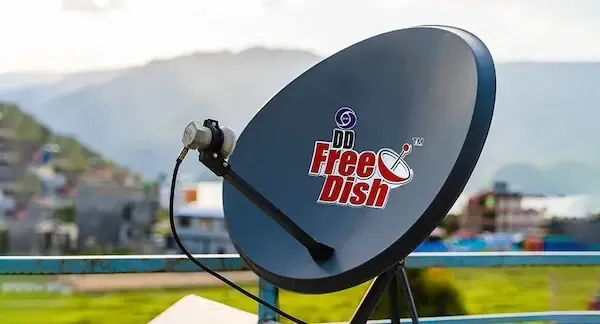
Scam Advisory: Fake “DD Free Dish Allotment & Agency” Schemes
Prospective shop owners and rural technicians are frequent targets of fraudulent websites running fake “Prasar Bharati Dealer Registration” portals. These scams promise exclusive block-level distribution rights, monthly honorariums, or government-backed technician salaries in exchange for an upfront registration deposit of ₹2,500 to ₹50,000. Prasar Bharati operates exclusively through its official domain (prasarbharati.gov.in). The government neither charges franchise fees nor issues authorized dealer certificates to private retail outlets.
How the DD Free Dish Ecosystem Actually Works
Unlike commercial direct-to-home (DTH) operators such as Tata Play, Airtel Digital TV, or Dish TV, which encrypt satellite uplinks using proprietary Conditional Access Systems (CAS), DD Free Dish broadcasts unencrypted FTA signals. Transmission originates from the GSAT-15 satellite at orbital slot 93.5° East, delivering public service programming and private channels that win carriage slots via Prasar Bharati’s periodic e-auctions.
Because the signals travel unencrypted through open space, no subscription authentication card or proprietary government hardware is required to decode them. The commercial ecosystem around DD Free Dish consists of two open segments:
1. Independent Hardware Manufacturers: Third-party electronics companies manufacture DVB-S2 satellite receivers, MPEG-2 and MPEG-4 set-top boxes, low-noise block downconverters (LNBFs), and 60cm Ku-band reflector dishes under standard Bureau of Indian Standards (BIS) manufacturing codes.
2. Local Retailers & Field Technicians: Local electrical retailers, mobile repair shops, and DTH technicians source unbranded or private-label hardware from open wholesale markets (such as Delhi’s Lajpat Rai Market or regional electronic hubs), assembling and installing the kit for retail end-users.
Realistic Capital Outlay for a DD Free Dish Retail & Installation Venture
Entering the DD Free Dish retail market requires no licensing payments to the government. Capital is allocated strictly toward initial inventory procurement, testing gear, and basic shop fit-out.
| Investment Component | Realistic Outlay Range | Operational Scope & Details |
|---|---|---|
| Initial Hardware Inventory | ₹25,000 – ₹80,000 | Wholesale procurement of 25–60 units of MPEG-4 DVB-S2 set-top boxes, Ku-band dishes, universal LNBFs, HDMI/AV cables, and RG-6 coaxial cable drums. |
| Field Installation Tools | ₹8,000 – ₹20,000 | Digital satellite dB meter/finder, heavy-duty hammer drill, crimping tools, ladder, and basic cable diagnostic gear. |
| Shop Setup & Counter Display | ₹15,000 – ₹50,000 | Small test counter with a CRT/LED screen for hardware validation, shelving units, and localized outdoor signage (independent branding). |
| Statutory Business Registration | ₹2,000 – ₹5,000 | Local Udyam MSME registration, trade license, and GST registration for commercial invoice generation. |
| Total Realistic Working Capital | ₹50,000 – ₹1,55,000 | Sufficient to launch an active independent satellite dish retail and field-service counter. |
Unit Economics, Gross Margins, and Technician Earnings
Profitability in the DD Free Dish trade does not stem from recurring subscriptions, since the platform has zero monthly fees. Retailers earn exclusively through upfront equipment margins and technical field labor charges.
Equipment Sales Margins: A standard MPEG-4 set-top box sourced in bulk from wholesale markets costs between ₹550 and ₹850 per piece, depending on manufacturing build and warranty. The complete retail package—including dish, LNB, and cabling—is sold to consumers for ₹1,400 to ₹2,200. This yields a net gross product margin of ₹250 to ₹500 per kit.
Installation & Alignment Fees: Labor represents the highest margin stream for technicians. Positioning the Ku-band antenna toward GSAT-15 (93.5° E) with optimal carrier-to-noise ratio commands an installation fee of ₹300 to ₹500 per home setup. Subsequent troubleshooting visits for signal realignment after monsoons or heavy winds generate recurring service fees of ₹150 to ₹300 per callout.
Revenue Stability: While margins per customer remain modest, volume velocity in tier-3 cities, rural belts, and semi-urban labor corridors remains strong. A technician or small shop installing 40 to 60 systems per month typically generates a net operating surplus of ₹25,000 to ₹45,000 after accounting for local fuel and shop utilities.
DD Free Dish vs. Commercial Pay DTH Business Models
Understanding the structural difference between open FTA platforms and commercial pay television models helps clarify why revenue streams diverge completely from standard telecom or DTH agencies.
| Business Parameter | DD Free Dish (FTA Model) | Commercial DTH (Tata Play, Airtel, Dish TV) |
|---|---|---|
| Operating Structure | Unregulated open hardware distribution | Formal corporate dealership / master agency |
| Recurring Income | None (Zero subscription platform) | Monthly recharge commissions (typically 2% to 4%) |
| Hardware Source | Open-market electronics manufacturers | Proprietary, CAS-locked, operator-issued STBs |
| Target Audience | Price-sensitive, rural, and secondary TV households | Urban, sports, and multi-channel premium viewers |
| Regulatory Oversight | Ministry of Information & Broadcasting / Prasar Bharati | TRAI commercial tariff orders & subscription mandates |
Steps to Start an Independent DD Free Dish Business
If you plan to service households seeking free television reception, bypass agency-broker intermediaries and execute this practical retail roadmap:
1. Source BIS-Certified Hardware: Connect directly with verified DTH equipment manufacturers or established electronics distributors in wholesale hubs. Ensure set-top boxes hold valid BIS certifications and support DVB-S2 reception, as legacy MPEG-2 boxes face phased carrier obsolescence.
2. Master Satellite Signal Calibration: Invest in a dependable digital satellite finder. Precision alignment to azimuth 127° and elevation ~55° (varying slightly across Indian states) is required to prevent rain fade and channel loss on weak transponders.
3. Bundle Comprehensive Local Service: Differentiate your business by offering combined delivery, mount-drilling, cabling, and channel-tuning packages with an explicit 6-month or 1-year replacement warranty on internal power adapters and remote controls.
Don’t forget to check out other franchise or dealership based: Adani Solar Dealership Cost in India: Investment, Margin & Process
FAQs About DD Free Dish Dealership
Does Prasar Bharati appoint official DD Free Dish distributors?
No. Prasar Bharati operates strictly as a public broadcasting network and does not run commercial dealer, franchise, or distributorship networks. Any entity marketing an “official government agency agreement” is running a fraudulent scheme.
What is the cost of a DD Free Dish set-top box for consumers?
Retail pricing for a complete standard installation (dish antenna, coaxial wiring, LNBF, and MPEG-4 receiver) ranges from ₹1,500 to ₹2,500, with zero subsequent monthly recharge fees.
Do I need a special license to sell DD Free Dish boxes?
No specific broadcasting license is needed. You only need a standard retail enterprise registration, such as a local municipal trade license and a GST registration (if your annual turnover crosses statutory thresholds), to operate as an independent consumer electronics retailer.