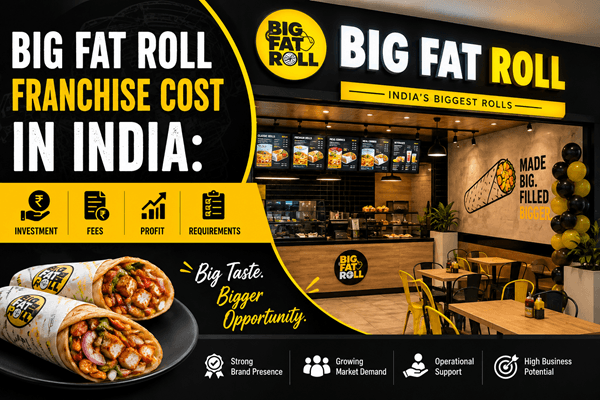
The Indian quick-service restaurant (QSR) sector has seen a surge in specialized wrap and roll concepts, driven by grab-and-go convenience, college micro-markets, and late-night delivery demand. Within this space, brands like Big Fat Roll—operating localized outlets in southern urban hubs such as Bengaluru and Mangalore—attract aspiring food entrepreneurs seeking a small-format, high-velocity food venture.
However, launching an outlet requires looking beyond top-line marketing claims and understanding the real capital required to commission, open, and stabilize a kitchen in 2026.For financial planning purposes, establishing an independent or franchised roll counter typically falls within a broad bracket of ₹10 lakh to ₹25 lakh, dictated by square footage, electrical load specifications, dining format, and metropolitan real estate rates.
Because public disclosures regarding official franchise models, upfront royalty agreements, and brand-level territory rights remain sparse for emerging regional chains, prospective licensees must navigate these figures with strict due diligence.
Investor Caution: The Franchise Fee Trap & Scam Verification
A frequent pitfall in the Indian food-and-beverage franchise industry is the unsolicited franchise broker scam. Fraudulent intermediaries frequently build third-party lead generation websites, claiming to represent emerging brands, and demand non-refundable application charges, initial site inspection fees, or token franchise deposits via digital transfers. Prospective operators should observe strict verification rules before remitting funds:
Always verify whether the business operates on a genuine Franchise-Owned, Franchise-Operated (FOFO) model, a Company-Owned, Company-Operated (COCO) corporate leasing model, or simply a central kitchen supply/distributorship contract.
A legitimate franchisor will never demand cash or personal UPI transfers for discovery calls; they will provide a draft Franchise Disclosure Document (FDD), registered corporate bank account details under a legal entity, a formal trademark certificate, and contact access to existing operational unit owners.
Realistic CapEx: Outlet Setup and Commercial Infrastructure
The upfront capital expenditure (CapEx) for a roll counter is heavily front-loaded into kitchen equipment and leasehold improvements. While rolls require less cooking floor area than full-service dining, commercial local municipal health regulations require dedicated exhaust venting, heavy-duty electrical wiring for induction or commercial griddles, and grease-trap plumbing.
An unprepared “bare-shell” unit demands extensive civil masonry and MEP (Mechanical, Electrical, Plumbing) works, pushing setup costs significantly higher than taking over a warm-shell restaurant space.
Commercial refrigeration, stainless steel (SS 304 grade) preparation counters, deep fryers, sandwich presses, tandoors or flat-top hot plates, point-of-sale hardware, and fire suppression systems constitute the foundational hardware. Neglecting equipment specifications during initial budgeting frequently leads to cost overruns before day one of operations.
| Investment Component | Compact Kiosk / Cloud Kitchen (250–400 sq.ft) | Dine-in / High-Street Cafe (600–1,000 sq.ft) |
|---|---|---|
| Franchise Fee / Onboarding (Indicative) | ₹2,00,000 – ₹3,50,000 | ₹3,50,000 – ₹5,00,000 |
| Civil Interiors, Branding & Signage | ₹3,00,000 – ₹5,00,000 | ₹6,00,000 – ₹10,00,000 |
| Commercial Kitchen Equipment & POS | ₹2,50,000 – ₹4,00,000 | ₹4,50,000 – ₹7,00,000 |
| Licenses (FSSAI, Fire, Trade, GST) | ₹30,000 – ₹60,000 | ₹60,000 – ₹1,20,000 |
| Initial Stock, Sauces & Packaging | ₹75,000 – ₹1,20,000 | ₹1,50,000 – ₹2,50,000 |
| Working Capital Reserve (3–4 Months Runway) | ₹2,00,000 – ₹3,00,000 | ₹3,50,000 – ₹5,00,000 |
| Total Estimated Capital Outlay | ₹10,55,000 – ₹17,30,000 | ₹19,10,000 – ₹30,70,000 |
Metro vs. Tier-2 Market Realities: Security Deposits and Leases
A major error among first-time food entrepreneurs is failing to isolate real estate security deposits from capital construction costs. In prime commercial corridors of cities like Mumbai and Bengaluru, commercial landlords regularly demand 6 to 10 months of rent as an upfront refundable deposit.
Securing a prime 400-square-foot location at ₹80,000 per month can instantly tie up ₹5 lakh to ₹8 lakh in frozen capital before construction begins.
Conversely, non-metro hubs or secondary commercial micro-markets in cities like Pune or Hyderabad often operate on 3 to 6 months of security deposit with lower base rentals, preserving cash for marketing and operational stabilization.
When building an investment model, property deposits should be calculated as an independent line item rather than folded into kitchen interior budgets.
Unit Economics: Margins, Food Costs, and Delivery Aggregators
Operating a roll business yields gross margins that appear attractive on paper—often ranging between 55% and 65% on core ingredients (flour, oils, proteins, sauces, and wrapping paper). However, net operational margins tell a different story once delivery aggregators enter the equation.
For outlets relying on Swiggy and Zomato for 60% or more of daily ticket volume, platform commissions (typically 20% to 28%), merchant onboarding fees, dynamic ad spending, and packaging expenses substantially erode net profitability.
A sustainable franchise unit must cultivate direct over-the-counter sales to protect cash flows. In a healthy scenario where rent is capped under 12% to 15% of monthly gross revenue and staff costs remain below 18%, a well-managed store can generate a net EBITDA margin of 12% to 18%. Breakeven timelines typically range from 14 to 22 months, provided the outlet hits its baseline target of 80 to 120 orders daily.
Compare Other Opportunities:
Baap of Rolls Franchise Cost in India (2026): Setup Cost, Fee Breakdown, and ROI Analysis
| Financial Metric | Estimated Share of Revenue | Operational Commentary |
|---|---|---|
| Cost of Goods Sold (COGS) | 32% – 38% | Raw materials, customized pre-mixes, proprietary sauces, and food-grade packaging. |
| Aggregator Commissions & Discounts | 14% – 20% | Commissions, sponsored platform ranking, and customer discount absorption. |
| Store Rent & CAM Charges | 10% – 15% | Dependent on high-footfall location; higher ratios jeopardize monthly viability. |
| Staff Salaries & Welfare | 12% – 16% | 2 to 4 kitchen and counter staff, including roll masters and prep helpers. |
| Utilities, POS & Marketing | 6% – 8% | Commercial three-phase electricity, LPG, Wi-Fi, local flyers, and hyper-local ads. |
| Estimated Operating Margin (EBITDA) | 12% – 18% | Subject to consistent volume, minimal wastage, and controlled inventory pilferage. |
Mandatory Due Diligence Checklist Before Signing
Before committing capital to any emerging food brand, prospective business owners should undertake systematic verification steps:
First, inspect the Trademark Registry on the IP India portal to verify that the brand name and logo are registered under Class 43 (Services for providing food and drink) without pending oppositions. Second, demand a clear breakdown of Supply Chain Dependencies: understand whether sauces, dough, and marinades must be purchased exclusively from the franchisor at set prices, which directly sets your long-term food margin ceiling.
Third, audit Exclusivity Clauses to ensure you receive a guaranteed geographical radius protection preventing another company-owned or franchised counter from opening within your immediate delivery zone.
Editorial Note: Costguide.in conducts independent financial feasibility audits of business and franchise models. Figures shared above are derived from prevailing Indian QSR market standards and comparative food retail data. We are not officially affiliated with or authorized by Big Fat Roll. Investors are advised to seek independent legal and chartered accounting advice prior to executing commercial leases or franchise contracts.