While third-party franchise portals frequently aggregate broad ranges without context, practical food service viability hinges on separating fixed capital deployment (CapEx) from operating liquidity (OpEx). Commercial kitchens in the pizza quick-service restaurant (QSR) space face distinct operational pressures, notably refrigeration loads, three-phase power upgrades, and cold-chain ingredient shelf life.
Prospective franchise partners must treat initial estimates as indicative budgeting guidelines rather than all-inclusive figures, as commercial licensing and local commercial security deposits vary substantially across Indian metros.
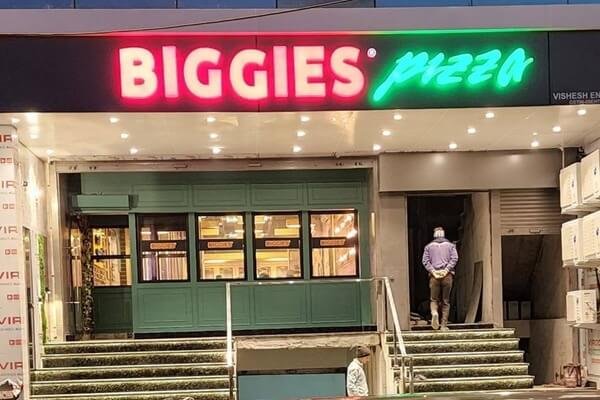
Comprehensive CapEx & Startup Cost Breakdown
A frequent error among first-time food entrepreneurs is conflating the one-time franchise onboarding fee with the turn-key store buildout. The brand access fee typically accounts for ₹3 lakh to ₹5 lakh, which grants intellectual property usage, operational standard operating procedure (SOP) manuals, point-of-sale integration, and initial staff culinary training.
The physical leasehold improvement represents the single largest expenditure, absorbing ₹6 lakh to ₹12 lakh for tiled slip-resistant flooring, modular ordering counters, brand-compliant façade lighting, acoustic panelling, and HVAC installation.
Pizza preparation requires high-duty commercial appliances. Operators cannot cut corners on equipment without risking service bottlenecks. Between ₹4.5 lakh and ₹8.5 lakh must be set aside for heavy-duty electric or conveyor deck ovens, commercial planetary dough mixers, refrigerated prep tables with GN pans, upright chillers, blast freezers, stainless steel workbenches, and grease-trap exhaust systems.
Pre-launch branding, local marketing blitzes, uniform procurement, and initial municipal compliance (FSSAI central/state licenses, local health trade licenses, and fire NOCs) typically consume an additional ₹1.5 lakh to ₹2.5 lakh.
Table 1: Estimated Capital Expenditure by Outlet Format
| Investment Component | Delivery / Cloud Kiosk (300–500 sq. ft.) | Dine-In Casual QSR (800–1,200 sq. ft.) |
|---|---|---|
| Franchise Fee & Brand Onboarding | ₹3,00,000 – ₹4,00,000 | ₹4,00,000 – ₹5,00,000 |
| Civil Works, Interiors & Electricals | ₹4,50,000 – ₹6,50,000 | ₹8,00,000 – ₹12,00,000 |
| Kitchen Equipment & Exhaust Setup | ₹4,00,000 – ₹5,50,000 | ₹6,50,000 – ₹8,50,000 |
| Initial Raw Material Stock & Packaging | ₹1,50,000 – ₹2,50,000 | ₹3,00,000 – ₹4,50,000 |
| POS, Tech Stack & Signage | ₹1,00,000 – ₹1,50,000 | ₹1,50,000 – ₹2,50,000 |
| Pre-Opening Marketing & Statutory Licenses | ₹75,000 – ₹1,25,000 | ₹1,50,000 – ₹2,00,000 |
| Mandatory Working Capital Reserve (90 Days) | ₹2,00,000 – ₹3,00,000 | ₹3,50,000 – ₹5,00,000 |
| Total Estimated Setup Budget | ₹16.75 Lakh – ₹24.25 Lakh | ₹28.00 Lakh – ₹39.50 Lakh |
Unit Economics, Food Costs, and Profit Margins
Revenue sustainability in a pizza franchise depends on keeping food costs and delivery commissions from eroding unit-level margins. Pizza benefits from favorable gross margins on base ingredients such as flour and water, but cheese (mozzarella blends), processed meats, proprietary sauces, and branded corrugated takeaway boxes generally push the consolidated cost of goods sold (COGS) to 38% – 44% of gross sales.
Operational profitability is strongly dictated by channel mix. Direct dine-in and takeaway sales yield healthier returns, whereas sales generated through third-party food aggregators face standard take-rates between 18% and 25%, alongside promotional discounts.
Under disciplined management, an established outlet achieving ₹5 lakh to ₹8 lakh in monthly gross revenue can anticipate an operating net EBITDA margin of 12% to 18%, corresponding to a store-level payback timeline of 20 to 30 months.
Table 2: Estimated Monthly Operating P&L (Representative Store Model)
| Operating Line Item | Cost Percentage (%) | Monthly Value (On ₹6,00,000 Gross Sales) |
|---|---|---|
| Gross Revenue | 100% | ₹6,00,000 |
| Raw Materials & Packaging (COGS) | 40% | ₹2,40,000 |
| Commercial Rent & Maintenance | 12% – 15% | ₹75,000 – ₹90,000 |
| Staff Payroll (Kitchen Staff, Cashier, Steward) | 10% – 12% | ₹60,000 – ₹72,000 |
| Utilities (Commercial Electricity, Water, Gas) | 6% – 8% | ₹36,000 – ₹48,000 |
| Royalty / Brand Marketing Contribution | 5% – 7% | ₹30,000 – ₹42,000 |
| Delivery Commissions & Local Promotion | 6% – 8% | ₹36,000 – ₹48,000 |
| Estimated Net Profit (EBITDA) | 12% – 17% | ₹72,000 – ₹1,02,000 |
Geographic Feasibility and Commercial Real Estate Factors
Capital outlays differ significantly across Tier-1 and Tier-2 Indian cities due to commercial lease dynamics. In prime micro-markets across Mumbai (such as Bandra, Andheri, or Thane high streets) and Delhi-NCR (Connaught Place, Noida Sector 18, or Gurugram Cyber Hub), landlords routinely command security deposits equivalent to 3 to 6 months of gross rent, alongside baseline rental charges ranging from ₹120 to ₹250 per square foot.
This immediately inflates the entry barrier for prospective franchisees compared to tech-corridor hubs like Bengaluru and Hyderabad, where competitive commercial clusters in suburban catchments can be secured at lower entry rentals.
A smaller footprint does not necessarily eliminate high costs if the electrical infrastructure requires extensive enhancement. Modern pizza conveyer equipment pulls substantial electrical loads. Ensuring the lease agreement accommodates a dedicated 15 kW to 25 kW commercial three-phase sanctioned load, unobstructed exhaust ducting routes up the building facade, and reliable water drainage is critical before committing capital, regardless of which city you operate in.
Investor Due Diligence: Verification Protocols and Fraud Warnings
The proliferation of franchise brokerage portals and unauthorized lead generation websites has created significant fraud risks in India’s food and beverage franchise sector. Bad actors regularly construct mirror domains, fake Google Business profiles, and unverified social media handles offering instant approvals, subsidized franchise fees, or “guaranteed buy-backs.”
Franchise investors must enforce strict verification safeguards prior to parting with funds:
- Official Channel Validation: Initiate contact solely through the verified corporate headquarters or direct corporate domain (such as official portals like biggies.in). Disregard unsolicited WhatsApp messages, third-party broker claims, or calls from personal mobile numbers.
- No Personal Bank Accounts: Genuine franchisors never collect application fees, documentation charges, or initial token deposits into individual savings accounts. All transactions must be addressed directly to the brand’s registered corporate entity via account-payee RTGS/NEFT.
- Agreement Type Transparency: Verify whether the agreement is structured under a Franchise-Owned Franchise-Operated (FOFO) or Franchise-Owned Company-Operated (FOCO) model. Scrutinize the draft contract for unilateral exit penalties, minimum sales penalty clauses, territorial exclusivity radiuses (at least 2–3 km in dense urban sectors), and centralized raw material price-escalation caps.
- Physical Audit of Running Units: Visit at least two operational outlets unannounced to verify customer traffic, POS functionality, inventory delivery cadence, and actual franchisee satisfaction before signing agreements.
Domino’s Franchise in India [2026]
Is a Biggies Pizza Franchise Right for You?
Investing between ₹16 lakh and ₹35 lakh in a pizza franchise provides an alternative to starting an unbranded independent restaurant, giving you established recipes, vendor supply chains, and uniform store design. However, brand equity alone cannot compensate for poor store-level unit economics or excessive rental commitments.
An investor who secures a modest rental lease with manageable fixed overheads, maintains direct oversight over kitchen hygiene, and actively manages food wastage stands a solid chance of generating consistent double-digit net margins.