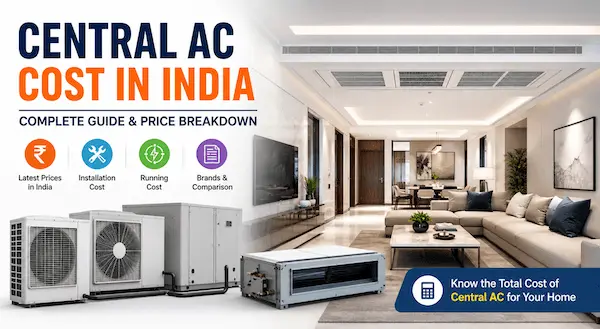
Turnkey Central AC Cost Estimates by Property Size
Central HVAC budgeting in the Indian market is closely tied to heat load calculations, sensible heat factors (SHF), and the total volume of conditioned air. Unlike standalone split AC units sized strictly on floor area, central systems must account for ambient roof heat, external glazing exposure, and structural duct runs.
| Property Configuration | Carpet Area (Sq Ft) | Required Tonnage / Capacity | Ducted Split System Cost | VRF / VRV Inverter System Cost |
|---|---|---|---|---|
| 2 BHK Apartment | 850 – 1,100 | 3.5 – 4.5 TR | ₹2,20,000 – ₹3,20,000 | ₹3,50,000 – ₹4,80,000 |
| 3 BHK Apartment | 1,200 – 1,800 | 5.0 – 7.0 TR | ₹3,20,000 – ₹4,80,000 | ₹5,00,000 – ₹7,50,000 |
| 4 BHK / Luxury Flat | 2,000 – 2,500 | 7.5 – 10.0 TR | ₹4,80,000 – ₹6,80,000 | ₹7,50,000 – ₹10,50,000 |
| Independent Villa / Duplex | 3,000 – 4,500+ | 12.0 – 18.0 TR | ₹7,00,000 – ₹11,00,000 | ₹11,50,000 – ₹18,00,000+ |
On a unit area calculation, basic ducted systems generally sit between ₹300 and ₹450 per sq ft, while premium multi-zone VRF systems average ₹550 to ₹900 per sq ft. The high end of this spectrum accounts for multi-port distribution boxes, motorized dampers, and insulated galvanized iron (GI) or phenolic foam ducting.
System Architectures: VRF/VRV vs. Ductable Units
Homeowners evaluating central air conditioning often conflate ductable split units with true VRF architecture. A standard ducted system utilizes a central evaporator distributing air through fixed ducts, cooling common zones simultaneously. If one zone requires cooling, the main compressor runs at high output, which can lead to unnecessary energy draw in partially occupied residences.
In contrast, Variable Refrigerant Flow (VRF) or Variable Refrigerant Volume (VRV) systems utilize a single variable-speed inverter outdoor condensing unit linked to multiple indoor units (such as slim concealed duct units, 4-way cassettes, or wall-mounted blowers) via branched copper piping.
Because refrigerant metering is dynamically managed room-by-room, power consumption scales down to matching load requirements, offering up to 30% to 40% reduction in seasonal electricity consumption despite higher initial capital costs.
Leading HVAC Brands and Equipment Pricing in India
Equipment manufacturers operate through certified project distributors, system integrators, and commercial dealer networks. Direct retail showroom availability for complete VRF networks is rare because systems require tailored engineering designs prior to billing.
| Brand | Market Segment | Average Machine Rate (Per TR/HP) | Typical 3 BHK Equipment Cost | Noted Engineering Strengths |
|---|---|---|---|---|
| Daikin (VRV) | Premium / Luxury Tier | ₹65,000 – ₹85,000 | ₹4,20,000 – ₹6,50,000 | Proprietary variable refrigerant temperature (VRT), low acoustic levels, proven tropical duty cycles. |
| Mitsubishi Electric / Heavy | Premium Tier | ₹62,000 – ₹82,000 | ₹4,00,000 – ₹6,20,000 | High seasonal energy efficiency ratio (ISEER), robust PCB heat dissipation in peak summer. |
| Blue Star | Mid-to-Premium Commercial | ₹48,000 – ₹65,000 | ₹3,20,000 – ₹5,00,000 | Extensive domestic service footprint, customized residential VRF V Plus line, competitive spares. |
| Voltas / Carrier | Value / Standard Commercial | ₹42,000 – ₹58,000 | ₹2,80,000 – ₹4,40,000 | Budget-friendly ductable options, cost-effective initial CapEx for mid-sized apartment blocks. |
Operating Expenses: Monthly Running Costs and Tariffs
Electricity expenses form the largest portion of the lifecycle cost of central cooling in India. In metropolitan centers like Mumbai, Delhi-NCR, Bengaluru, and Chennai, residential tariffs operate on tiered slabs that quickly hit peak brackets (often ₹8 to ₹12 per kilowatt-hour).
A typical 6 TR residential VRF setup running 8 hours daily during summer draws roughly 18 to 32 units of electricity per day depending on occupancy, ambient temperatures exceeding 42°C, and thermostat setpoints.
This translates into a monthly power bill ranging from ₹5,500 to ₹14,000 for dedicated air conditioning. In contrast, non-inverter ductable systems without multi-stage zoning can drive this figure above ₹18,000 per month under identical thermal conditions.
Related Franchise Audits:
Daikin Dealership Cost in India [2026]
Consumer Alert: Unofficial Dealers, Sizing Errors, and Hidden Costs
The HVAC installation sector in India faces significant gray-market exposure. Prospective homeowners frequently encounter unauthorized third-party contractors quoting unusually low figures by substituting essential balance-of-plant components with substandard materials. Common issues to monitor include:
Sub-Gauge Copper Piping and Insulation: Contractors may quote for heavy-gauge refrigerant pipes (e.g., 20 or 22 gauge) but substitute them on-site with thinner, cheaper alternatives that fail under modern high-pressure refrigerants like R-410A or R-32. This leads to early refrigerant leakage, compressor burnouts, and costly re-opening of completed gypsum false ceilings.
Under-Sizing for Lower Quotations: Unethical contractors may artificially reduce the tonnage requirement during initial bidding to appear competitive against reputable engineering firms. An undersized system runs continuously at maximum load without reaching setpoint temperatures, inflating electricity bills while voiding the manufacturer’s performance warranties.
Unverified Authorized System Integrators: Tier-one brands (Daikin, Mitsubishi, Blue Star) enforce strict dealer authorization matrices. Equipment purchased from non-authorized vendors or unauthorized online listings does not qualify for comprehensive factory warranties or official technician commissioning support. Homeowners should verify dealer credentials on the brand’s official portal before releasing mobilization advances.
Pre-Installation Technical Feasibility
Executing a successful central air conditioning project requires close coordination between your HVAC contractor, interior designer, and civil engineer before structural ceiling work commences.
Key technical parameters include ensuring adequate slab-to-false-ceiling clearance (a minimum of 12 to 15 inches is required to comfortably house concealed indoor duct units and gravity-fed drain lines), verifying three-phase electrical sanction load with the local distribution utility (DISCOM), and planning dedicated, well-ventilated outdoor condenser platforms that prevent hot air recirculation.