Executive Summary: Navigating Electric Vehicle Retail
Entering the Indian electric vehicle (EV) sector in 2026 requires understanding the critical distinction between conventional dealership distributorships and traditional franchise licensing models. While promotional advertisements frequently advertise “EV franchises” starting at nominal budgets of ₹5 lakh, establishing a commercially viable, OEM-compliant showroom and service center typically demands between ₹15 lakh and ₹1.2 crore depending on the vehicle class and brand positioning.
Prospective dealership owners must navigate evolving national subsidy frameworks under the PM E-DRIVE scheme, strict working capital cycles, and recurring working capital costs to secure sustainable returns.
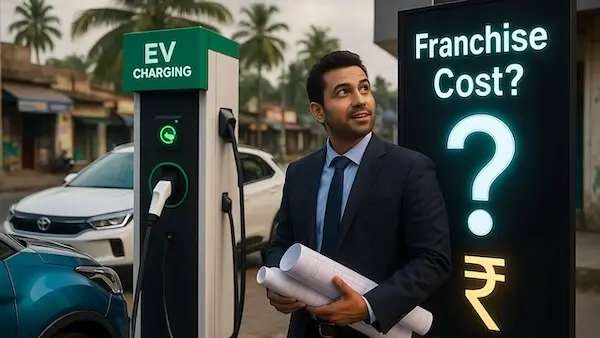
The “Franchise Fee” Trap: Direct Dealerships vs. COCO Models
A common misconception in the automotive sector is equating an EV retail license to a fast-food franchise. Legitimate automobile manufacturers (OEMs) operate through authorized dealership agreements or distributorship models, not traditional royalty-collecting franchises. When an applicant is asked to pay a standalone, non-refundable “franchise onboarding fee,” it is frequently a red flag for predatory aggregator behavior or phishing fraud.
Legitimate OEMs collect refundable security deposits, require real estate commitments, and demand wholesale inventory advances rather than fees for name-licensing alone.
Furthermore, brand expansion models differ fundamentally across the market:
Company-Owned Company-Operated (COCO): Brands such as Ola Electric pioneered aggressive direct-to-consumer digital sales and company-owned experience centers. While third-party service partners and delivery hubs have emerged, they do not offer conventional territorial dealership franchises. Claiming to buy an “Ola franchise” on an open portal is a documented vector for cyber fraud.
Dealer-Owned Dealer-Operated (DODO): Established legacy two-wheeler players like TVS Motor Company (iQube) and Bajaj Auto (Chetak), alongside dedicated EV pioneers such as Ather Energy, operate under structured DODO dealership agreements. These entail standard OEM contracts, corporate visual identity (CVI) interior mandates, diagnostic tooling purchases, and wholesale dealer margins per invoiced unit.
Realistic Industry Capital Expenditure (CapEx) for 2026
Establishing an automotive outlet involves substantial capital deployment across tangible assets, corporate brand fit-outs, and liquidity reserves. The breakdown below details the realistic capital required to open an authorized outlet across three primary retail segments.
| Cost Head / Investment Area | Electric 3-Wheeler (E-Rickshaw/L5) | Tier-2/3 Regional E-Scooter | Tier-1 Premium E-Scooter (Ather/TVS/Bajaj) |
|---|---|---|---|
| Space Requirement | 400 – 800 sq. ft. | 800 – 1,200 sq. ft. | 1,500 – 3,000 sq. ft. (3S: Sales, Service, Spares) |
| Refundable OEM Security Deposit | ₹1,00,000 – ₹2,50,000 | ₹2,50,000 – ₹5,00,000 | ₹10,00,000 – ₹20,00,000 |
| Showroom Fit-out & Brand CVI | ₹1,50,000 – ₹3,50,000 | ₹4,00,000 – ₹8,00,000 | ₹15,00,000 – ₹30,00,000 |
| Service Bay, BMS Diagnostics & Tools | ₹1,00,000 – ₹2,00,000 | ₹2,50,000 – ₹4,50,000 | ₹6,00,000 – ₹12,00,000 |
| Initial Stock (Vehicle Inventory) | ₹5,00,000 – ₹10,00,000 (4–8 units) | ₹10,00,000 – ₹18,00,000 (10–15 units) | ₹30,00,000 – ₹60,00,000 (25–40 units) |
| Spare Parts & Battery Buffer Stock | ₹75,000 – ₹1,50,000 | ₹2,00,000 – ₹4,00,000 | ₹5,00,000 – ₹10,00,000 |
| Charging Infrastructure (AC Slow / DC Fast) | ₹50,000 – ₹1,00,000 | ₹1,50,000 – ₹3,00,000 | ₹4,00,000 – ₹8,00,000 |
| 3-Month Working Capital Reserve | ₹1,50,000 – ₹3,00,000 | ₹3,50,000 – ₹6,00,000 | ₹10,00,000 – ₹20,00,000 |
| Estimated Total Setup Capital | ₹11,25,000 – ₹23,50,000 | ₹27,00,000 – ₹48,50,000 | ₹80,00,000 – ₹1,60,00,000+ |
Unit Economics: Margins, Subsidy Shifts, and Revenue Streams
A common mistake among first-time dealers is projecting gross vehicle sales margins as the sole measure of net profitability. In automotive retail, margins on ex-showroom vehicle pricing are thin, typically ranging from 4% to 8% for established premium two-wheeler brands, and up to 10% to 14% for localized Tier-3 electric three-wheelers. The commercial sustainability of a dealership depends heavily on auxiliary revenue channels:
Finance and Insurance (F&I) Origination: Dealers earn direct commissions by partnering with NBFCs and retail banks for vehicle financing, yielding between ₹1,500 and ₹4,000 per loan disbursed, alongside commissions on comprehensive motor insurance underwriting.
After-Sales and Component Replacement: Unlike internal combustion engine (ICE) vehicles that demand recurring engine oil flushes, spark plug swaps, and mechanical valve adjustments, electric vehicles feature fewer moving components. Consequently, traditional scheduled maintenance revenue is lower. Dealers must offset this by monetizing battery health diagnostics, accidental chassis repair, tire replacements, motor controller servicing, and authorized accessories.
Policy Context (PM E-DRIVE vs. FAME II): While older market analyses frequently reference the FAME II framework, that scheme officially expired and was succeeded by the PM E-DRIVE Scheme (along with the interim EMPS framework). PM E-DRIVE features tapered demand incentives for electric two-wheelers and three-wheelers, with subsidies capped per kilowatt-hour and scheduled to reduce gradually through 2026. Dealership viability must therefore be calculated on core product competitiveness and unit-level dealer margins, rather than dependency on state-funded consumer price rebates.
Recommended For You:
Ather Electric Scooter Franchise Cost in India 2026
Geographic Strategy: Metros vs. Tier-2 and Tier-3 Hubs
While metropolitan markets offer early technology adoption and higher consumer purchasing power, their high commercial rental rates (often exceeding ₹120 to ₹250 per square foot) severely compress net operational margins. Conversely, Tier-2, Tier-3, and peri-urban markets present lower real estate overheads, reduced staffing expenses, and strong demand for both commercial cargo three-wheelers and commuter two-wheelers.
Entrepreneurs targeting these regions benefit from shorter payback periods (18 to 28 months) compared to Tier-1 urban dealerships, provided they secure consistent supply lines for critical electronics and spare parts.
Frequently Asked Questions
Is there a legitimate “franchise fee” when opening an EV dealership in India?
No. Authentic automotive OEMs do not charge non-refundable franchise fees simply to license their brand name. Capital deployment is directed toward refundable dealer security deposits, official architectural showroom build-outs, diagnostic service equipment, and advance stock purchases. Offers demanding upfront, uncollateralized “allotment fees” should be treated with extreme caution.
Can an individual purchase an Ola Electric dealership in 2026?
Ola Electric maintains a predominantly direct-to-consumer sales model through company-owned centers. While they have expanded partner service networks and logistics touchpoints in specific regions, standard multi-car or scooter retail dealerships are not sold via third-party franchise portals. Any website requesting retail franchise deposits on behalf of Ola is fraudulent.
What is the realistic minimum budget for a small electric scooter showroom?
For a regional, Tier-2 or Tier-3 electric scooter brand, a minimum realistic budget is ₹25 lakh to ₹35 lakh. This covers an 800 sq. ft. showroom setup, mandatory service tools, minimum inventory of 10 to 12 vehicles, branding fit-outs, and initial operating reserves. Premium brands like Ather or TVS iQube require ₹80 lakh or more.
How has the shift from FAME II to PM E-DRIVE affected dealer margins?
The transition from FAME II to the PM E-DRIVE scheme has reduced direct consumer subsidies on electric two-wheelers. Dealerships can no longer rely on steep government incentives to generate consumer demand. Successful operations must focus on transparent pricing, aggressive vehicle financing partnerships, commercial fleet tie-ups, and customer service delivery.